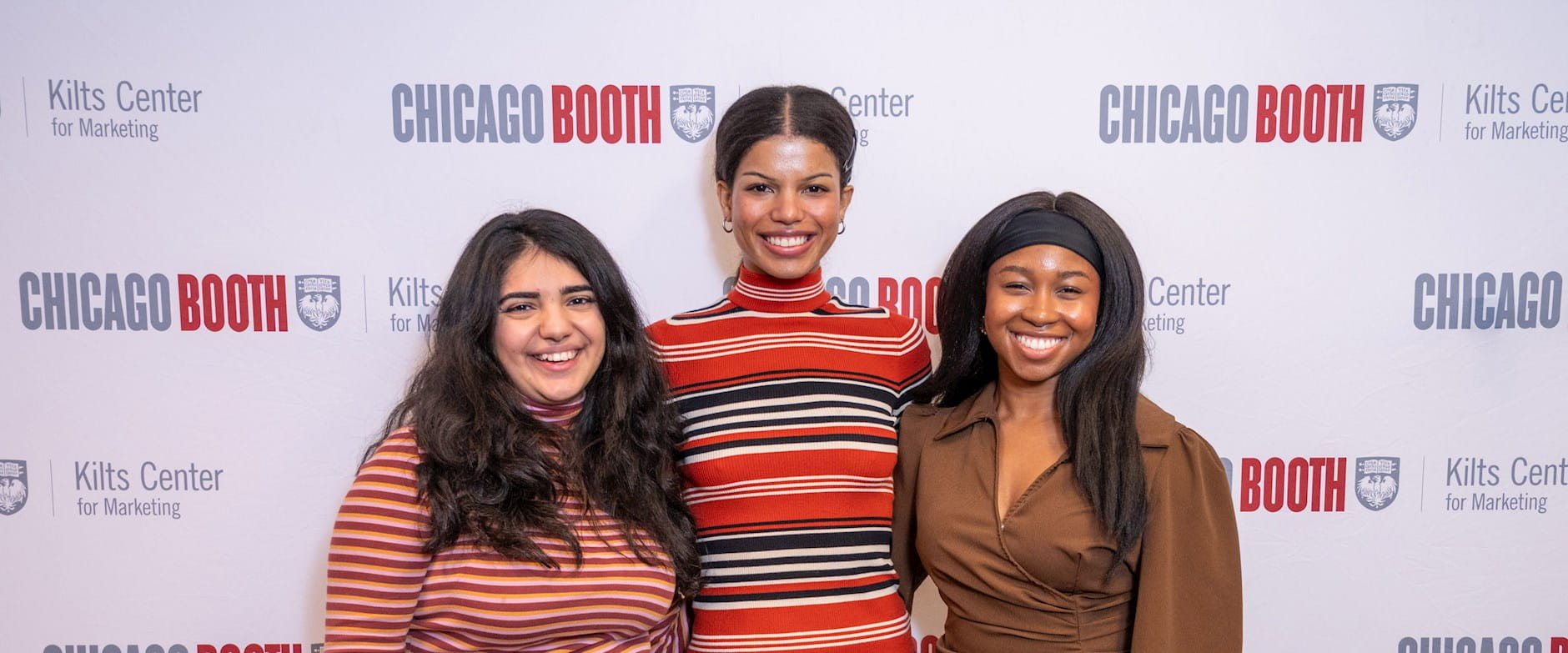
Belle Nahoom, Bettye Igbenebor, and Belema Hart of Team Be.
The Thrill of the Pitch
At the annual Kilts Center Case Competition, MiM students got real-world experience creating a product pitch for Adobe.
- By
- February 19, 2026
- Marketing
On the day of presentations at the 2025 Kilts Center Case Competition, one team felt particularly nervous and excited to give their pitch.
Team Be, comprised of students in the Master in Management Program, had worked hard in the week leading up to presentation day. But could they compete with the more experienced teams of MBA students?
This was the first year the competition was open to students in Booth’s specialized masters programs. Team Be was the only group without any MBA candidates. In fact, all three members were undergraduates just the year before.
“Other people in the competition had been doing consulting for years,” says MiM student Belle Nahoom, AB ’25, a member of Team Be. “We’d never done this before, all these people were older than us, and we were very scared. But it also made us feel like we were on the same playing field as teams with all this work experience. We felt good.”
A Creative Pitch for Adobe
Every year, the Kilts Case Competition gives Booth students the opportunity to work on a real-world challenge for a sponsoring company and build marketing skills important to jobs in product, brand, and general management. This year, the sponsor was the creative software company Adobe, headquartered in San Jose, California.
For the first round, Adobe gave a simple directive to 21 student teams: Pitch something creative that the company may want to use as a product.
Nahoom and her teammates Belema Hart and Bettye Igbenebor, AB ’25, created a video pitching an AI tool that would give Adobe users specific ideas on how to build their own videos. They had fun creating it, especially since Nahoom and Hart had both studied theater during undergrad.
Team Be was accepted into the second round to pitch on competition day, along with seven other teams. “I think the judges appreciated how much energy we brought to the competition,” Nahoom says.
For the second round, teams were told to focus on adding a feature to either Adobe Express, a content creation app, or Adobe Acrobat, a PDF manager. Teams had one week to create their pitch before presenting it to judges—including Adobe employees.
It was an exciting time for everyone on Team Be. They all wanted to succeed and give the pitch their best shot, using strategic thinking and creativity to build a solution. But putting together the presentation was often stressful.
“Focusing on one idea was difficult,” Hart says, as they all had good, unique ideas, and Adobe’s product ecosystem is expansive.
Ultimately, Team Be decided to pitch a new feature for Adobe Express called “Adobe Workspace.” The idea was to create a cloud connection between all of Adobe’s apps, akin to a shared drive in Google, making it easier for business users to share information across the entire ecosystem.
As they worked, the team grew more confident. “The experience was fast paced, highly collaborative, and energizing,” Hart says. “It pushed me to connect big-picture strategy with the human needs behind it.”
“I learned to not look at other people’s ideas and say that theirs are better than mine. We wanted to try something different that we felt good about. When you’re pitching, that’s what matters.”
— Belle Nahoom
A Valuable Real-World Experience
Team Be felt butterflies on presentation day, but they also had a newfound confidence. They knew they had given it their best shot. They presented to the judges at 9:30 a.m. and waited for results until 2 p.m., enjoying the thrill of the day.
When the results were announced, Team Be didn’t place, but the judges were impressed that Team Be was MiM’s lone representative in the competition. They loved getting feedback on their pitch from the judges, including Natasha Chan, principal solutions consultant at Adobe.
“We were completely blown away by the excitement, professionalism, and effort demonstrated by all the teams,” Chan says, adding that some of the winning decks from the competition were sent to Adobe’s head of product for education. “Though they were given a short amount of time, it was clear that each team spent a great deal of time researching and experimenting with Adobe’s tools.”
The winning team, FireflyChart, presented an AI-powered feature for Adobe Acrobat that would allow users to analyze files and generate editable charts in Adobe Express using text prompts. This would be an AI partner that “thinks like an analyst and designs like an artist,” says Manana Asatiani, a Full-Time MBA student and member of FireflyChart.
Asatiani’s team—which also included Full-Time MBA students Mira Mookerjee, Kavya Ramamoorthy, and Yuyang Zhang—also sought market data to find pain points. They surveyed 70 students and found that while 90 percent need to create complex charts, less than 40 percent are happy with the current results.
“The members of FireflyChart were truly a master class in professionalism,” Nahoom says. “Our team really looked up to them. It was really cool to hear what they had to say about their experience.”
Team Be all agree with Asatiani’s assessment of the entire competition: “It was such a valuable real-life experience, something that really prepared us for what actual product managers do,” she says.

Manana Asatiana, Yuyang Zhang, Kavya Ramamoorthy, and Mira Mookerjee of team FireflyChart.
Team FireflyChart, from left to right: Manana Asatiani, Yuyang Zhang, Kavya Ramamoorthy, and Mira Mookerjee
Lessons from the Case Competition
While Team Be didn’t win, Nahoom says that the competition gave her invaluable experience in marketing innovation and strategy.
Now, she understands the patience it takes to work with others on a big problem. She also saw the analytical side of marketing applied to a real-world case. And while it was a difficult process, Nahoom enjoyed seeing herself and her teammates grow and become more confident as the competition went on.
Enjoying the experience is key to pitching a product, Chan says. Anyone who pitches in a future Kilts Case Competition must know that having fun and showing conviction for their idea helps it shine.
“If you’re not excited about your own solution or enjoying the process, it will always show in your final presentation,” Chan says.
More than anything, Nahoom saw the power of learning by doing. One of the biggest lessons she learned: Be confident in your work and avoid comparison with others.
“I learned to not look at other people’s ideas and say that theirs are better than mine,” she says. “We wanted to try something different that we felt good about. When you’re pitching, that’s what matters.”

Booth News & Events to Your Inbox
Stay informed with Booth's newsletter, event notifications, and regular updates featuring faculty research and stories of leadership and impact.
YOUR PRIVACY
We want to demonstrate our commitment to your privacy. Please review Chicago Booth's privacy notice, which provides information explaining how and why we collect particular information when you visit our website.