At Booth, students develop leadership skills through a set of learned actions.
Professor Linda Ginzel talks about teaching leadership frameworks and how understanding four main determinants can impact your ability to lead effectively.
Leadership is a choice—not a state of being, but a set of actions. It is a skill that can be developed, and that’s what I ask my students to do. They might come into my class thinking that they are either born with it, or not, but I try to establish early on that leadership can be learned. I should know—I teach it!
It’s a joy to teach at Chicago Booth, where the students are quantitatively oriented. They appreciate having frameworks to apply to their thinking—so I make it a point to teach the leadership framework laid out in “Rethinking Management Education,” a seminal paper by Harry L. Davis, a Booth professor and namesake of the Harry L. Davis Center for Leadership (coauthored by Robin Hogarth).
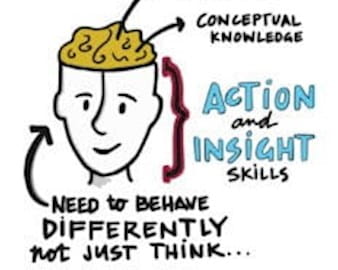
Davis and Hogarth’s leadership framework identifies four important determinants of leadership: domain knowledge, conceptual knowledge, action skills, and insight skills. They are at the heart of our activities at the Davis Center.
I also teach the management of meaning—an idea I first learned about from Stanford’s Jeff Pfeffer. For example, I hand out a green pen to each of my students. This pen is a symbol to remind students that leadership is a continuous process and requires focus on all four of these aspects of leadership. Another analogy I like to use is what I call the Ginzel Frontier (like the Pareto Frontier, but for leadership). You have to reflect, get feedback, and practice in order to max out on experience and become wiser, younger.
I want my students to question assumptions—even the most basic, or what I call the load-bearing assumptions. If they do that, they will help me achieve my goal as a teacher: that my students continue to strengthen their own frameworks well into the future.
One student recently published a blog about this approach and how we can extract real value from our experiences. Read it here »