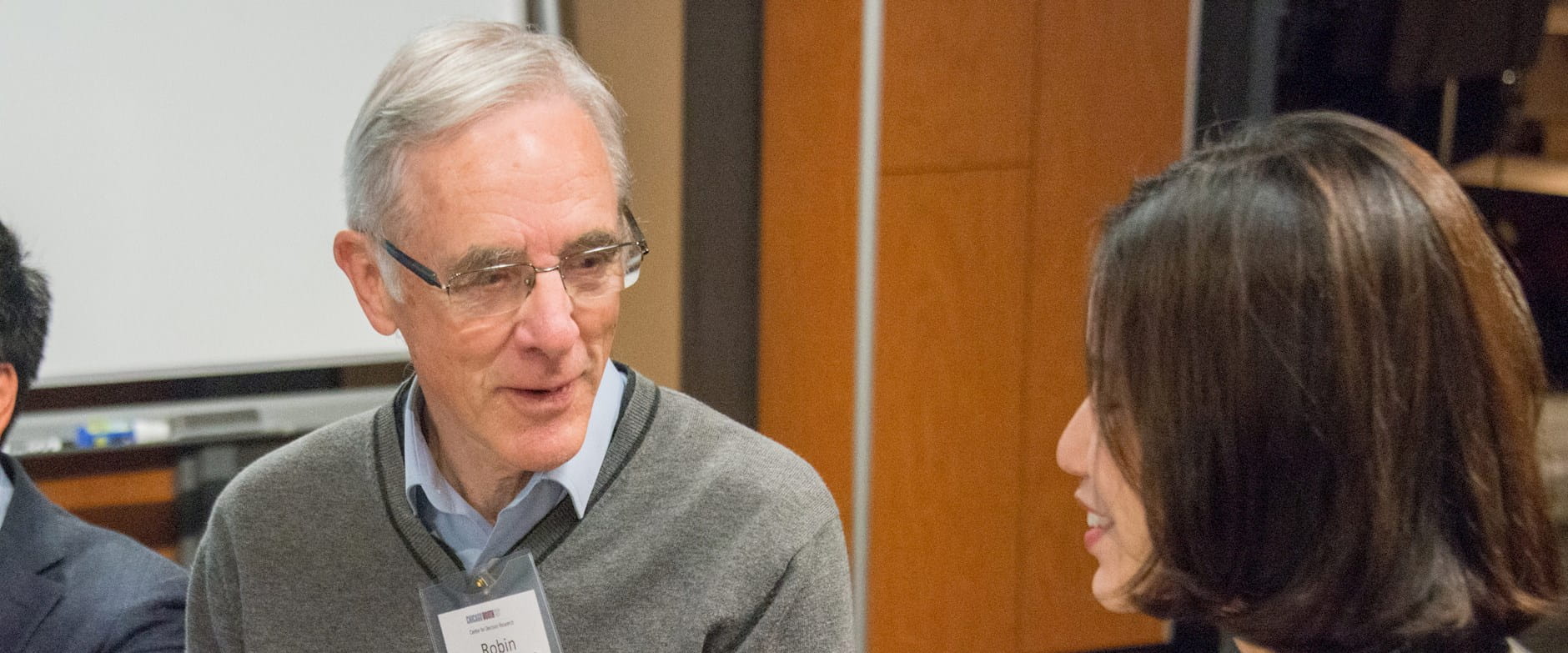
In Memoriam: Robin Hogarth, 1942–2024
The former deputy dean and professor was instrumental to the field of behavioral science, focusing on the psychology of judgment and decision-making.
- By
- June 03, 2024
- Faculty Impact
Robin Hogarth, PhD ’72 (Psychology, Statistics), a pioneer in the field of decision research and a longtime member of the Chicago Booth faculty, died April 21 in Barcelona. He was 81.
Hogarth, formerly the Wallace W. Booth Professor of Behavioral Science, joined the Chicago Booth faculty in 1979, a few years after completing his doctorate at the University of Chicago. Hogarth took on a variety of roles during his 22 years at Booth, including serving as deputy dean from 1993 to 1998. During his first year, he helped expand the Executive MBA Program to Europe, launching the Barcelona campus alongside Harry L. Davis, the Roger L. and Rachel M. Goetz Distinguished Service Professor Emeritus of Creative Management. With his late Booth colleague and friend Hillel Einhorn, he also helped to create the Center for Decision Research—now called the Roman Family Center for Decision Research—where he served as director from 1983 to 1993. It is now one of the world’s most influential centers dedicated to the science of human decision-making.
Before coming to Booth, Hogarth held positions at INSEAD and London Business School. Born in India to British parents, he spent his school years in Scotland. After completing high school, he did not pursue an undergraduate degree, instead becoming a chartered accountant through an apprenticeship. He later received his MBA from INSEAD in 1968, then attended the University of Chicago for his PhD.
For his colleagues—including Richard H. Thaler, the Charles R. Walgreen Distinguished Service Professor of Behavioral Science and Economics and former Roman Family CDR faculty director—Hogarth’s influential paper on managerial psychology and learning environments continues to inform their teaching. “I am fond of his terminology that environments can be ‘kind’ or ‘wicked’ for learning. A wicked environment does not offer decision-makers the sort of feedback they need to learn. It is easy, in such cases, for these decision-makers to become overconfident,” Thaler explains. “Smart organizations help the managers by giving them the sort of feedback that tells them when they are making mistakes.”
Another one of his influential papers, written with Davis, laid out a powerful framework that underlies much of the Booth curriculum today. Called “Rethinking Management Education: A View from Chicago,” the paper still resonates with many MBA faculty, including clinical professor of managerial psychology Linda E. Ginzel, who assigns it to her students. Two decades after its publication, Ginzel wrote an essay about it for Chicago Booth Review: “The paper contained a revelation: while MBA graduates were well-armed with domain knowledge and conceptual knowledge, they needed certain skills in order to make the most of what they had gained in the classroom. Meeting this need would be the core of a new approach that augmented Booth’s traditional strengths by focusing on two new types of skills, what Davis and Hogarth called ‘action’ and ‘insight’ skills.”

Robin Hogarth with his wife Carmen Pi-Sunyer and two of his former students.

Robin Hogarth (middle) with current and former Roman Family CDR faculty directors Nick Epley (left) and Richard Thaler (right).

From left to right: Professors George Wu, Robin Hogarth, Harry Davis, Linda Ginzel, and Nick Epley.

Robin Hogarth (right) with friend and Booth colleague Harry Davis in the 1970s.
1 of 1
After his long career at Booth, Hogarth spent more than 20 years living and working in Barcelona, where he was a professor at Pompeu Fabra University before his death. Though Hogarth spoke Spanish, French, and some German, he regretted not learning to speak Catalan despite understanding it well, says his wife, Carmen Pi-Sunyer. When not reading to keep up with his discipline, Hogarth often walked to explore Barcelona’s streets or the Spanish countryside, where the family also owns a home. “He was always a quiet person and expressed himself with big smiles or some sarcastic comments,” Pi-Sunyer recalls. “He was really very human.”
Davis, who continued to stay in touch with Hogarth via frequent Zoom calls, says it was the mark he left on others that remains his legacy. “Robin contributed a great deal in his writing and research. But for me, it was his never-ending support of others throughout his entire life in helping them surface their own voice. He worked tirelessly and selflessly,” says Davis.
Joshua Klayman, professor emeritus of behavioral science, recalls how Hogarth once told him a PhD student was hesitant to share his opinion because he found Hogarth too knowledgeable, and therefore intimidating. Hogarth told Klayman that the comment caught him off guard. “He was so surprised to hear this because in his mind, he was still an 18-year-old kid himself,” Klayman recalls. “He was whatever the opposite of full of himself is—he wasn’t impressed with himself, but he was just very good.”
Hogarth wrote numerous papers and published 10 books, including Insights in Decision Making, a Tribute to Hillel J. Einhorn (1990), a collection of essays honoring Einhorn that Hogarth edited; Educating Intuition (2010), winner of the Association of American Publishers’ PROSE Book Award; and his most recent book, The Myth of Experience: Why We Learn the Wrong Lessons, and Ways to Correct Them (2020), a collaboration with fellow behavioral scientist Emre Soyer.
He received an honorary doctorate from the University of Lausanne in 2007 and the Lifetime Achievement Award from the European Association for Decision Making in 2023. Upon accepting the award, Hogarth credited those he’d worked with throughout his career: “I would not be in this position if I hadn’t—over the years—had such a remarkable group of colleagues and students with whom to collaborate. So, the award is due to the many colleagues and students who illuminated my professional career, and I thank them for sharing my journey.”
Hogarth found working with PhD students one of the most gratifying aspects of his career. He took the time to list many of their names, research papers, and affiliations on his personal website. He also spent hours guiding them well after graduation and ushering them into their own careers, says Pi-Sunyer.
On his website, Hogarth wrote, “One of my professional blessings has been my involvement with PhD students.”
He is survived by his wife of 24 years, Carmen Pi-Sunyer, five children and stepchildren, five grandchildren, his first wife, Helene Hogarth-Delmas, and his sister, Caroline Warren.
A modified version of this story appeared in the Fall 2024 print issue of Chicago Booth Magazine.

Booth News & Events to Your Inbox
Stay informed with Booth's newsletter, event notifications, and regular updates featuring faculty research and stories of leadership and impact.
YOUR PRIVACY
We want to demonstrate our commitment to your privacy. Please review Chicago Booth's privacy notice, which provides information explaining how and why we collect particular information when you visit our website.