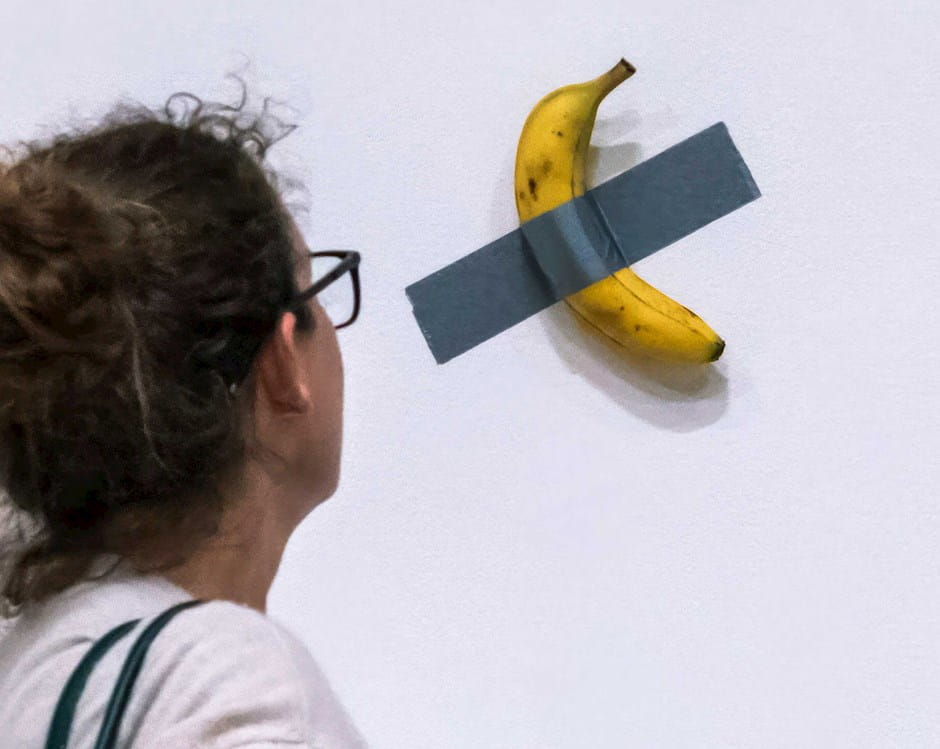
The Surreal Economics of the Contemporary-Art Market
Why prices (if you can even find them) have gone berserk.
The Surreal Economics of the Contemporary-Art Market
Canice Prendergast passed on the investment of a lifetime 10 years ago.
Prendergast, the W. Allen Wallis Distinguished Service Professor of Economics, oversees and acquires pieces for Chicago Booth’s extensive contemporary-art collection.
In 2016, he attended painter Amy Sherald’s solo exhibition at Monique Meloche Gallery in Chicago. Her striking, pastel-hued portraits of Black figures were selling for $7,500. But on that day, Professor Prendergast left empty-handed.
Two years later, Sherald painted one of the most conversation-driving American works of this century: Michelle Obama’s presidential portrait. Now her paintings sell for $750,000 on the primary market and have gone for more than $4 million at auction.
This is the complexity of the art world, as Prendergast and Meloche explained at the recent talk Inside Contemporary-Art Markets, which took place at Chicago Booth’s Charles M. Harper Center. Collectors are making investments, hoping to acquire pieces by artists early to midway into their careers that will balloon exponentially in value—like a Sherald painting in 2016. But these investments require a mix of skill, taste, and luck.
Gallery owners like Meloche and fellow panelist Mike Schuh, MFA ’09, MBA ’25, facilitate these sales, acting as an artist’s sole representative to buyers in a city, usually for a 50–50 split of revenue. The shows that gallerists choose to exhibit signal to buyers that they see potential in the artists, many of whom may be young or under the radar.
“The thing about many collectors is they don’t know what they’re buying,” Prendergast said at the event. “So, often they will use the gallery as the certifier of quality.”
It may be surprising to see more than 75 business students packed into a room for a discussion about art. But the intention of Booth’s new Arts and Creative Enterprise Initiative, which Prendergast codirects, is to explore the connections between art and business. This talk in February was the ACE Initiative’s first event.

Prendergast opened the discussion with a brief overview of the contemporary-art market. Contemporary art, he said, has grown from being 3 percent of the total art market in 2000 to 25 percent today, at $5 billion annually. But it’s vastly skewed, Prendergast added, with 3 percent of all artists accounting for 70 percent of the sales.
“There’s a truism that one car that’s a little bit better than another car sells for a little bit more,” Prendergast said. “That’s not the way the art world works. The art world is very much a superstar market.”
Gallerists like Meloche and Schuh typically represent about 20 artists at a time, whom they connect with through art fairs or their personal networks. An artist’s work has to “hit me visually,” Meloche said, to represent them. Schuh, who owns the Chicago gallery Regards with his wife, added that it’s key to build a relationship with an artist before eventually taking them on as a client.
“Once we get to a point with an artist where we feel like we believe in the work enough and develop enough trust in this person, it’s just an invitation of like, ‘Do you want to do something together?’” he said.
Those relationships are crucial for Meloche and Schuh to ultimately sell their artists’ work. Meloche, for instance, described participating in a protest performance that one of the artists she represents, Ebony G. Patterson, organized in Jamaica in 2014. Patterson had created 50 colorful coffins for participants to hold aloft, and after seeing them, Meloche convinced Patterson to show them at her booth at the Untitled Art fair in Miami. The installation received coverage in The New York Times and continues to be shown at museums around the world.
“There’s a truism that one car that’s a little bit better than another car sells for a little bit more. That’s not the way the art world works.”
— Canice Prendergast
Schuh, who earned his MBA through Booth’s Weekend MBA Program, noted that it’s “really rare” to find people with MBAs in the art world. However, he said the skills the degree helps you develop can be useful, especially for those who want to innovate in this fairly staid market.
“You’re learning how to be a great manager and a great strategist,” Schuh said. “And I don’t think there can be enough people with that kind of capacity working in this industry.”
Meloche added that her husband and gallery partner has used his background in real estate and finance to advise some of their artists, who can struggle with financial planning. In one case, he helped an artist who still had student loans at age 65 to buy a house.
Gallery owners also have to protect their own investments in artists. Shortly after Sherald painted Michelle Obama’s portrait, she left Meloche’s gallery for Hauser & Wirth, a “megagallery” that represents more than 80 artists and estates at more than a dozen locations.
That’s why Meloche said she always personally buys a piece from each of the artists she works with: to keep equity in their careers, even if they eventually leave her gallery.
“I’m working really hard for these artists, and these artists are working really hard to do their work,” Meloche said. “But it’s a weird, mostly contractless Wild West.”
Toward the end of the talk, a student asked about the alternative: What happens when a gallery struggles to sell an artist’s work? Schuh noted that most galleries, including his, try to capitalize on their commercially viable artists to offset those who don’t sell as well. But he added that his gallery’s goal isn’t only to make sales—it’s to be “an incubator” for artists’ talent.
“Sales are inconsistent,” Schuh said. “And when you're bringing in new artists, I just have no expectations of that happening. So for us, it’s a real commitment from the beginning. We are really committed to supporting the work and its evolution.”
A modified version of this story appeared in the Fall 2026 issue of Chicago Booth Magazine as “Putting Contemporary Art in Focus.”
Read Chicago Booth Review’s fall cover story on Professor Prendergast’s art market research, which won a Best in Business Award from the Society for Advancing Business Editing and Writing.
Why prices (if you can even find them) have gone berserk.
The Surreal Economics of the Contemporary-Art Market
Stay informed with Booth's newsletter, event notifications, and regular updates featuring faculty research and stories of leadership and impact.
YOUR PRIVACY
We want to demonstrate our commitment to your privacy. Please review Chicago Booth's privacy notice, which provides information explaining how and why we collect particular information when you visit our website.