

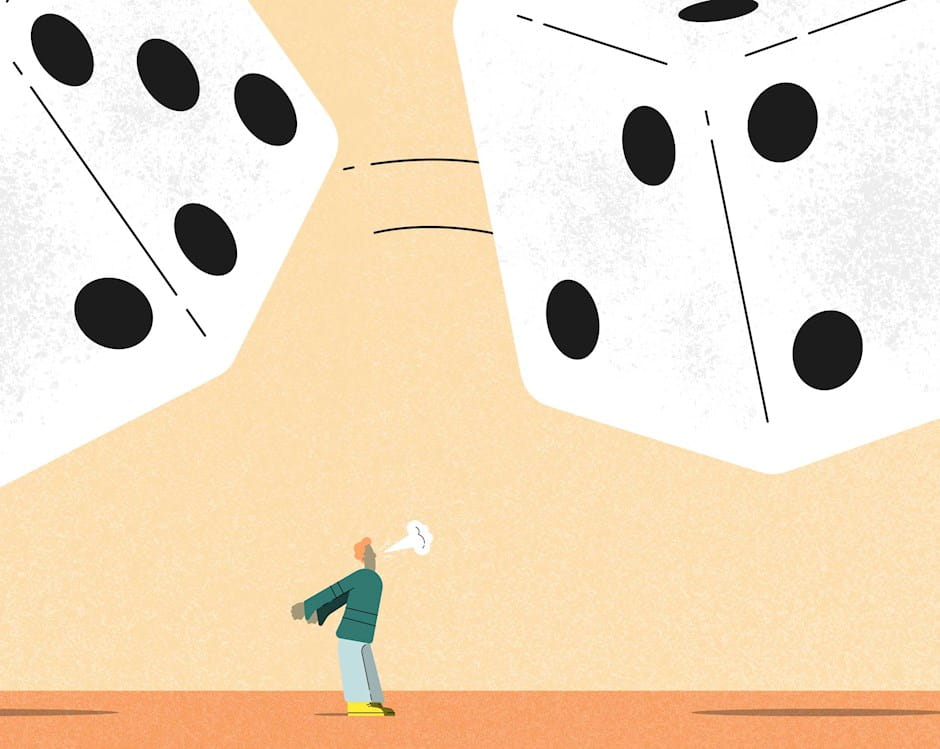
Lucky Break? We Just Don’t Believe It
People can’t resist drawing inferences from random experiences.
{PubDate}
Reid Hastie studies judgment and decision making (managerial, legal, medical, engineering, and personal), memory and cognition, and social psychology. He is best known for his research on legal decision making and he is currently studying the role of causal reasoning in judgments of all kinds and the wisdom of crowds in collective decisions.
Hastie has written a textbook, Rational Choice in an Uncertain World: The Psychology of Judgment and Decision Making, in collaboration with Robyn Dawes of Carnegie Mellon University, and a popular book on collective intelligence, Wiser: Getting Beyond Groupthink to Make Groups Smarter, with Cass Sunstein. He is involved with the Center for Decision Research at Chicago Booth.
He taught previously at Harvard University, Northwestern University, and the University of Colorado where he was director of the Center for Research and Judgment Policy.
Hastie has served on review panels for the National Science Foundation, the National Institute of Mental Health, the National Research Council, and on 18 professional journal editorial boards. His research was funded continuously by the National Science Foundation and the National Institutes of Health from 1975 to 2005. He has published more than 100 articles in scientific journals, including Psychological Review, Psychological Bulletin, Psychological Science, Journal of Experimental Psychology, Cognitive Psychology, Developmental Psychology, and the Journal of Personality and Social Psychology.
Hastie earned a bachelor's degree in Psychology from Stanford University in 1968, a master's degree in Psychology from the University of California at San Diego in 1970, and a doctoral degree in Psychology from Yale University in 1973. He joined the Chicago Booth faculty in 2001.
Judgment and decision making (managerial, legal, medical, engineering, and personal), the neural substrates of decision processes, memory and cognition, and social psychology. Some currently active research topics include: the impact of rumors and "news" on stock market forecasts; the role of explanations in category concept representations (including the effects on category classification, deductive and inductive inferences); civil jury decision making; neural and physiological substrates of risky decision making; and the psychology of reading statistical graphs and maps.
With N. Pennington, "Explanation-based decision making," in T. Connolly, H. R. Arkes, and K. R. Hammond, eds., Judgment and Decision Making: An Interdisciplinary Reader, 2nd ed. (New York: Cambridge University Press, 2000).
"Problems for judgment and decision making," Annual Review of Psychology, vol. 52 (2001).
With R.M. Dawes, Rational Choice in an Uncertain World: The Psychology of Judgment and Decision Making (California: Sage Publishers, 2001).
With T. Kameda, "The robust beauty of majority rules," Psychological Review (2005).
With A.G. Sanfey, "The neuroscience of decision making," in E.E. Smith and S.M. Kosslyn, eds., Cognition: Mind and Brain (New York: Prentice Hall, 2006).
For a listing of research publications, please visit the university library listing page.
| Number | Course Title | Quarter |
|---|---|---|
| 38002 | Managerial Decision Making | 2026 (Winter) |
People can’t resist drawing inferences from random experiences.
{PubDate}
The solution is to incorporate more mathematical thinking in decision making.
{PubDate}
Chicago Booth’s Reid Hastie, Kristen Castillo of AbbVie, Pedro de Andrade Faria of Tarpon Investimentos, and Parexel's Chris Baker discuss the challenges of leading employees across international boundaries.
{PubDate}