From Queen Elizabeth I refusing a patent for the knitting machine in 1589, to Keynes sounding the alarm in 1930, to JFK raising the same concerns from the Democratic nomination stage in 1960, Erik Hurst took a packed room at Chicago Booth on a trip through centuries of economic history. The throughline was hard to miss: we have been panicking about machines taking jobs since before the birth of the United States. Not much has changed about the fear. Everything has changed about the technology.
So what does that mean for the future of work?
The socioeconomic growth born from past technological revolutions has always played out over centuries, and the fears that once accompanied each structural shift have faded as economies adapted. With AI, we are just at the beginning. The fears exist, and while history suggests that pattern of disruption followed by growth will hold, AI isn't just another tool. It's something that moves faster, reaches further, and touches parts of the workforce that tractors and assembly lines never could. The question isn't just whether we'll adapt—it's whether we'll adapt fast enough, and who may get left behind in the process.
The Framework for Technological Growth
To make sense of where we are headed, Hurst offered a framework of four questions that he established as the analytical backbone for technological disruptions, AI included.
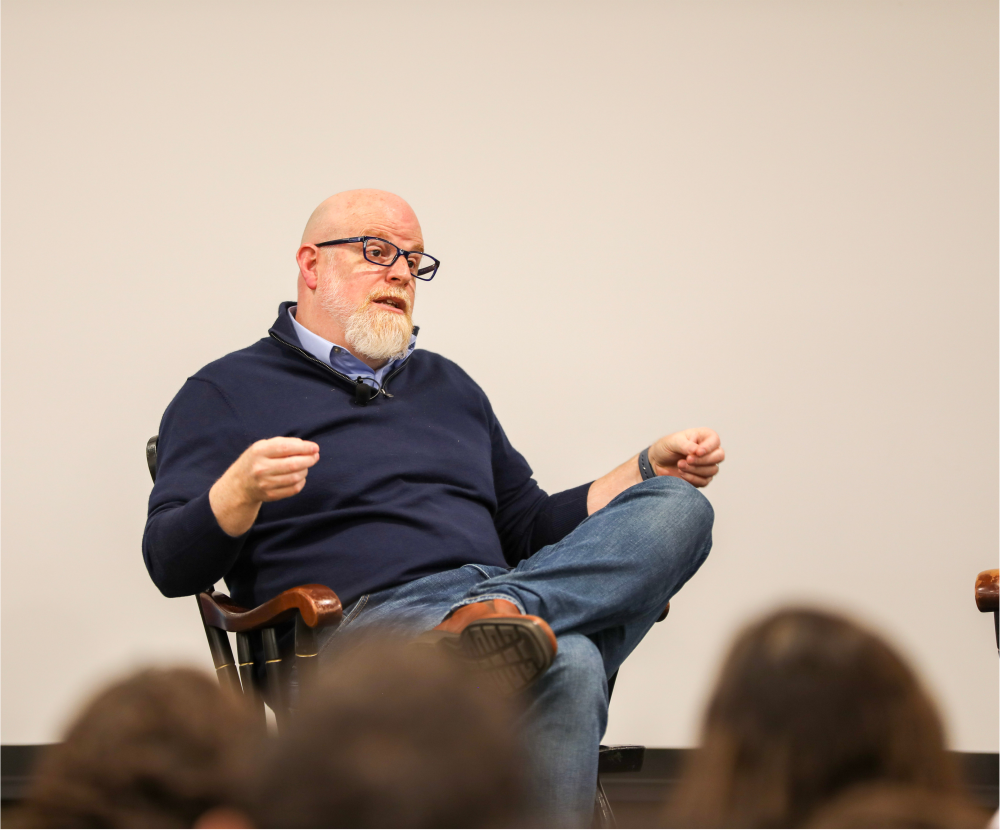 The first is the most fundamental: is the technology a complement or a substitute? If automation complements existing skills, making workers more productive, it encourages what economists call seamless growth. But as it starts replacing them outright, that's when the harder questions arise. The second follows that line of thought: if workers do get displaced, do their skills transfer elsewhere? When the tractor impacted for agricultural labor, displaced farmers could move into manufacturing because the smaller skill gap and timing of the shift worked in their favor. The third question is about friction: even when growing sectors exist, what's standing in the way of getting there? Retraining takes time, relocation costs money, and the path from one industry to the next isn't always a straight line. The manufacturing sector over the past 25 years made that clear. About 2 million men dropped out of the workforce not during a recession, but through a slow structural bleed that no adjacent industry was positioned to absorb. And the fourth question—arguably the most currently relevant—is speed. The faster a technology moves, the less time any of those natural adjustments have to keep up.
The pattern that emerges across history is consistent: disruption, displacement, upheaval, and eventually, a reshuffled economy with new opportunity on the other side. It has never looked clean in midst of change. What remains to be seen is whether AI follows that same pattern, or whether its’ speed and scope are inherently changing the game.
A Conversation with Sanjog Misra and Erik Hurst
To explore that question, Sanjog Misra joined Hurst on stage as the event shifted from presentation to conversation.
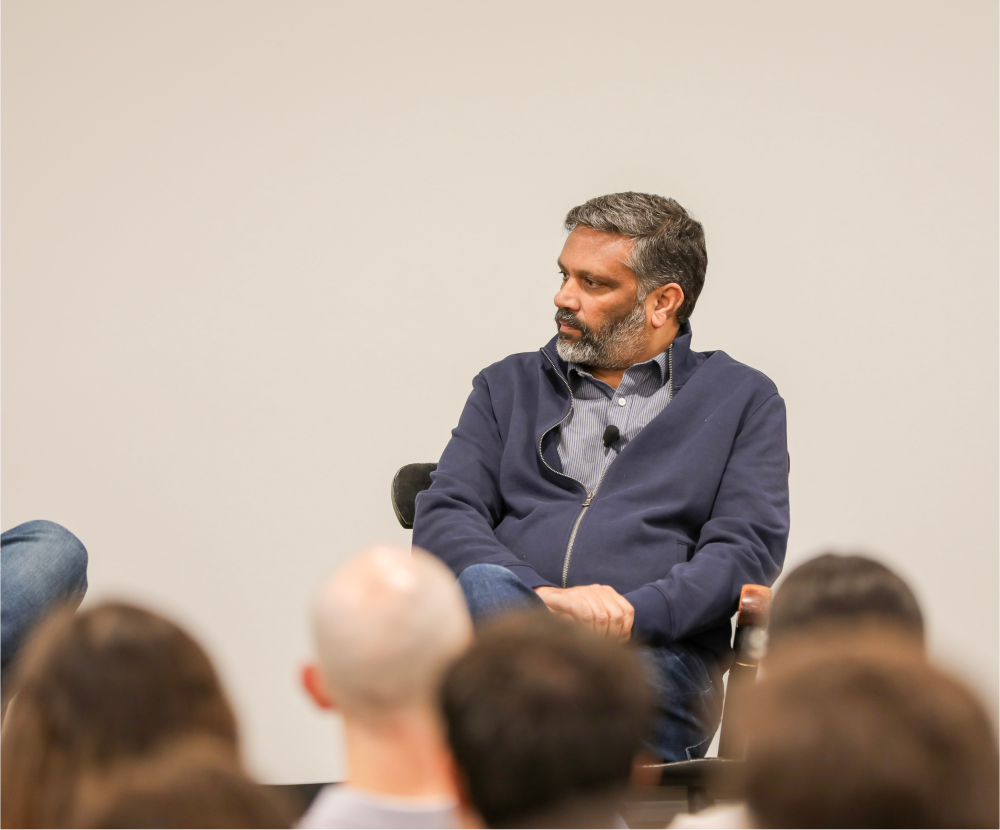
"In most ways," Hurst opened, "AI is just another tool." But as the two exchanged thoughts, it became clear that this particular tool has a different weight to it than the revolutionary ones that came before. While past disruptions replaced physical labor, AI is replacing mental labor; not just changing what we do things with, but what we think with. It doesn't just mimic human thought processes. In many cases, it does them better.
The experience of it is also more heterogeneous than past technologies. AI acts as a massive productivity boost for knowledge workers and researchers while hitting lower-end roles—entry-level positions, truck drivers—with considerably more force, because their defined and repeatable tasks are more easily handed off to an agent or a driverless car. And within Hurst's framework, AI blurs the line. The complement vs. substitute question is a moving target; today it may feel like a complement, but the technology is learning and adapting at the same time we are, which means tomorrow is an unknown.
What makes that uncertainty feel more urgent than past moments of disruption is speed. Misra framed it through the lens of electricity: as a civilization, we went from lighting a light bulb to driving an electric car, but we're covering that same distance in a fraction of the time. In January 2025, we were talking to AI. By the end of 2025, we were thinking with it. In the first months of 2026, we crossed again into something entirely new: doing with it. Agentic AI that doesn't wait to be asked, but acts, delegates, decides. It’s no longer a gradual curve, but a compression of history.
"The internet democratized information," Misra compared. "AI democratizes intelligence." And perhaps the most striking illustration of that came not from the stage but from the audience exchange that followed: the observation that it is often the more affluent who are slowest to adopt this technology, while a ninth grader in a rural village in India is already using it through WhatsApp. The tool is already everywhere; the real potential lies in those who decide to use it.
The Bigger Questions
With the novelty of AI, comes harder questions than we've had to previously consider. The audience at the BFI and CAAI Public Event didn't shy away from them, pressing Hurst and Misra oneverything from what the labor displacement data actually shows right now (not much yet, though the lag is real and the signals are there), to whether policy can realistically keep pace with something moving this fast (the honest answer: probably not), to why the response should be adaptation rather than resistance. Hurst was direct in hisanswer to the last: you can't unilaterally stop something that the rest of the world is running toward. The better question is how you manage the transition for the people caught in the middle.
What came through clearly across all of it was a certain level of productive uncertainty—the kind that comes not from not knowing the answers, but from being honest about how new the questions are. As Misra put it: "Today, the only skill worth learning is learning."