


Booth welcomes two new professors working at the intersection of AI, technology, business, and society.
- By
- July 15, 2025
- Center for Applied Artificial Intelligence
The University of Chicago Booth School of Business is pleased to welcome three new faculty members whose research sits at the forefront of artificial intelligence, language, behavior, and societal impact. As part of Booth’s continued investment in AI and its role in shaping business, markets, and institutions, these new scholars bring diverse perspectives, a collaborative spirit, and a shared commitment to both foundational research and real-world impact. Learn more about incoming faculty members Kawin Ethayarajh and Suproteem Sarkar.
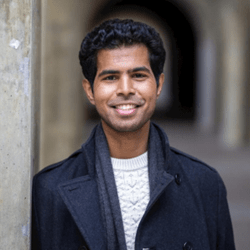
Kawin Ethayarajh, Assistant Professor of Applied AI and Kathryn and Grant Swick Faculty Scholar, joins Booth from Princeton University, where he was a postdoctoral fellow at the Princeton Language and Intelligence initiative.
His research introduces and advances behavioral machine learning, a new paradigm situated at the intersection of AI, behavioral science, and economics. “Machine learning is not a sterile industrial process,” Ethayarajh explains. “It is bound by the behavior of real-world actors—consumers, firms, states—not just clean, idealized datasets.” By incorporating insights from behavioral economics, he designs algorithms and systems that are grounded in how people and institutions actually behave.
Among his most recognized contributions are Stanford Human Preferences, one of the largest datasets of human preferences over text, and Kahneman-Tversky Optimization, an algorithm now widely used to align language models with feedback.
His work has received several accolades, including a Meta Fellowship (2021) and an ICML Outstanding Paper Award (2022), and has been incorporated into some of the most widely adopted language models.
When asked about his decision to join Booth, Ethayarajh points to the university’s unique intellectual ecosystem: “I work in an emerging field that demands cross-disciplinary dialogue. Booth’s unparalleled strength in economics, law, and the social sciences makes it an ideal place to ground the future of AI in real-world complexity.”
He aims to build a more human-centered vision of AI—one that, like behavioral economics before it, acknowledges the messiness of real-world decision-making. “Creating AI with people in mind is the best way to create a tide that raises all boats,” he says.
Ethayarajh earned his PhD in Computer Science from Stanford University and his BSc from the University of Toronto.
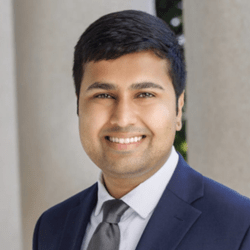
Suproteem Sarkar joins Chicago Booth with a research agenda that spans economics, finance, artificial intelligence, and behavioral science. His work investigates how algorithms interact with behavior, productivity, and innovation.His recent projects include training language models for economic forecasting, and analyzing how market participants perceive firms and technologies. Sarkar is interested in how new technologies interact with business and policy—and how this intersection will change over time.
“Empirical findings in the economics of algorithms are shaped by the current generation of technologies and adoption patterns,” he says. “It is important to assess how these patterns may evolve.”
Sarkar received his PhD in Economics, SM in Applied Mathematics, and AB in Computer Science from Harvard University. He has also built experience with technology development through previous roles at Microsoft and Google.
At Booth, Sarkar looks forward to collaborating across disciplines: “Researchers here and throughout the university are taking creative approaches to important questions.”
These new appointments reflect Booth’s expanding commitment to addressing the ethical, strategic, and societal implications of artificial intelligence. With wide-ranging expertise—from behaviorally grounded algorithms to cognitive modeling and applied AI safety—Ethayarajh and Sarkar exemplify the school’s vision of AI scholarship: deep in theory, broad in application, and fundamentally human in orientation.
As Booth continues to grow its AI research community, we look forward to the contributions of these scholars in shaping the dialogue around technology and business—and in training the next generation of leaders for a world transformed by intelligent systems.