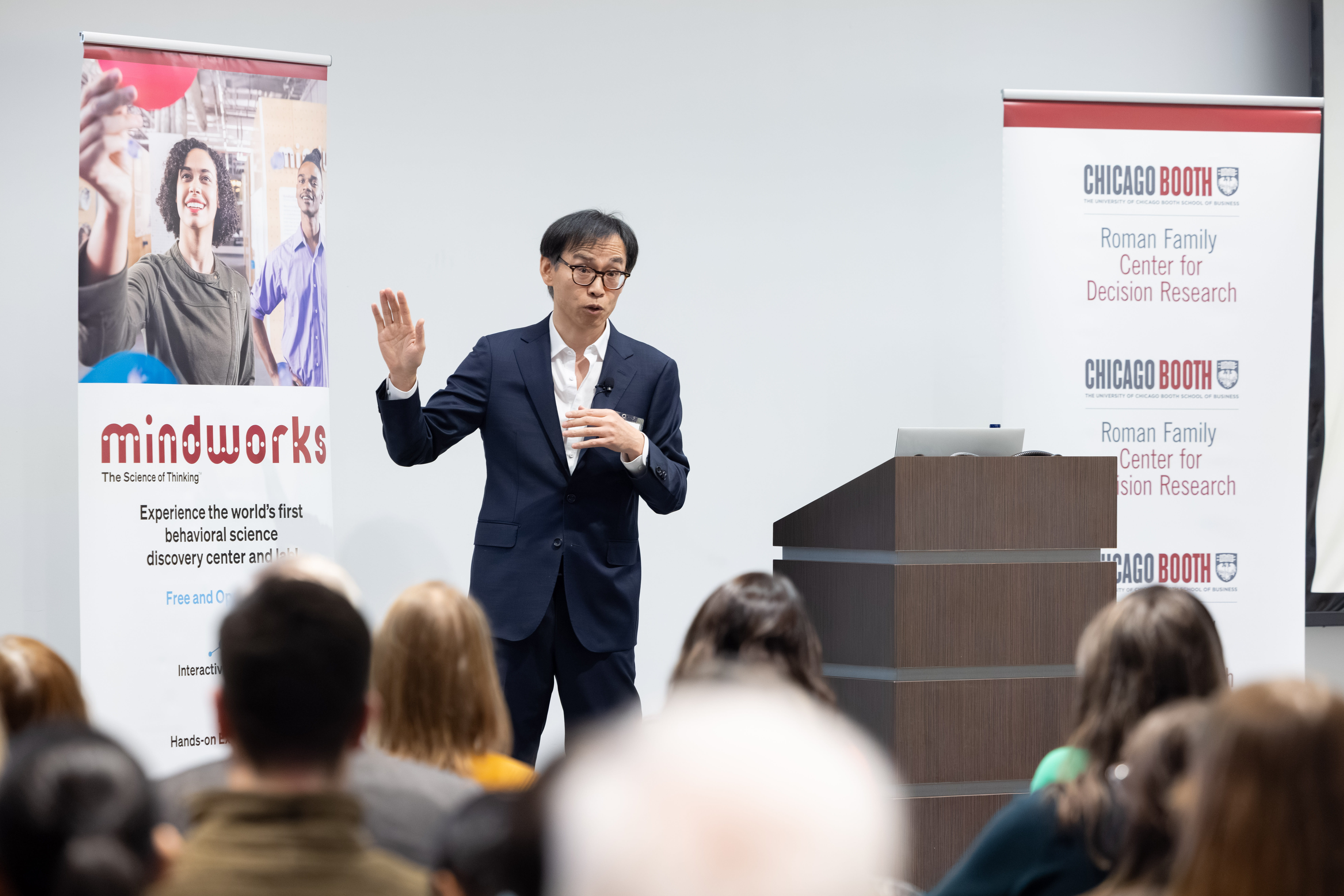
- And tonight, I'm honored to welcome my friend and colleague, Shige Oishi. Shige is the Marshall Field for distinguished service, professor of psychology at the University of Chicago and director of the Oishi Lab, which conducts groundbreaking research and wellbeing, cross-cultural differences, residential mobility, gratitude, and a host of other fascinating topics. His work has won numerous awards and he was selected to the American Academy of Arts and Sciences in 2023. He has published over 200 articles in book chapters, and it's one of the most cited social personality psychologist. He will talk about his most recent book, "Life in Three Dimensions." Shige has studied human wellbeing for many decades now, but until his recent work, most of the literature has been focused on increasing happiness. Think of positive psychology and don't talk about two Eastern Europeans about that. Another stream of research has been on finding meaning in life, but it is difficult, if not impossible, to reduce complex notions such as what constitutes a good life to single dimensions. Shige's reason work expands this notion to include what he calls psychological richness, which is about the role of curiosity and exploration in life. The book is a pleasure to read and has received a number of accolades. For example, it was on the JP Morgan summary reading list and on Seattle Times 12 fresh paperbacks to kick off the new year. So if you haven't bought it, go ahead. I'll let Shige speak about his work. I just want to add that after reading the book, not only I learn about psychological richness, but I was impressed by his white and deep knowledge of world literature. Not that this fact on its own is unusual, but I already knew about his impressive knowledge of world cinema and more surprisingly, American sports. Not just baseball, but also basketball. I'm not sure how he does it, but he does it all. So please welcome Shige Oishi.
- Thank you. Thank you so much, Alex, for wonderful, wonderful introduction. It's such an honor to be introduced by the psychologist I really admire. So thank you, Alex. And thank you so much for coming here today. This morning, I was really worried that I'll be one talking to Alex, but luckily, weather recovered and you are kind enough to be here. So thank you so much. So my name is Shige Oishi. Before I begin my talk, I think many of you don't know who I am, so I just wanna introduce myself very, very quickly. Three things about me. So the first thing is that I am Japanese. And I was born and raised in Japan and this is my mom.
- This is my dad with, with my son, Kai. So growing up I never, ever imagined that I will leave Japan, and this is just unbelievable that I'm here and I'm a professor here and giving this lecture. This all changed when I did study abroad in my fourth year, and I went to Lewiston, Maine, anything. So advisor in Tokyo essentially said, "If you have one year, just go to somewhere where you find no Japanese because the whole goal is to learn English." But I managed to find three other Japanese students and I hung out quite a bit. So my English was still not that great. But anyway, so I'm Japanese. The second thing about me is, Alex already revealed this a little bit, but growing up, I loved watching Mo. I loved baseball and I played kendo Japanese fencing. And this was very good because every practice start with a one minute meditation. So that really helped me prepare for big talk like this. I get meditation, I'm ready to go. Okay. But most importantly, I am a psychologist. And when you think about somebody who is psychologist, you're probably thinking about somebody like this. And I actually, when I was undergraduate, I wanted to be like this, but I realized that I'm not good at this. So instead, I became this kind of psychologist who is staring at the data all day and try to understand what we learned from the data. Okay, so today, I will talk about this big topic of what is a good life? And essentially, my story already Alex alluded to, but two essentially fundamental and primary answer to this question were happiness and the meaning. And in psychology, since mid 1980s, that just tremendous amount of effort and research into studying scientific study of happiness. And we learned a lot, we learned a lot. And some were interesting, some are counterintuitive. But after a while, there were a group of people came up and sort of criticized, perhaps happiness is not everything. Perhaps happiness is a little bit too much about ourselves. And good life maybe have to be something to do with societal contribution, whether this person is making difference in the world. So a group of psychologists started to examine a meaningful life whether the person feel like their lives are meaningful, worthwhile by making difference in the world. So that research has gone on for another 20, 30 years. Now we know quite a bit about meaningful life as well as difficult as it is to measure, okay? But then again we feel, I feel that something is missing. So about 10 years ago, in summer of 2015, every summer, I think about sort of what kind of new research project I wanna work on next semester, next academic year? And I just realized in 2015 that I've been doing researching, studying happiness for 20 years because I enter PhD program in 1995. So that was my sort of the midlife crisis moment that, "Oh my gosh, 20 years, what have I done?" And we learned a lot, but also there was lots of remaining questions. So that's when we started, I started to think about the third path, third answer to this question of what is a good life? And the third one is what we call psychological richness. Richness in terms of lived experiences, lesson we learned, adventure we took. Okay. So hopefully, today we will get to that. But I will start with the happiness and then meaning, and then go there. Okay, so why happiness was the first sort of the answer to good life question? Here, we have to go all the way back to ancient Greece. So about 2,500 years ago, Aristotle was lecturing about this exact topic, what is a good life? And the book one is interesting. The title is "The Object of Life." So he start out his book saying, "We all pursue bunch of different kinds of goals." And how many of you had the New Year's resolutions? Right? Or just one, you guys don't have any. So you might have goals or resolutions like, I'm gonna eat better, exercise more and lose my weight. But Aristotle would say, is that the ultimate goal? Losing weight, for instance? Then he would say, no, because we usually want to lose weight so that we'll be healthier or will be more attractive, or something else. So these are instrumental goal, goal for something else. So then you can ask the same question, why do you wanna be healthy? Why do you want to be physically attractive? Then maybe that being healthy is also not the ultimate goal. Maybe you want to be healthy because you want to do things you really want to do, or you wanna be physically attractive so that you get treated nicer, or you get to go certain events that you feel like you're excluded or whatever. But anyway, the point is that he went through all kinds of goals or values people have. Ancient Greek, honor is a huge thing. So honor, status, power, money. But he essentially argues that everything is instrumental. Only one thing is the ultimate goal of goal. Goal for itself. And that he says, is the happiness. Living well or doing well. Okay, so fast forward to 1984, my graduate school advisor, Ed Diener, published this famous paper entitled "Subjective Wellbeing." Up to that point, there are some, psychologists who are studying psycho happiness, but essentially most of the empirical psychologists taught things like happiness, things like love are too fuzzy to scientifically study. And Ed in this paper essentially argued that, well, it is very difficult to measure, but it's better to measure with some inaccuracy than without having any idea or any data. So he started this scientific study of happiness. And the key word here is subjective. So that's what differentiate between philosophical approach and the psychological approach. So philosophical approach like Aristotle is essentially it's a happiness. That's the ultimate goal. Doing well, living well. But by which he means that you have to lead a virtuous life. You have to engage in contemplation. So he argues that if you are doing that, if you're virtuous, and if you're engaging in contemplation, namely philosopher, if you're a philosopher, then you're leading a good life. But if you're not a philosopher, you're not exactly leading a good life. On the other hand, Ed had the different ideas. That's a very top-down, prescriptive sort of notion of good life. Why don't we ask bunch of people whether they feel like they're leading a good life? And whether we can gain enough information as to what differentiate those people who say their life is going well and those people who are saying their life is not going well. Because even among those who lead virtuous life or contemplative life, there are some people probably who feel genuinely that this is the worthwhile pursuit, while others might not feel that way. So he wanted to really ask people and start from there. So he created the five-item scale. Things like in most way, my life is close to ideal. One, strongly disagree, seven, strongly agree. Conditions of my life are excellent, one to seven, I'm satisfied with my life. One to seven. Okay, so then he collected bunch of data, lots of data. Then now you can ask more interesting question, who is happy? Are rich people happy? Lottery winner happy? Physically attractive people happy? Young people happy? Healthy people happy? These are the sort of the things that a lot of people pursue. Interestingly, rich people are happier than the poor people. That part is not interesting at all. But what was fascinating was that Ed actually got the data from Forbes Richest American, this five-item scale, and the average was 4.77 out of seven-point scale. If you ask University of Chicago undergraduate, that's almost exactly the average score you get. So although these are super rich people, obviously, but they're not that much different than we are. So they are on average, happier than the poor people, sure. But the difference is much, much smaller. Lottery winners, essentially the finding is very similar. Physically attractive people. My goodness, Ed took a picture of everybody had 10 people rate physical attractiveness correlated with the self-report and the objective rating of physical attractiveness. What's the finding? Zero correlation. Zero correlation. So physical attractiveness in that case was not at least objective rating. By the way, subjective rating of physical attractiveness. How attractive do I feel like I am? Right? If you know Seinfeld, right? Kramer, ask Kramer. He'll say, "Yes, I am very attractive." Those are the people who are really happy. It's not the objective rating, okay? Anyway, so it sounded like external factors don't matter as much as we think we are. So then the next question is, who is happy? So Ed collected lots of data and the most important factors that things like very much the internal attributes, internal things, how we view the world. Some people see the world as a glass half full. Some people see it as half empty. So neurotic people for instance, definitely see the world as a half empty. And these neurotic people, even if they're making $200,000 with a nice apartments and so forth, they're not that happy. On the other hand, if you're not that neurotic, those people who see the glass half full, then even if your objective living conditions are not that great, they do say that their life is pretty satisfying. Another big factor was a gratitude. Those people who are grateful for what they have or what other people did for you, they tend to say they're happy than unfortunately, a lot of people we know, right? I'm grateful people who think they deserve more. Those are the people who are not satisfied with what they have because as they get more, they want more. So another interesting finding from the decision making judgment literature was that some people are maximizer, right? When they apply for college, they apply for 30 schools and try to get into the best possible school. satisficer, on the other hand is literally, those people who are happy with whatever good enough option. So these are the people who say, "Well, university of Virginia is a really good school. I get the in-state tuition, so maybe I'm gonna just apply to the early decisions on this school." Right? Interesting study by Sheena Iyengar and Barry Schwartz. They followed college senior who were applying for job. They measure maximizing tendency and satisfies tendency and how many job application they sent, how many interview they got, what kind of job they got. It was a maximizer, as you can imagine, who got more interviews, more job offers, and who got higher paying job. Satisficer, not so much. But six months later after graduation, Sheena and Barry ask these student, former student now working for six months, how are you guys doing? How satisfied are you with your job? Ironically, the maximizer who got objectively better job, they were less satisfied with their job than the satisficer. So essentially the main message from happiness research is that you have to be happy with what you have. Ambitions too much ambition, too much desires go against the maximization of happiness. Williams James had the very famous formula about self-esteem, but I think that fits in the happiness as well. So essentially, happiness could be that amount of success you have divided by your ambitions, okay? And most of us Americans are really working hard to maximize the success, but as success increases, your desire and ambition increases, then the ratio is not changing. So that's the problem. When you ask Dane and the Finnish, why are they so happy? In the world ranking, they're always top. They often say, "Well, we don't expect that much." We are content with what we have. Very different response than Americans, right? So that's the point. So that's the kind of data and ideas we learned. So I'll just give you one quote I like. So I don't know how many of you know "Howards End," E.M. Foster, there was a movie, Anthony Hopkins played the main character, Henry. So Henry is like a booth MBA student. He has a prestigious job, he wanna conquer the world. He goes to Africa, make a lot of money, he wanna live in a bigger and bigger and bigger house. Ruth, his wife, the first wife was born in Howard End, small cottage outside of London, and all she wants is spend time in Howards End, taking care of garden. And at one point Ruth says, "Henry, why do people who have enough money try to get more money?" And when I did read this sentence, I was like, "Wow. I sort of know I should be satisfied, but I'm doing that already." Right? So I think this is the reason why Ruth might be a happier person than Henry. Okay, so, so far what we found in happiness research is that it's not a big success, big promotion, new house, new car, those are the things that makes us happy. Well, to be clear, those things make us happy, but just not for that long, okay? Just dissipate pretty quickly. What sustain our high level of happiness is the frequent small, repeatable, enjoyable activities. So Ed had this brilliant chapter, that title captures everything. Essentially, happiness is the frequency, not the intensity of positive emotion. We were perhaps mistaken of focusing on one or few rare big events in life. We should really focus on how to maximize, how frequently you have cup of coffee with your best friend, family barbecues, you know, taking walk in the morning and chat with your neighbors. And those are the things that are foundational to happy life. Okay. So I made it sound like a happy life is great, right?
- But not everybody, oops, likes happiness. One of the most influential French writers, Gustave Flaubert famously said, "To be stupid, selfish, and to have good health at three requirements for happiness, though if stupidity is lacking, all is lost." And he was really afraid of being stupid. I mean, it's just really interesting. He was so afraid of like, 'Okay, I don't wanna be stupid, I don't wanna be stupid." So this is his correspondence to his, Flaubert. So some people who take Gustave Flaubert's idea or a critique of happiness, they want to maximize meaning in life, more of the social contribution rather than themself. Okay? But the meaningful life is very difficult to understand. Actually, Mike Steger was my first graduate student when I started my faculty position in 2000. And he said, first meeting, "Shige, I really wanna study meaning in life." And I said, "Don't do it." You're not gonna have enough time. It will take at least 15 years to establish reliable scale. But he was persistent, persistent. So his dissertation was meaning in life questionnaire. Now society, like 7,000 times. He did a TED Talk and he's a Mr. Meaning in Life. So good for him, but. I'm really happy for him, just to, seriously. So what we learned about this fuzzy concept though is that the three things really differentiate those people who say their life is meaningful versus those people who struggle finding meaning. One is sense of significance or mattering. Whether you feel like your life matters. When you have small children to raise, then obviously, you feel like you matter, right? Because without you, they really suffer. So that's the sense of significance that required for meaningful life. But another thing is that most of us oftentimes struggle, "What am I doing with my life?" Or, "Why do I have to do this task?" Right? Oftentimes we feel like stuck or feel like confused. "I don't know where I'm going." The meaningful life is complete opposite of that. Essentially the meaningful life is full of purpose, very clear sense of direction. I know exactly where I'm going. So if you have your job, clear goal, clear purpose, maybe you feel like your life is meaningful, right? So this is a sense of directions and purpose, okay? The final thing is that all of us have so many different roles that we play. Sometime, we feel like our life is torn apart. The family demand, work demand feels really fragmented. When you feel like sense of fragmentation, then it's very difficult to find your life to be meaningful. So the last key piece essentially is the sense of coherence. The different parts of your life seems to cohere, fit together. And this is where essentially those people who have strong religious beliefs tend to have this sense of coherence and they tend to score higher on meaning in life. And I'm not very religious. So if you're not religious, you can have your own political belief or scientific belief or whatever belief to guide you and give you some kind of, you know, guiding principle. If you have that, I think you have still find some sense of coherence. Okay. So what kind of complete things people say when Pew center for instance, ask, "What gives you sense of meaning in your life?" About 50% of Americans said family, which is not surprising. And about 30% of then said job or career. So we talked about this already, right? When you are taking care of children or parents, then you feel like tremendous sense of meaning because you're making a difference, making contribution. But at the same time though, this is not so stable because if you thought your life is meaningful, because I'm a parent, what happens when they grow up? They don't need you anymore. Unfortunately, college students still need help, right? I was hoping that my son, college son don't need it, but he's still need me. So I still feel a sense of meaning. But once he really doesn't need me, then finally, I might have this existential crisis, okay? But more seriously in America as well as the UK and elsewhere, there are increasing number of adult children who go no contact with their parents. And if you had the sense of meaning based on being a parent, and if you unfortunately experience this, then of course, your sense of meaning is crushed. Similarly, if you thought your life is meaningful because of your career. And what happens when you retired? There are so many people who say, "I lost my self-worth in retirement because I was the go-to guy or go-to person. Now my role has completely changed and I don't feel like I'm needed as much." And these are difficult transitions. And because of course, Korea and families takes up so much of our life that of course are the main source of meaning, but also fragile because our role and relationship with family and job change over time. And if you are one of those, don't feel bad because Tolstoy, he just published "War and Peace." Worldwide acclaim. He's 50 years old. And he says this, "I had a good wife who loved me and who I loved, I was more respected than I had ever been, and yet, I could give no reasonable meaning to any actions of my life." So he had all of a sudden, the existential crisis. So this is the difficulty and challenge of meaning, finding meaning. To me, oftentimes, finding meaning in life because life is so complicated, is just like essentially trying to figure out what the abstract painting means. Have you guys seen this? It's in the Art Institute. John Mitchell. My son claims that he loves this painting. So I go there and look, and I'm a modern art person, but I'm looking at and looking at really trying hard, just cannot make sense of it, right? Just cannot make sense of it. I read the author, the painter, John Mitchell, 1955. Thank goodness there's a title. There's so many modern arts without title, right? I get so mad because come on, give me some clue, right? So the clue is the city landscape. Wow, okay, city landscape. I try and try, I still haven't seen it. But the point is clear, right point is that the life is like looking at the abstract art. It's just you. If you cannot find the meaning, nobody else can help you. Well actually, I'm gonna try to help you. So what might be the trick? Well, when you look at the people who find their meanings and compare them with those who don't, then the difference is that those people who can find meaning can find the patterns in life. They can connect the dots, they can see the continuity between past, present, and the future. Very interesting finding about nostalgia. How many of you're nostalgic person? Good for you because nostalgic people tend to find more meaning than not so nostalgic people. But why? Right? Why is the question. And one of the reason is that the nostalgic people tend to maintain their old friendship. They keep friendship from middle school, high school. And to the extent that you still have a high school friend and middle school friend, you can see yourself, right? "Oh yeah, I was like this, now I'm like this." So you can see discontinuation between past and the present through your old friends. And if you're not nostalgic, you don't care about old friends. Then again, the past and the present seems so separate. Then it's very difficult to find the meaning. So as long as you can find the dot, connect the dot, past, present and future, then it's much, much easier. Okay? Another example is Socrates. Be like Socrates. So this is the painting, the death of Socrates. Socrates is 70 years old, he's sentenced to death. So his followers and just disciples are devastated. One of them, Crito, try to help him. Already arranged the escape route to foreign country. But Socrates refused to go. He's ready to go, ready to die. After all, he says philosophy to learn how not to fear death. So the whole point of reading and learning about philosophy is come to turn with death. And of course, he had this bizarre notion of soul, that the soul continue after the current life. So he had no fear because his soul will continue. But also more realistically, his legacy, right? His idea about the importance of interrogation, we have to help each other examine our life. That will continue with that next generation and next generations and next generation because he had so many students. So one way you can make meaning perhaps is to be a mentor, especially, you know, mentoring the next generation of people, ideally, who share some of your vision. Then you can see that your life will continue to the future. If you are not the person person however, one last recommendation. Literally, just the plant the tree. So George Orwell said this, "The planting of a tree is a gift which you can make to posterity. And if the tree takes root, it will far outlive the visible effect of any of your other actions, good or bad." So literally or metaphorically, what you wanna do is plant a tree. All right. How are we doing with time? Okay, okay. All right. So now we are going to climax. Okay, so happiness and meaning are great. Of course, if you can have it, you should have it. But at the same time, I must say something is missing. So let's go over, right? Happiness. The mindset that is conducive to happiness is this satisfying approach. This is good enough for me, right? And also the way to increase happiness is just hang out with your best friend or family member. That means you are staying in your comfort zone. What happened to your curiosity, adventure, and explorations? If you just solely try to maximize happiness, then you are much more likely to stay in your comfort zone. Similarly, I said that you can find the meaning from family or career. But again, this is a very, very small world. Many of you probably remember the movie famous movie, "It's a Wonderful Life." George Bailey, right? Had all kinds of ambitions when he was young. He wanted to travel all over the world. He wanted to go to New York City, build 100-story building, he wanted to create a new town. But because of family demand, he stayed in his small town, helping out the poor folks to get the loans and so forth. And at the end of the movie, of course, he was rewarded. Everybody appreciated his kindness. That's a wonderful life. But what happened to his ambitions? One of the most interesting finding from social psychology over the last 30 years I would say, is the findings about regret. So what do you regret? The things you did over last couple weeks or a month ago. Usually, you're thinking about some stupid thing you bought. Why did I buy this? Or stupid things you said to others, right? But if you think about lifelong regret, what do you really regret when you think about your entire life? When you do that, it is usually it's a regret of inaction. Why didn't I go to Boston when I had the opportunity? Why didn't I tell Lucy I loved her? To be clear, that's just an example. I don't know any Lucy. So those are the things actually, the older people when they think back, look back. And I cannot help but think of George Bailey at the end of the death bed. As wonderful as his life was, would he live a life of fulfillment, a good life, truly good life? Okay, one, just a little empirical findings from what's missing from happiness and the meaning. In personality psychology, we have big five personality, extroversion, neuroticism, agreeableness, conscientiousness, and openness to experiences. Four out of five personality traits are fairly tightly correlated with happy life and meaningful life, except one that is openness to experience. Openness to experience is the one personality trait that is not strongly associated with happiness or meaning. So in other words, happy life and the meaningful life could be gained without openness to experience as I explain. But then what happened to the good life that could be characterized as being open to new experiences? So I admire all these people, Jane Goodall, Yayoi Kusama, you know, Anthony Bourdain, Miles Davis. And essentially, what is missing from happiness and meaning to me is really the life of curiosity, life of adventure, life of spontaneity and playfulness and artistic appreciation. Okay, so about 10 years ago in my research lab, we started thinking about, okay, how can we conceptualize this idea, the good life through adventure and curiosity? Initially we thought maybe experiential richness, but then the richness through reading books or films and things like that is a little bit missing. So in the end we decided to call it psychologically rich life and psychologically rich life, as I said earlier, is essentially the richness of experience. So material richness, we know how to count, right, dollar. Essentially, psychological richness is essentially your psychological portfolio full of unique, interesting experiences. And maybe it's through films and you know, books, but it's all inside you. So I wrote this piece in the wired world just came out. Essentially psychological richness is an attempt to measure the wealth or richness that is in your mind, in your memories. So what did we learn from our last 10 years of research? So psychological richness, that one of the biggest corets personality corets was as we expected, openness to experiences. We did a lot of studies. One of my favorite study is not the diving study but the study abroad study. So we track group of college students who are doing study abroad that semester, compare them with the students who are staying on campus, but those who are interested in going to study abroad in the future. So pre-departure, we compare big five, SES, socioeconomic status, everything, no difference between these two groups. Week one, we measure psychological richness, no difference whatsoever. But 13 weeks later, there's a huge difference. On campus group, psychological richness does not change at all because it's again the typical semester. But those who went study abroad, right? They have a lot of difficulties. Language problem, culture is different, etc. etc. And they really have to resolve those difficulty and differences. So although they are not that happy or they don't find necessarily study abroad to be more meaningful than on campus people actually, psychological richness just enhanced quite a bit. Similarly, college students who take really difficult classes. There are many of them at UChicago, right? Those of them find their life to be psychologically richer than those students who just take easy A classes like my class. Although they're happy but they're not psychologically richer, right? We do daily diary study, 14-day, day diary study. Every day we ask, how's the day? How happy were you? Meaningful psychological rich. What kind of things did you do? Did you do something new? Did you meet someone new? Did you eat something new? With in person, okay, on the day they did something new. They thought that they was way more interesting, psychological richer than on the day they didn't do a thing. Routine day. Actually, they found the routine day to be quite happy, but they didn't find the routine day to be psychologically richer. So doing something different does help every day. Okay. Finally, let me talk about some potential, yeah, potential societal constraints. So we are here, right? Interested in world economy. Yes? Maybe. Actually, one of my favorite books is Adam Smith, "The Wealth of Nation," 1776. So Adam Smith start "The Wealth of Nation" with the story of pin factory. Very famous. So if we each of us try to create the pin, we work eight hours, how many pin do you think we can make? One. One. If we have 10 people, 10 workers, then at the end of the day, we have champions. But what if you do divide up the job among 10 people? How many pins they produce? Adam Smith said 48,000. 48,000. And that's the basis of productivity, economic development, right? We want to maximize our productivity. Then what we do is division of labor, okay? So that's wonderful in terms of maximizing economic output. But what happens to psychology? So my graduate student, Yonge Cha, there, raise your hand. So Yonge did all this study of amazing division of labor. So we randomly time people to do this division of labor or non division of labor. Do everything on your own. Productivity wise, of course, the division of labor team win big time, they're way more productive. But we ask, so what do you think of the task? How interesting was it? How intriguing was it? Cliche, psychologically rich. It is the non-productive whole production conditions, they report those higher level of psychological richness. So in our life, right, in order to be successful in our job, we have to be productive. So we try to specialize, try to divide up and conquer, but at the same time, that might be going against maximizing your sense of psychological richness. So in your life, when you have opportunity, try not to outsource too much, try not to rely on others. My suggestion is DIY. Okay, so I'll show you our DIY project. When we lived in Charlottesville, side yard was mess. So we wanted to have the patio. We got the three quotes. The cheapest one was $9,000. $9,000? That doesn't make any sense. We checked the cost material course, it was like 4,000. So Jay and I thought, "Okay, let's save $5,000. Let's do it ourself." Digging like seven inches. It's just full of trees. It's just really hard. And you have to put the weed barriers, gravel, and then just not know this, this, I flat on this. Takes forever, forever, forever. It took us three months, three months. And a lot of times, I was like, "I can't get out." And of course, we had never fought. But during this time, it's like, "Why didn't we ask professional? Why were we so cheap? Why are we doing this?" Right? But three months later you have decent, you know, side porch and most importantly, you have very interesting story to tell. So that's the whole point of do it yourself. It's not for it efficiency, it's not for productivity or resale value. Probably, it reduced the resale value of this house. But still, it was wonderful. Okay, so let me finish my talk with quoting Eleanor Roosevelt who wrote "You Learn by Living." "So the purpose of life after all is to live it, to taste experience to that utmost, to reach out eagerly and without fear for newer and richer experience. You can do that only if you have curiosity, unquenchable spirit of adventure." So what is a good life? I will argue that it's happiness, meaning, and psychological richness. And I show there are many ways to achieve these three goals. Okay? If you wanna maximize happiness, you can be a satisficer. Try to increase the frequency of small joy. If you wanna maximize your meaning, be useful for others. Try to connect the dot and try to leave a legacy. And if you wanna increase your psychological richness, then do something new and different. Be spontaneous, be playful. Thank you so much and I hope you live in three dimension this year.
- [Chris] Okay, wonderful. Thank you so much for that talk. We have a few minutes left for a Q&A. So if you have a question for our amazing speaker, feel free to throw your hand up in one of us with a microphone. We'll come find you deal. Great.
- Well, thank you. I really enjoyed that and actually wanna have a very long conversation with you over a beer. But short of that, can you talk a little bit about intrinsic and extrinsic validation and how people move through that? And in the context of that, also, it seems like a lot of experiences become commodified or transactional. You know, you used to just like put on a backpack and go, and now you can arrange a gap year for $40,000, right? So if you could talk a little bit about that intrinsic versus extrinsic validation and how that operates in an increasingly commodified transactional world.
- Yeah, so I mean, you mean by accommodations? Maybe like people want to just put up on the social media and just show off your experience and so forth or?
- [Audience Member] Yeah, I mean I think some people get motivated intrinsically about what's meaningful.
- Oh.
- [Audience Member] What's meaningful to them versus needing validation from external sources.
- Yeah, other people will find this cool, so I'm gonna do it. Yeah, yeah, yeah. So I think obviously this case, if you did it intrinsically, probably, the results are better. But what's great about experience is that a lot of time, there are lots of unexpected things happen. So even if you start it out extrinsically, if you find some experience and you actually change the way you view the world. And as far as psychological richness is concerned, I think that's okay. So maybe, you know, I mean I see young people, well my sons doing a lot of cultural thing for sort of like looking cultural, you know, arts galleries and go to the jazz bar and stuff. So, yeah, but you know, we do a lot of things out of vanity, but at the same time, you know, when you actually do it, you learn a lot of things. So, you know, I don't necessarily like the checklist kind of thing. Oh, I did this, I did this 'cause in the end, it is all about your memory. You have to remember these experiences for it to be accumulating, right? Psychological richness is all about accumulation of unique, interesting experiences. Some of the sensations seekers go around and do all kinds of things, but they don't reflect upon. So it's not really adding up. So I think that's the more important part, although I totally agree that you want people to do it more intrinsically, not just for extrinsic reasons. Yeah.
- [Audience Member] Hi. It sounded like we need to have like a very frequent little happy moments every day, like habits, but then also do something new and exciting. So like how do you comment on this tension? Or how frequently should we do these?
- Yeah, yeah, yeah. So at any given moment, you have to choose. So there's a trade off. If you try to maximize happiness, maybe you cannot maximize richness and so forth. Fortunately, our life is pretty long. So at some moment or phase of your life, you might try to maximize happiness or meaning and some phase of your life, maybe shift the emphasis a little bit. And also psychological richness, for instance, can be found in somewhere nearby. So for instance, I lecture from my office to lecture hall, you know, before writing this book, I was always, "Okay, it will take five minutes, so I'm gonna leave five minutes before." Right? Take a shortest cut and always straight. Now I try to leave like 10 minutes earlier and try to take a different route. And by doing that, you notice different, you know, buildings, beautiful trees, beautiful bench and things like that nature. So even within your neighborhood, when you start changing your route and so forth, you can start seeing something that you didn't know. And even the long term relationship, I wrote about this in my book, you know, sometimes, you find something new about your partner and that's what's really rewarding. So certainly, I'm not saying just go out there and do all the wild stuff. No, no, no, no, no, no. You don't have to do that. You just try to change your commute a little bit and then try to explore the neighborhood you haven't explored, right? Maybe if you're not type of person who explore a lot, and you might wanna revisit your favorite movie, favorite book. When I read that Mrs. Dolloway, second times, I found so many new things. And then, you know, by revisiting your favorite books or movies, you can also find the richness. So I think there are lots of different ways to do it and it's in a book. So I'm just.
- [Audience Member] Hi, I have the next question over here. First of all, this is oh, great talk. Thank you for giving it. I'm the founder of Livable Legacy. So, this is right up my my alley and I'm really interested about putting this into practice. So my question for you is how universal is this? Is it universal across life stages? And is it culturally specific in any way?
- Yeah, so we have one paper in 2020. We ask people from nine different countries. If you can pick one life, which one would you choose? Would you choose happy life, meaningful life, or psychologically rich life? Americans predominantly chose happy life, followed by meaningful life. Only 13% of them chose psychological rich life, which was very depressing for me. But then when we look at the data from Norway, Germany, and Portugal, a little bit better in terms of the richness. On the other hand place like Singapore, I think that data came from Singapore Management University, namely business students. So that was the lowest amount of psychological richness. They wanted to make a difference in the world of meaning and happiness. So there are some clear cultural differences. Also, when I ask freshmen, okay, which one would you prefer? Freshmen predominantly say, "I wanna have psychological rich life. I wanna explore." But then the second year already it's like, "I want a have a happy life." And then the graduate senior say meaningful. I wanna, you know, have a legacy. So I think it changes depending on life phases. Probably right before the retirement, you really wanna make sure you have the legacy. Maybe as soon as retirement start, maybe you want some explorations and psychological richness. And I think these things change as your life and resources and time change over time.
- [Chris] Great, I think we have time for about one more question. It's gonna be right over here.
- [Audience Member] Thank you. And thank you for the insightful talk. I'm just curious whether you think that the benefits of psychological rich fullness would be influenced by whether the person is a consequentialist? People are different in like dealing with consequences. Some of the people might be more relaxed about the consequence.
- Yeah, definitely. I think, you know, so-called anxious generation, they tend to sort of choose the safe measure, academic major so that they can get a job and so forth. I think that's all about consequences, right? They're worried about, you know, not getting a job and things like that. Then that fear really prevent them from exploring. So what I'm trying to do is I want them to get a job, but at the same time, don't worry too much, focus too much about the outcome. Because a lot of people, right? Live a life. Alex, did you plan this life like this? No. Did I plan this way? No. Nobody really planned out the future, right? And if you just worry about the immediate, you know, consequences so much, then I think you lose sight of the big picture. So that's sort of what I wanted to say. Just focus on curiosity, explore. And when you have this psych richness mindset, even if the things didn't turn out fine, you can always say, "At least I tried." The opposite is lifelong regret, right? I could have done it, but I didn't try, so.
- [Audience Member] Thank you.
- Okay, thank you so much.