

Think Better with Kurt Gray
- November 18, 2025
- Think Better Series
Nick Epley:
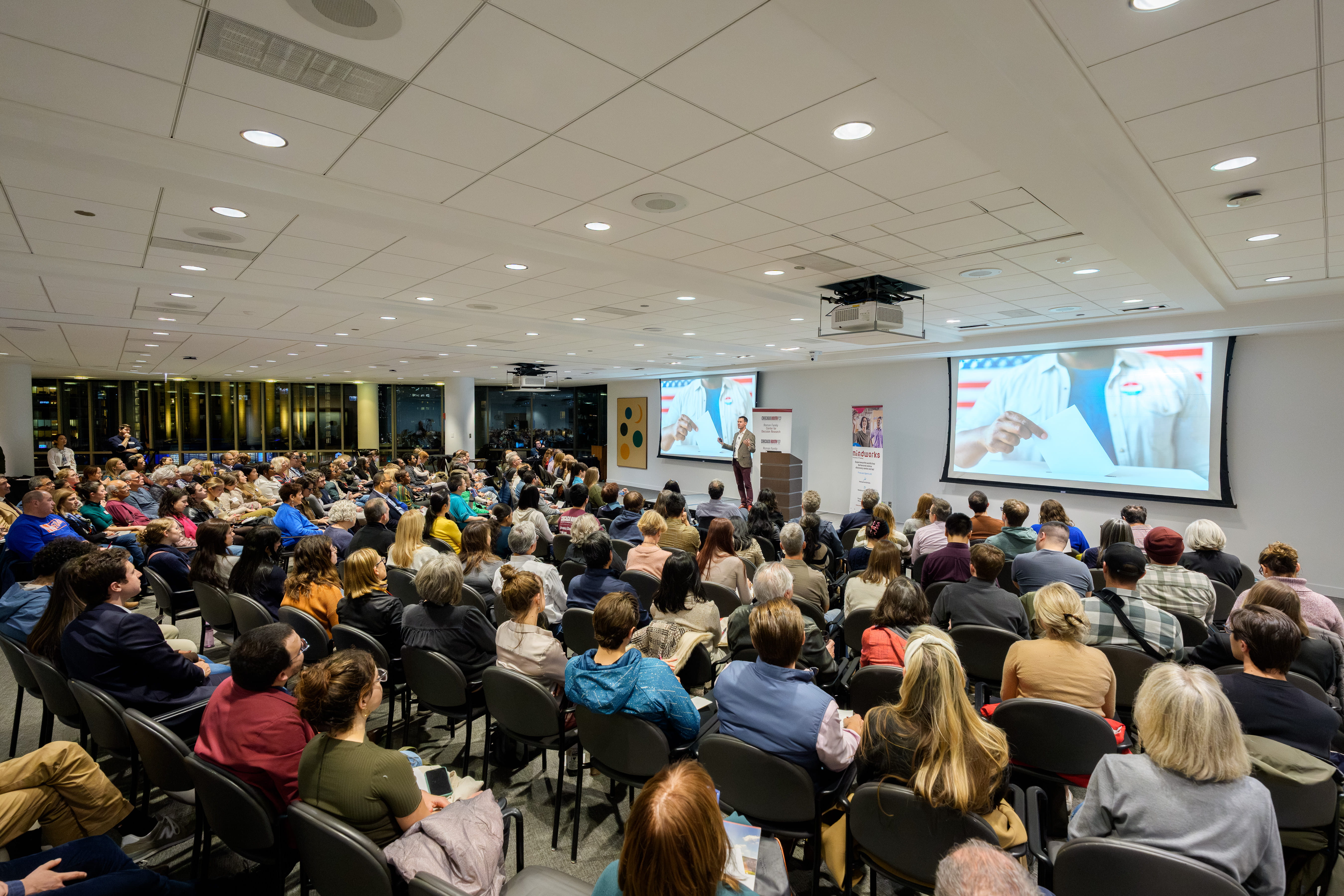
Welcome to our first Think Better Talk of the 2025/26 academic year. Thank you so much for coming, so happy to have so many of you here in person and welcome to all of you over Zoom who are joining us online as well. My name is Nick Epley, I'm the faculty director of the Roman Family Center for Decision Research. This speaker series here is just one of the many things that we do as a center to support behavioral science at the University of Chicago. The main thing that we do in the PIMCO Decision Research Lab is we run the infrastructure that's necessary to conduct behavioral science research of the kind that you're going to hear about tonight from Kurt Gray. And one very unique thing about behavioral science is that it is a discipline, it is a field that you can not only experience and learn about as a participant like in these kinds of talks, but you can also participate in the creation of it.
So, if this is something that's of interest to you and you want to see what it's like to actually generate this kind of data, just down the street at 224 South Michigan, we have a working lab called MindWorks, if you have not been there, it's free, it's fun, you can earn swag, like hats over there that I see people wearing, for participating in research. So, if you have not visited us there at MindWorks at 224 South Michigan, please do as soon as you're able. So, I have a great pleasure tonight of introducing Kurt Gray, who I have known now for over 20 years, starting in his first year as a PhD student at Harvard, where I was on the faculty at the time before, just before I moved here, we only overlapped for a few months before I came.
Kurt has had an enormously distinguished career since he got his PhD from Harvard in 2010. He worked for a couple of years at the University of Maryland, then spent about a dozen years at the University of North Carolina Chapel Hill, and then just this summer he moved to Ohio State, where he is the Weary Family Foundation endowed Chair in Social Psychology. He's in the Department of Psychology there. And you can tell how impressive a researcher is by the number of words in their title, so you know Kurt's impressive. We in fact knew that Kurt was impressive as a student and as a researcher almost from day one when we met him on campus, and we knew he was different in two ways. One most obvious way that Kurt was different was in his intensity and just his general energy level.
So, Kurt often makes me think of the spinal tap speaker that's turned up to 11, Kurt lives his life turned up to 11. You're going to see that in his presentation, his brain just works more aggressively than most of ours do. And Kurt has turned that intensity into an extremely productive career. Kurt Publishes research at a clip that's somewhat hard to fathom, so for instance, just last year, the same time he was publishing this book he's going to talk about tonight, he also was a co-author on 24 peer reviewed papers, that was last year. That's a solid career, like a 10-year career for many faculty, Kurt did that last year. We knew he was different in a level of intensity.
The other way that we knew that Kurt was different was he just thought differently about problems, which is often one of the key secrets to being a great scientist of any kind, but that's true in behavioral science as well, and there were two ways at least in which he thought differently about things. One is that he just asked different kinds of questions. He just looks at the world in a slightly different way. And so ask questions that other folks just often aren't inclined to ask. His first book co-authored with his late PhD advisor, Dan Wegner, who was himself a brilliant mind in the field, was called The Mind Club. And social psychologists for decades had been studying social cognition, how people think about people, kurt thought that sounded a little boring, and so he wondered what do people think about other things, like minds of all kinds?
What kind of mind do people think a frog has? Or a God? Or a comatose person? Or someone with a particular disease, for instance? And so, he wrote this book, and did a bunch of research, that kind of blew open a field into a whole bunch of new directions that it hadn't ever moved into before, because Kurt thinks about problems differently. The other way in which he thinks about problems differently is that he tends to see to the core of problems in ways that many don't, one of the ways in which I think behavioral science operates at its best is when it takes a noisy, fuzzy, difficult to understand world out there, that seems to have all kinds of complexity to it, and simplifies it down to its fundamental dimensions, that's something that statistics allows you to do, to identify the core components of a noisy environment to figure out what the actual signal is, and Kurt is a master at this.
So, for instance, in his book, The Mind Club, his first book, Kurt articulated a theory that there are lots of different minds out in the world that we think about, right? Lots of dimensions of people that we think about, but when you actually look closely at it, you dial down the microscope to actually look at its fine contours, there aren't 10 dimensions, 20 dimensions, 100 dimensions, in fact, there are only two, he thought. Two ways in which we think about the minds of others. One, what can they do, their agency, and the other is how do they feel? What's their experience like, right? So, you take this very complex thing and Kurt was able to simplify it down into two dimensions, and once you get that kind of clarity and simplicity, you see things differently.
Kurt is going to do that again for us tonight. For about the last 10 to 15 years of his career, he's focused on morality, which is another one of these topics that seems noisy and fuzzy. What do we think is right and wrong? Why do we think something is right or wrong? How do different people think differently about right and wrong? It just seems enormously complicated. But Kurt, again, in his masterful way has thought about this problem a little bit differently, and his argument to us tonight, among other things, is going to be, not that there are a whole bunch of different dimensions to morality, as many psychologists have argued, but in fact, if you dial it down and sharpen the focus, there's only one. There's only one.
He's going to tell us what that one is tonight. I'm very happy to have Kurt here tonight, he's one of the brightest minds and behavioral scientists, one of the best of the next generation, and we are very lucky to have him here. I'm very proud of him and what he has done. Kurt, thank you for coming.
Kurt Gray:
Thank you.
Nick Epley:
Great to have you here.
Kurt Gray:
All right, thanks so much for having me, thanks for that lovely introduction. Full disclosure, Nick terrified me my first semester of my PhD, but I'm a little less afraid now. So, thank you for that. All right, we are more divided than we've ever been today, I don't know if you know that, but it's pretty bad. If you look at how we were in the 90s, we were a little divided, and if you look at how we were even just a little while ago, in 2017, we are further apart, and if you look today, it's even further apart still. And this is just where we are in policies, let alone where we are in our emotions towards each other. Team red, team blue.
It doesn't take a lot of imagination to look at this interaction and think, huh, it's not going great. This is not an interaction where there's a lot of positivity, a lot of mutual understanding. And so, I think it's really important that we move past as best we can, these contentious, these disagreeing times. And I think this really matters in your life, it matters in the workplace, it matters in all sorts of cases, but I'm going to suggest it matters for a particular time that's coming up very soon, Thanksgiving. It's coming up real fast, there's a lot of uncertainty about how it's going to go, and there's this great study that came out some time ago that shows that if you have cross partisans, so team red and team blue at the same dinner table at Thanksgiving, that dinner ends half an hour earlier than if it's only one or the other.
And this means there's no time for pie. And if there's no time for pie, that is a terrible state to be in, and we need to make some changes. And so, today we're going to cover why we fight about morality and politics, and not just that, but how we can make it better, and you have some real tools when you go forward into your workplaces, into your families, and into your Thanksgiving dinners real soon. All right, so there's three sections of the talk, one is why we fight and get outraged, how the minds do or really don't differ between liberals and conservatives, and how best to bridge divides and find common ground.
And I want to say from the outset, I am a behavioral scientist, I'm not a pastor, I'm not a philosopher, I will not tell you what the right thing to believe in is, I will just tell you how our minds work, and how to come along better. Okay? So, don't ask me what the right thing is, I don't know. I study these things. All right, why do we fight and get outraged? Well, there's two easy but ultimately wrong answers for why we're so divided today. One is that the other side is stupid, and two is that the other side hates you, and is filled with evil intentions. Let's cover the first one first. This idea that the other side is stupid. When you're having a conversation about politics, about the economy, you are likely extremely confident about your opinion, right?
You're like, I know how the economy works, and I have a really good sense of what we should do about it, right? You're confident about how complex things work. But I'm going to suggest today that maybe a little bit of humility is warranted, and that maybe we shouldn't be so cocky when thinking about really complicated problems. And I'm going to suggest that we think about something much simpler in our lives, and right now I'd like you to pick up your piece of paper and your pencil, it should be on your seat... Also thanks to Amy for doing all the logistics here, for getting you those pieces of paper and your pencil, thank you.
All right, put up your hand if you've never seen a bicycle. Excellent. I would like you in the next minute to draw a bicycle in sufficient detail that you can show someone how it works mechanically. Proceed. It's got two wheels, that's a hint. And don't cheat, I'm a college professor, I can tell if you're not looking at your own paper. Folks on Zoom, please, bicycle. I'm laughing with you, laughing with you. Oh yeah, this is nice. Nice. All right. Well, lots of reason for humility from what I'm seeing. Al right. So, these are the kind of bicycles that people draw, none of these are bicycles. None of these work. These are not bicycles, this is a bicycle, and if you drew that, congratulations, but many people did not draw that despite being very familiar with the idea of a bicycle.
And so, this is a very important demonstration because it shows that maybe we shouldn't be so confident about our understandings of the economy or other complicated issues. So, maybe they're dumb on the other side, but are they dumber than our side? I don't know. We're all trying to do our best here in the world, so we can have a little more humility when it comes to complex issues. What about the idea that they hate us, that they're trying to destroy us? Well, this is the story told by media elites and by folks that have been termed conflict entrepreneurs by journalist, Amanda Ripley.
So, this narrative that they advance is something I call the destruction narrative. And it's... Whoops. It is the idea that they are trying to burn it all down, like some superhero villain, just like light the world on fire. And this narrative is very popular on social media. So, if you tune into X, which I advise you not to do, you will see this narrative, they're out to get us, they're burning it all down. I think this narrative is not true, and the work that I've done, and many people have done, show that people don't believe what they believe because they want to destroy something, but because they're trying to protect things that our moral convictions are held because we're trying to protect ourselves, our communities, and our societies.
And when people pass votes, it is to protect themselves and their communities. And in fact, work shows that the average American is part of something called the exhausted majority, we're not trying to yell at each other on social media and our daily lives, we just want to get through our lives, have a reasonable Thanksgiving dinner, and have an economy and a society that works. So, then why are we filled with moral conflict then if everyone's trying to protect themselves? Well, they're closely connected. We're filled with moral conflict because we worry about our safety, we worry about threats, and because we feel victimized. We get morally outraged when we feel threatened or attacked. Now, you might wonder why would we feel so threatened and attacked today? We live in a society that's incredibly safe, all things considered, compared to the ancient past.
But I think even today, we feel vulnerable to harm. And that is because, why do we feel vulnerable? Because... Whoop, this clicker is sticky. Because of human nature. I just jumped ahead, so now you know why. Because of human nature, right? When we think of humankind, there's a narrative that we talk about in school, that we are apex predators. And sure today we can hunt wolves from helicopters, and that's an amazing thing that humans can achieve, we are very apex predatory, but for millions of years, we were not, right? If you look back in the anthropological record, this is how we evolved mostly for the millions of years when we were Australopithecus. There's literally a skull they found in South Africa with holes in the skull coming from a saber-toothed cat. We spent most of our time being afraid. And you can just look at our bodies today, right? Look at your claws right now on the end of your fingers, they are sad, sad claws.
We just call them fingernails, we don't even call them claws, right? A real predator has talons, has claws, even your house cat is more of a predator in its heart of hearts than we are. So, ultimately, we are more prey than predators throughout evolution, and this means that we often are afraid. And of course, we're not afraid of wild animals today, although if you went out into the bush right now in the darkness, you probably would be afraid. But today we fear other predators. If your kids or grandkids are playing in the front lawn and you see a white panel van drive slowly up the street and then slowly back down the street, you don't think, huh, is that a lost locksmith? I hope they find whether they're going. No, you think come inside, come inside, right? There's a kidnapper out on the loose.
And so, when we get afraid of other people, especially people on the other side, the way we combat the threat that the other side causes to us, that's when we get outrage. We get outraged on social media, we get outraged with each other, We're not sure what to do, but more angry about it. Because it used to be something useful, but in today's social media environment, it's not so useful anymore. And so, America is really divided by the different understandings of threats, concerns about harm, and so if you want to understand how someone on the other side thinks and feels, think about what they fear. So, if you are pro-gun rights, then you might be afraid of someone breaking into your house. But if you're pro-gun control, you might be afraid of someone shooting up a school.
Both of these folks are afraid for children, but perceive those harms differently. And so, again, if you want to understand the other side, ask yourself what is the other side trying to protect from harm? Who are they trying to protect, and how? Okay, so why do we fight and get outraged? It's because we want to protect ourselves and those around us from harm. Now, we'll talk about liberals and conservatives, right? I've just told you that we all care about harm, but it's clear that we disagree, right? Liberals and conservatives, we vote for different policies, we have different politicians that we champion, and so it's easy to assume that we have different moral minds, somehow in our brains there's some differences there.
But this idea is wrong, it's a myth. We all have the same harm-based moral mind. We all condemn harm. The problem is that... Sticky, sticky. The harm... Oh my goodness. The problem is that harm is a matter of perception. Oh my goodness. There we go. Harm is a matter of perception. So, if you see someone smoking marijuana, is it just something that's nice to do and relax after a long day at work, or is it something that's corrupting America's youth and destroying our families? How you see the harm of the situation determines your moral judgments on the issue. And in fact, every moral issue that we disagree about is grounded in disagreements about perceived harm. Immigration, guns, gay rights, you name it, there's different perceptions of harm.
And so, when we're disagreeing, we're really disagreeing often about who seems the most vulnerable to victimization, to suffering. And look, we all agree that kids, they're vulnerable to harm, which is why every moral cause from the beginning of time has said, think of the children, it's always think of the children, we're always trying to protect the children. But what about a soccer player? Is a soccer player vulnerable to harm? Well, if you are on team blue, then you think that this soccer player is filled with pain, it's so sad, they're vulnerable to harm. But if you're on team red, you think this is total bullshit. The soccer player is not hurt and just wants a penalty kick.
Completely different visions of vulnerability. This happens with all sorts of moral issues. So, a pregnant woman, how vulnerable is she to harm? Is she more vulnerable to harm than the fetus that's inside her? If you say a fetus is more vulnerable to harm, you're more likely to be pro-life, and if you think the pregnant woman is more vulnerable to harm, you're more likely to be pro-choice. And here's the hard part, it's impossible to know for certain how vulnerable some people are or some entities are, it's up to us to perceive that amount of vulnerability. And so, a lot of moral disagreement can be understood with the assumptions we make about who is especially vulnerable to harm or to victimization. In fact, we've asked people this question hundreds and thousands of people about how vulnerable are entities to harm, and we've kind of settled on four broad clusters that help explain political debate in America today.
One, you can call the environment, things like coral reefs or rainforests. One we label the other, you can think of this as marginalized folks, so undocumented immigrants, trans people, Muslims. You might say, well, they're just marginalized, but maybe some folks will say, well, how do we know who's really marginalized? This is a kind of broader term. The other really means people who are outside the center of American power. The powerful, speaking of that, so corporate leaders, state troopers, how vulnerable are they to harm? And the divine, Jesus, God, the Bible, how much can they be victimized? And so, your answer on these questions really dictates where you stand on a lot of political issues. So, take a minute and just think about where you stand on this. Where's the environment on the scale of one to five, the other, et cetera?
All right, so we've got the graph here, got to give you some science. On the left you've got liberals, on the right, you've got conservatives. Make sense? And then we've got perceived vulnerability here on the Y-axis. So, what our data show is that maybe not surprisingly, if you are further on the left, you are more likely to see the environment and the other as more vulnerable to harm or victimization compared to those on the right. Other hand, it's an opposite effect for the powerful and the divine. Okay? So, here we are, conservatives more vulnerable to harm and less vulnerable to harm for liberals. Now, I think this pattern's interesting for each of these things. So, if you want to know how do people feel about a policy that could hurt the environment, but help industries, or a policy that might harm the rich in a sense of taking more taxes away from the wealthy, these things are important.
But I think it's even more important if we zoom out and think of the broader pattern of these judgments here. And what these really show is the kind of competing narratives on the left and right of how we should think about society and things like power. Folks on the left, extreme progressives, tend to divide the world into, there's oppressed peoples and there are oppressors, and what we really need to do is remedy that huge difference in vulnerability. On the other hand, conservatives are more likely to see everyone as equal in terms of their abilities to have success, to have freedoms, we're all born equal, we all have agency, we all make choices. And so, there's a grain of truth of each of these, right? Liberals think about group-based differences, conservatives more think about individuals and their choices.
But this explains why folks on the right are more likely to say taxation's theft, if you earn your money, shouldn't you keep it? And folks on the far left are willing to say, eat the rich. Maybe not literally, but sometimes, because they're seen as having less vulnerability than someone who's more vulnerable. The UnitedHealthcare CEO who was assassinated, that's a flashpoint, a controversial issue, left says, is it really so bad? And folks on the right say, well, he had kids, he's a family man. Black Lives Matter versus Blue Lives Matter, same thing. Folks on the left think, well, Black men especially are more likely to be victims of police violence, whereas folks on the right say, well, these police officers put their lives on the line, even if they're in positions of power societally, they put their lives on the line and they're at risk.
So, there's so many issues that we can think about that map on to this structure. And now... Not there, here we go. And so, when you think about victimhood, when you think about how the other side perceives victimhood, there is a tendency to think that maybe they don't authentically believe it. When someone says, well, you think police officers are vulnerable to harm, or you think these folks are vulnerable to harm, you're just saying that, you don't believe it, you're just saying it to piss me off, to get some conflict. But I think this is not true, and data backed this up, people genuinely implicitly deeply perceive these things. And I like the word perceive because then we can use an analogy as with vision. So, let's look at this, let's think about what is darker, A or B, everyone knows A is darker. If you think otherwise, you're obviously making it up.
They're the exact same color, they're the exact same color, but the reason you think they're different is because how you were raised, your visual system makes you think that if something is in shadow... Oh my goodness, come on clicker. Because something's in shadow, it's actually lighter than it is. But even if you know the answer, objectively speaking, you can't help but see it. And so, our moral judgments are a lot like this. Even if you know something, it doesn't matter, morality's not about knowing, it's about feeling and feeling deeply, perceiving the world in a certain way. So, when someone disagrees with you, they're not just trying to make you angry when it comes to perceptions of harm, they're genuinely perceiving it that way. And so, to understand moral divides, you have to understand the harms that people see in their worlds, and this can come from their upbringing, this can come from their religion or their lack of religion, but you have to understand where people are coming from. And this allows us to build common ground with others.
So, it's easy to assume that liberals and conservatives have different minds, this is not true. Everyone's minds seek to protect the vulnerable from harm, but harm and vulnerability are a matter of perception. And this means that morality is powerfully a matter of perception. And liberals and conservatives see vulnerability and harm in systematically different ways. So, now we know why we fight about morality, the kind of core concerns about harm and threat, and now we know why liberals and conservatives disagree, and different visions of who's vulnerable in the world and how to kind of fix that vulnerability, and now we get into the, how do we make the world better? How do we have conversations better? How do we bridge divides?
Well, I've done a lot of work on this, and you might wonder, well, why do we even need to do science? Many people think, well, why do we even need to do behavioral science at all? We're all human beings, don't we already know how best to live our lives? Are we kind of imbued through evolution or some other way, the best way to live? Well, we ask people, imagine you're having a conversation with someone on the opposite side, what should they do in a conversation to make you respect them? The majority of people said, I want them to use facts and evidence. Don't give me stories, don't editorialize, give me the facts. Many fewer people think it's personal experiences or stories. But do facts really help us see the harms that other people are worried about? Do they help us see that other people are concerned about protecting themselves? What about this interaction?
Do we need one more fact here? Here's something I heard on NPR that you didn't know, it's a fact, right? Here's something I heard on Fox News, and you didn't know, it's a fact. Oh my goodness, you're right. Oh wow, it's so right. Here's a fact about abortion, oh wow, I guess I'll give up my moral convictions, you're so right, said no one ever. People don't give up their convictions just because of a fact, especially in the era of fake facts. And in fact, when, in fact when we give people the facts on the other side, like real facts, people are like, no, those are not the right facts, I want the real facts, the right facts that support my view. We're living in different information ecosystems, we have different facts. And so, instead of facts, what's very powerful is storytelling. We are a storytelling species. When you are sitting around the campfire, what you don't do is start talking about the mean, median, and the mode about statistics and T-tests. I've taught statistics, it's a real pain in the ass to know statistics.
It takes a lot. It doesn't take any time to learn from stories. I tell my kids stories, and they pick it up immediately. Stories are powerful. Especially stories where we share our personal experiences of harm. Because when we do that, people understand that we are rational. Even if they disagree with our assumptions of the world, they understand that we are trying our best to avoid harm and protect ourselves and our families. And we've tested this empirically. So, we tested this on campus, at UNC, we had a real student who was an accomplice of ours, so she was pretending to be walking around campus, and then we got another person who was actually our participant, let's say she's an alumna, she's like a middle-aged lady just dropped off her freshman daughter at campus, and we say, oh, look, would you guys mind having a conversation on campus?
And so, the participant, the lady says, sure, I'll talk to this nice student. Great. And we say, what's your view on guns? She says, well, I guess more restrictions, more control. Okay, great, you guys should have a talk. And then there are accomplice, our student says, look, I'm pro-gun rights, and anyone who thinks otherwise is frankly un-American. We need to get some conflict. And then she says, here's why I believe we need more guns, because of a fact, she'll give a real fact, which is how many times guns are used in self-defense in America every year, or she'll give an experience, which is that her mom used a gun to defend their family from an intruder. Now, it's just one story, but when we record those conversations, when we record that... We won't even bother. When we record those conversations, and have a separate team of folks rate those conversations for how respectful they are, we find that the conversation that's grounded in personal experience is more respectful than one that's grounded in facts.
Even though we all know that facts are important, they're not the best way to start a conversation. We've looked at deeper, darker places for political conversations, so in the comments section of YouTube videos about abortion, this is not the place you go for civil discourse, and for being informed about the world, so we thought it would be a good case study for this hypothesis. And so, we looked at videos about abortion, where women would tell their story about abortion, either pro-life message or a pro-choice message, or we looked at videos where people would talk about facts. And we found, as predicted, that videos where people talked about their personal experiences, those comments were more positive and more socially supportive, suggesting that personal experiences help the bridge divides. We've looked at Fox News and CNN, right? Is Bill O'Reilly kinder to people who talk about stories or statistics? Stories, it's always stories.
We even partner with some organizations, this organization is called Narrative 4, they do a story exchange between people who disagree. They do story exchanges between some people who are on completely opposite sides. So, Todd Underwood runs a gun sales website, he auctioned off the gun that was used to kill Trayvon Martin. Carolyn Tuft watched her daughter die in a mass shooting. These people are so far apart that it's impossible to imagine people further apart. And yet, when they had their conversations and they shared each other's stories about harm and protection, real empathy was exchanged. Stories are powerful. Of course, facts still matter. I'm a scientist, and we've been talking about facts this entire time, but they're not necessarily the best way to start a conversation.
But of course, you might wonder, look, sure, stories are useful, I'm not sure that I feel comfortable telling my story to a stranger who disagrees with me politically. How do I even start that conversation? Well, luckily I've got some tips that can help you start that conversation. Some of them are from science, thank you, Nick Epley, and some of them were given to me in consultation with some folks who are actually out there bridging divides in communities, incredibly hard divides. And so, how do you start a civil conversation? Well, first, you need to connect, and then invite, and then validate, right? That's the sieve of more civil conversations. And it will help you have better conversations down the road.
So, what do we mean about connecting? Well, before you talk about politics, talk about something else first. Talk to someone like a human being. We all contain multitudes, there's so many things we're interested in. We like food, we like music, we like theater, we like video games, we like walking, whatever, we like breathing. Anything you can do that is less controversial than politics. Talk about something other than politics. But how do you get into this conversation, right? You're just going to talk? Well, one thing you can do is you can ask people questions. And again, Nick Epley's done a lot of this work. You can ask people questions about themselves, you can ask them even deep questions about themselves. When we think of someone who's a very good conversationalist, we think of someone who talks a lot. It turns out that people don't actually enjoy those conversations.
You've been on a date with someone who only talks about themselves, you don't think, wow, what a great conversationalist, right? You think, what an asshole, right? They didn't ask me one question, I don't want to know this person. And so, we like when people ask us questions, and deep questions, and it turns out we like answering deeper questions than we thought. And so, I feel very funny talking about this study because Nick's right here, and again, I'm terrified of him, and I don't want to get it wrong. But if you randomly assign people to have deep conversations and ask each other deep questions, like when's the last time you cried in front of someone? When's the last time you felt hope or joy? Or a question that I like from a Fast-Friends paradigm, how do you think you're going to die? That's a good question... You're sitting on the train. Hey, quick question, what's the next stop? Great. Also, how do you think you're going to die?
You're thinking, no one wants to answer this question, but it turns out that people are craving connection, right? People are craving telling their own stories. They want to be heard, they want to be seen. And so, we're wrong about how much people like having these conversations. Okay. So, now you've connected, right? You've told these deep stories about yourself, maybe not about politics, about something else, and now is the time to invite people to share their perspective. Now, when you invite someone, it is not a demand, okay? We love invitations to parties, we do not love demands to attend a party. One thing you can do is really focus on the idea of understanding. You're like, look... Let's use Nick. Nick, I know know we voted differently in the last election, and I know there's been a lot of talking points about it in the news, but I just want to understand where you're coming from, so maybe we can leave those news points behind, and just tell me your own perspective and your own stories about this idea. And so, that is an invitation.
There's ways to not invite people, and after the book was published, I got an email from someone in Western Australia, and she says, "Look, inviting, it doesn't work. I tried it, it doesn't work." And I said, "Well, maybe you could tell me how you invited this person." She says, "Fine, here's what I did. We're having a conversation about politics, about immigration, and I said, 'Look, I know you voted this way about immigration, it seems like that vote is all about supporting genocide, so tell me how you support genocide.'" It's not an invitation, right? Defend yourself from an accusation of genocide is not an invitation, right? It's not an invitation. So, now you've invited someone, they've told you their story, and now you have to validate it. It doesn't mean agreeing with someone, that is not what validation is all about. It's not agreeing.
What it is maybe just thanking them for sharing their feelings, their story. I know it was hard, I know it's a contentious time, so I appreciate you sharing where you're coming from. You can do this with active listening, even just nodding along is useful. And I talk a lot with church audiences, and so I really like this idea of grace. Having some grace for people who might say something that could be offensive, it's awkward, you're having these conversations, it's challenging, and so give people a little bit of grace and you'll be surprised that they give you grace in return. Okay? So, connect, invite, and validate. And now, we have a little bit of time, what I would like you to... And everyone's like, oh God, no, I know where this is going. You're lucky, folks on Zoom, but if you can find someone, you should do it. What I would like you to do is to turn to someone in the audience, who you have not spoken to before and try this, okay?
It's going to be good. This is a good practice for Thanksgiving, you're not all like turkey-ed up and half comatose, okay? So, find someone you haven't met before, connect, invite, validate, and then we'll all come back. All right? And stand up, stand up, stand up. Sorry, when people sit, it doesn't work, you got to stand up. Rise. There we go.
All right, two more minutes, two more minutes, make sure you invite and validate.
Kurt Gray:
Oh nice. Excellent.
All right, let's wrap it up. All right, let's sit down. Shhh. What do they do at school, like clap, clap, clap, clap? All right, let's sit down, I'm glad you're having a conversation. All right. Every second we talk, a puppy dies, it's very sad. It didn't work. It didn't work. It didn't work. All right, angels are weeping, angels are weeping because we're continuing to talk, so we should sit down. All right, excellent. We're over the hump. All right. Please, please be seated. All right. Y'all are great by the way, this is amazing. I've done this a bunch of times, and the excitement with which you had these conversations was great, I didn't hear anyone invoking genocide, but I wasn't so far deep, so I don't know if it was out there. So, hopefully connecting, and inviting, and validate is useful for y'all as you go out into the real world and your Thanksgiving dinners.
And so, when we think about how to best bridge divides, again, it's important to remember that we all have concerns about harm, and that stories are a better bridge than our facts. And that you can remember CIV for having conversations. Now, I added a slide in the talk for y'all, because every time I give this talk, I get the same question, which is, sure... You already know the question, this is great. Sure, it makes sense, I'm going to try to understand this person, and what's in it for me? Or what's in it for my side? Why am I trying to understand this person, and how is that going to affect the kind of change that I want? And I think it can affect change, and I write about this in the book, in some detail, and I think it is good for society, it is good for our hearts, and it can affect change.
And there's someone who has done these conversations better than I have and better than anyone that I know, and I don't personally know this gentleman, but he's an amazing inspiration, and his name is Daryl Davis. Dr. Daryl Davis. He has a book out, get his book too, it's a fantastic book. He's a blues musician, obviously a Black man, and he has devoted so much of his life to having conversations with KKK members. So, these are people who have been taught to hate him because of the color of his skin, and yet he puts himself, in very real ways, in harm's way to have conversations with them. He'll be at a diner with these folks, and he won't lecture them, he won't try to make them feel bad about themselves, or say like, yeah, but, yeah, but... Every time they a point up. He tries to understand them.
And so, someone might say, look, the reason that I am, I don't know if KKK members literally will say racist, but the reason that I'm part of the KKK is, look, I think that Black men are intrinsically violent, and after all the prisons are filled with Black men. And Daryl Davis will use personal experiences, he'll say, look, we're having a conversation right now, with me, am I someone who seems violent to you? And he'll, step by step, understand where they're coming from, understand their perceptions of harm, and through these conversations, affect real change. So many of these folks he's had conversations with have hung up their robes and tried to talk to their other clan members to do the same. Now, should you have to have these conversations? No. If you feel like someone hates who you are because of your race, or your religion, or your sexual orientation, you shouldn't have to have these conversations. But are they powerful and can they be effective in ways that other forms may not be effective? Yes, I think they are.
My one story is not as powerful as Daryl Davis's story, but I will give you a story, and that is when I took an Uber ride from my house to the airport in North Carolina, I sit in a seat, and the driver says, "What do you do?" I say, "I'm a professor." "What do you profess?" It's very witty, very witty. I can already tell it's going to go well. "What do you profess?" I say, "Well, I study morality in politics." He says, "Oh, you study morality in politics, well, here's what I believe. I am a Christian nationalist, but not the typical kind." Interesting, right? I know about this work, I know about Nick's work. And so, I could have just been like, whoa, and just played on my phone, but I ask him questions. And I say, "Well, what does that even mean? I've never met a Christian nationalist, let alone an atypical one, so tell me what that means."
So, he tells me what he thinks about God, what he thinks about the country, what he thinks about the church, the structure of the family, he tells me his economic views. He's kind of libertarian, but he talks about what it means to be Muslim in his mind... He's getting all these perceptions, and I'm active listening. I'm trying to understand where he is coming from. And then we're driving up to the airport, we're getting close, and then we start talking about abortion, like you do, be a little more contentious. And he says, he's pro-life, "Well, anyone who's pro-choice is basically like the Gestapo in the camps." You go straight to the Nazis or you can't go far in these conversations without genocide. And there is a law, it's not really law, but it's called Godwin's Law, and basically, it says that the more you have conversations about morality and politics, especially on the internet, the probability that someone mentions Hitler or the Nazis reaches one. So, 25 minutes in, Nazis. And so here's what I did.
I said, "Look, I teach a class on this to college seniors, it's a class about how to have these conversations, and in the class there are ground rules. And one of the ground rules is you can't liken people to the Nazis. You can't do it." And half of America who believes one thing on abortion are not the Gestapo, it's just not fair, and it's not a reasonable thing to do in the conversation that we're having. So, I'm not saying when you have these conversations, you need to be a doormat. You can set boundaries. But what he said after that is something that no one ever says in these conversations, which is, "I'm sorry, I didn't really mean to say that, what I meant to say..." It's awkward, had some grace. "What I meant to say is that if we're not concerned about fetal lives, what stops society from not caring about other kind of lives who are vulnerable to harm? The aged people, people in vegetative states, et cetera?"
That's a very reasonable idea. And we left that conversation. I feeling more respectful to him, and him thinking that college professors are not the devil, that I'm willing to listen and see where he is coming from, and I'm trying to teach people how to have better conversations. And so, when we try to understand moral divides, we can think about why people fight and get outraged, how the minds of liberals and conservatives do or don't really differ, and how we can best bridge divides. Polarization is not going away, not in the midterms, not in the presidential election, but we've got some key points to understand it better. The other side is not a monster bent on destruction, average everyday people you want to have a conversation with are not monsters, we can talk about political elites another day, but for average, everyday people, even the average senator or representative, they're trying to do their best for the country and their communities.
Everyone wants to protect themselves and their family, and that harm, and therefore, morality is ultimately a matter of perception. And when you want to bridge those divides, you can bridge them by telling stories and by being civil. Now, next time you had a conversation about politics, I hope you remember these tips, especially when you're sitting at the Thanksgiving dinner table with your friends or family. And so if you want to learn more, you can read the book, people seem to like it, and otherwise I'm happy to take questions that you might have. Appreciate it.
Speaker 3:
Awesome. Thank you so much, Kurt. There's a couple of us in the audience... We're over here. Who have microphones, so if you have a question, we've got probably time for about two questions depending on how they go.
Kurt Gray:
Great.
Speaker 3:
So, if got questions, flag one of us down-
Kurt Gray:
There's a gentlemen here.
Speaker 3:
Beautiful.
Kurt Gray:
Red tie. All right.
Speaker 4:
Thank you so much for everything that you shared, and one aspect that I would like to maybe share and ask your thoughts on. I've leaned a lot more toward Dialetheism as a foundation for looking at each individual from a perspective of the facts that the individual chooses to present relates to their truth. And if you're considering this, this, and this, and then, okay, the truth of what your outcome is is what that individual kind of expresses. And so, that helps me to look at each individual from a perspective that, yes, and based on the information that you've presented, it's true, or based on the information that someone else presents, it's true. What are your thoughts of looking at it from the perspective of Dialetheism and that application?
Kurt Gray:
Yeah, so great question. That's the first time I've heard that term, so I'll need to go look it up. But in general, I think you're exactly right. So, when I write in scholarly writings, in the book as well, I think about the informational assumptions that they make. So, everyone has the same kind of moral concern ultimately, but if you make different informational assumptions about X, Y, and Z, then it makes sense that you think that this is the truth. So, I think of this with kind of the religious divide. So, if you think that there is such a thing as an immortal soul, and it can be harmed by sin, and if it's harmed by sin then it will go to hell for all eternity, you can make some really different moral judgments, right? Than someone who's a secular progressive. So, I think you're exactly right. Yeah, thanks for bringing that up.
Speaker 4:
Thank you.
Kurt Gray:
Yeah.
Speaker 5:
Yeah, I thank you. I have so many questions, but I'd love to hear your comments a bit more about the difference between abstract and visceral learning, and binary versus complex understanding of issues. Just really quickly, I spent 11 months helping a 64-year-old homeless woman get back into an apartment, and she should have been really, really easy. She was not mentally ill, she didn't have substance abuse, she had two private pensions. And a couple of months in, this woman who was a friend of a friend asked if she could help. I'm an Upper West Side New York liberal, she was an Evangelical Republican Army brat from Oklahoma, and on paper we disagreed about everything. But when we were out in the world actually trying to help this human being, and interfaced with the systems and the community and the people, we never disagreed once, and we're great friends today. So, if you could talk a little bit about, because to me that was this whole difference between the abstraction of problems and ideas and experience versus actually the visceral reality of moving through the world and getting your information that way.
Kurt Gray:
Right. Yeah, great question, and thank you for doing that. We massively overestimate the disagreement between liberals and conservatives on so many issues. And I think a lot of the disagreement comes from how people imagine the issues in their mind. So, if you think about guns or abortion, folks on the left might think of a certain issue, and folks on the right might think of an issue in a certain way, but when presented with a real life case, a real life story, then we are much more likely to agree. And your example really showcases that, but there's some practitioners that try to get politicians to kind of move legislation forward by thinking about what is the most concrete instantiation of an issue. So, think of healthcare. You think of healthcare like, wow, folks on the right and folks on the left are really divided, but in fact, everyone thinks that emergency medical billing should be changed.
No one thinks that a family should go bankrupt from breaking an arm or a kid getting into an accident. And so there's been programs where they've managed to pass the legislation by really focusing legislators on specific issues and move that forward. It turns out they need to build community to start with that, so you get legislators in a room, in secret, because they don't want to be shown to cooperate, which is another sad thing, but then they get along together, they share their stories, and then they can work together in the legislation. So, I think that's a really powerful way to help other people in America, is like, let's focus on the actual things that we're trying to fix. Yeah, great.
Speaker 5:
And I'd say just real quickly, there's a data equity issue, no offense to a professor, but when we rely on abstract and quantitative data and not so much experiential data, we can make these mistakes and miss those opportunities.
Kurt Gray:
Absolutely, right. Because we're bad at statistics, we think in terms of concrete instantiations and stories. One more question. All right, wherever... There's lots of hands, so just like blood sport. Yeah, yeah, yeah.
Speaker 3:
[inaudible 00:58:22].
Kurt Gray:
All right.
Speaker 6:
So, you spoke about conflict arising because of how people perceive harm to the vulnerable, and I'm curious to what extent, if any, do people's personal needs come into play? Because I can also see conflict coming up because they have need for, in a personal conversation, need for personal respect, but it could go deeper than that. It's their vulnerabilities or just basic needs, need to have food and water on the table for my family, et cetera. And so, I'm wondering to what extent, if at all, that kind of plays into how these conflicts play out and how well people can overcome them given the same tools that you just provided?
Kurt Gray:
Yeah, it's a great question. So, what about needs. I think they matter a lot, right? If you feel literally vulnerable, then it's very easy to moralize these issues, but some of the work shows that it's in some sense the folks who don't need something at a really visceral level that are maybe most likely to morally disagree. If everyone agrees... Let's say, so there's a story in the book, folks that I was working with while looking for oil kind of up near the Arctic, we got stranded there. And we disagreed about some things, but those disagreements were not super relevant when we were worried that we were getting stalked by a lynx in the middle of the wilderness. It just didn't matter as much because we had something concrete to ground our concerns.
And it turns out that when we feel perhaps safer, when we feel like, well, I don't really need to worry about getting food on the table, so instead I'm going to worry about abstract things like what social media is doing to America, visions of how the country should be, that's when it becomes really easy to fight, right? Because we have different visions and so forth. So, in some ways, I'm not saying that we should all be physically hungry, but in some ways, one reason why we're so divided is because in some sense we're so safe. It's a great question. And I'm happy to talk after about things if there's time, and thank you for your attention, and thank you Zoomers.
Nick Epley:
That is an excellent note to end on, that we are so safe. Appreciate that, Kurt. So, thanks so much, Kurt, for coming. He will stay for questions afterward, I hope to see all of you at our next Think Better Event, on January 14th, 2026, when we will have Shige Oishi here, talking about living life in three dimensions. See you in January.
The Think Better speaker series, hosted by the Roman Family Center for Decision Research, welcomes leading scholars and practitioners to discuss how insights from behavioral science affect society, shape policy, impact business, and improve individual lives.
On November 12, 2025, social psychologist Kurt Gray (Ohio State University) joined the Think Better Speaker Series to explore what fuels outrage, morality, and political division, and how behavioral science can help us find common ground.
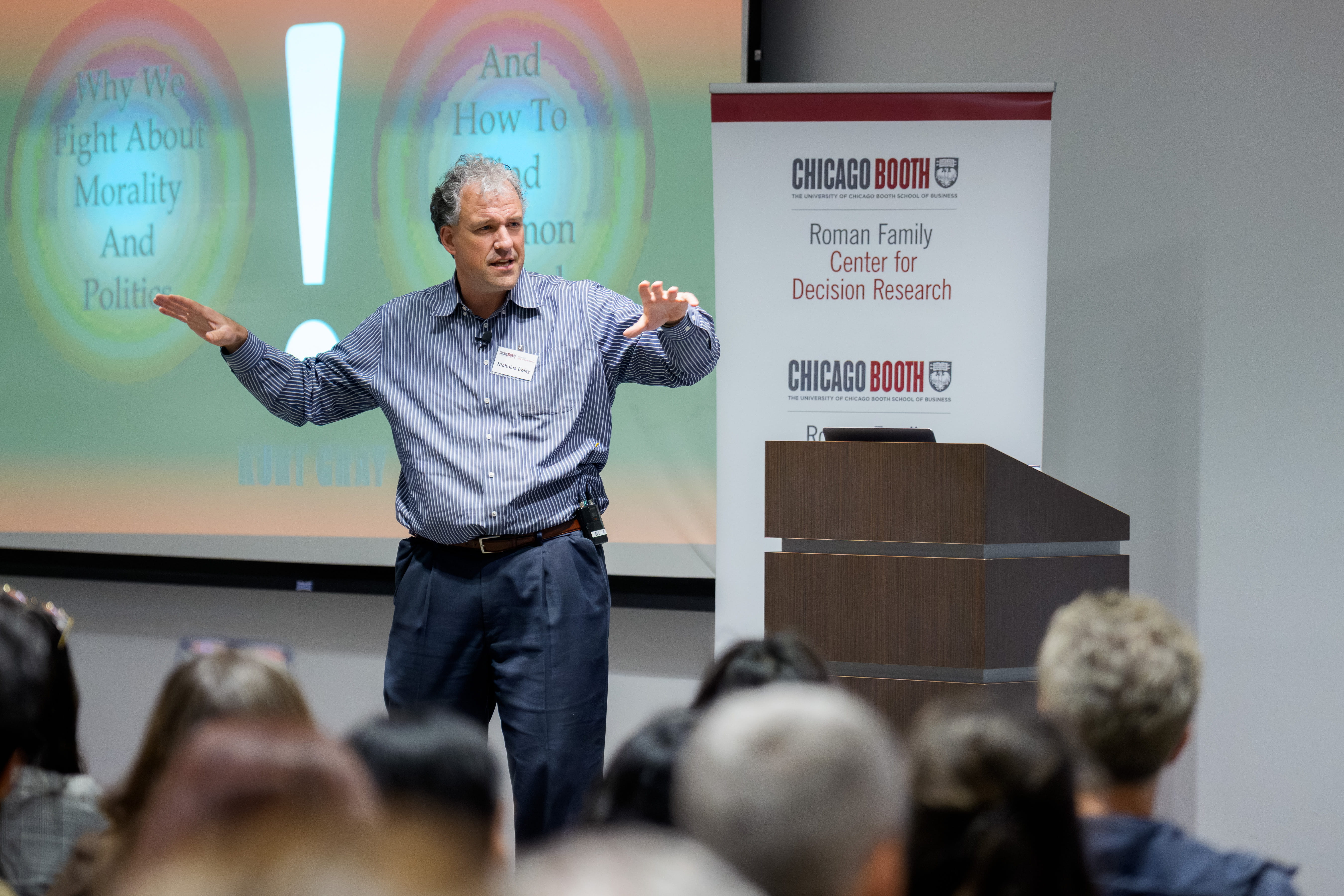
Opening and Introduction
The evening began with Nick Epley, Faculty Director of the Roman Family Center for Decision Research at the University of Chicago Booth School of Business, welcoming a crowd of attendees both in-person and over Zoom. Epley introduced Kurt Gray, a leading social psychologist from Ohio State University, as the night's featured speaker. He described Gray as a researcher who sees through complexity and brings clarity to messy problems, distilling difficult questions about the mind, morality, and social conflict into actionable insights.
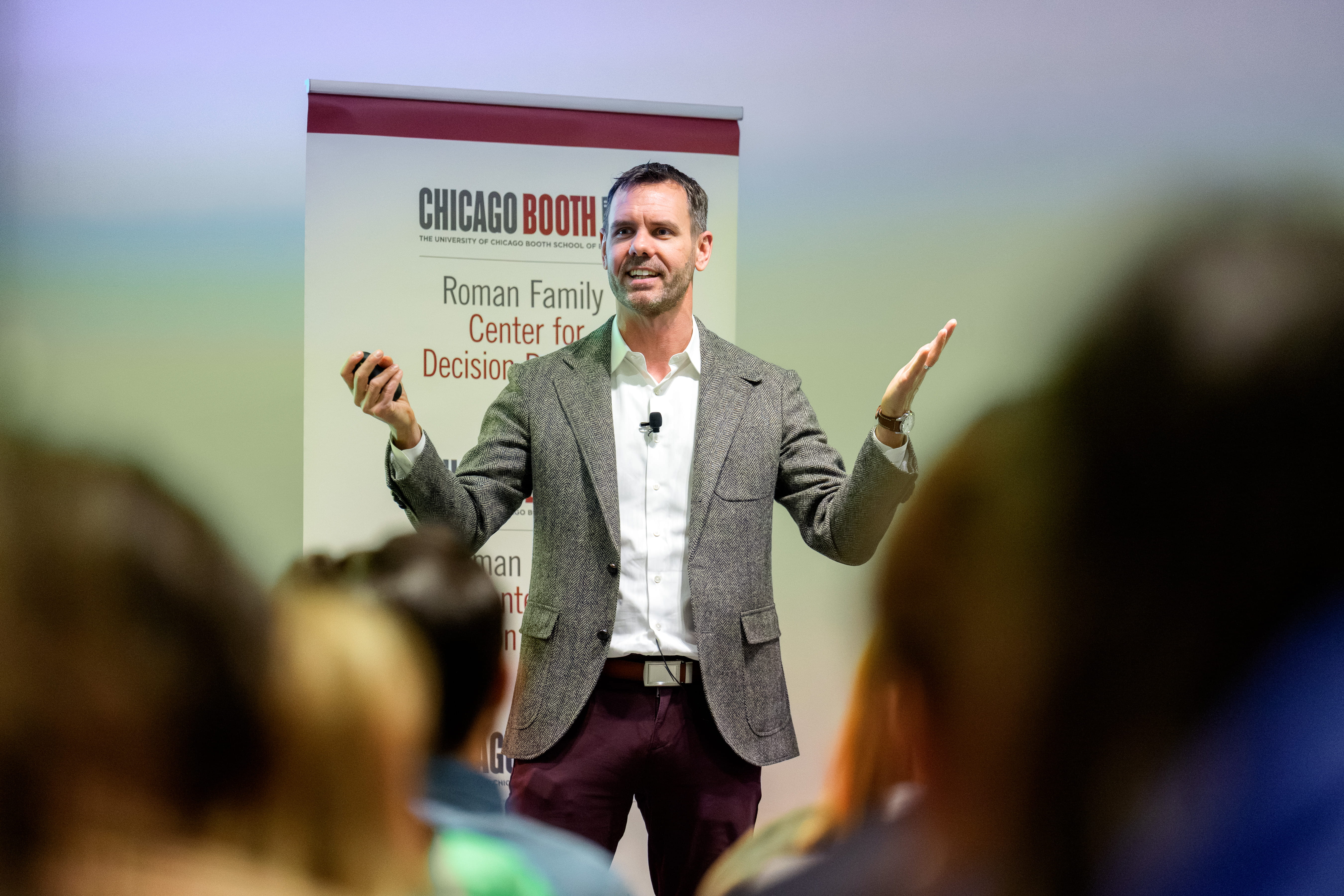
Examining Division in Society
Kurt Gray opened the talk by pointing out how divided our society has become, especially around politics and emotionally charged issues. He shared a study showing that dinners with people from different political backgrounds tend to end more quickly than those where everyone agrees. This simple example highlights how political division can affect our daily interactions. Gray used this finding to set the stage for a deeper look at why these divisions happen and how they shape our lives.
Gray structured his talk to address three main points:
- Why we fight and get outraged
- How the morality of liberals and conservatives does differ
- How to bridge divides and have better conversation
The Myths of Stupidity and Malice
Gray argued against two common explanations for why people clash over politics:
- The belief that the other side is unintelligent
- The notion that the other side acts out of hatred or malicious intent
He shared a classroom exercise in which people are asked to draw a bicycle and repeatedly fail to do so accurately, demonstrating that confidence does not mean genuine understanding. This humility, Gray argued, should extend to how we approach political and societal issues.
He also disputed the “destruction narrative,” which casts political opponents as wanting only to tear down society. Contrary to what social media often suggests, research reveals most Americans are part of an exhausted majority who simply want functional communities and peaceful lives, not perpetual conflict.
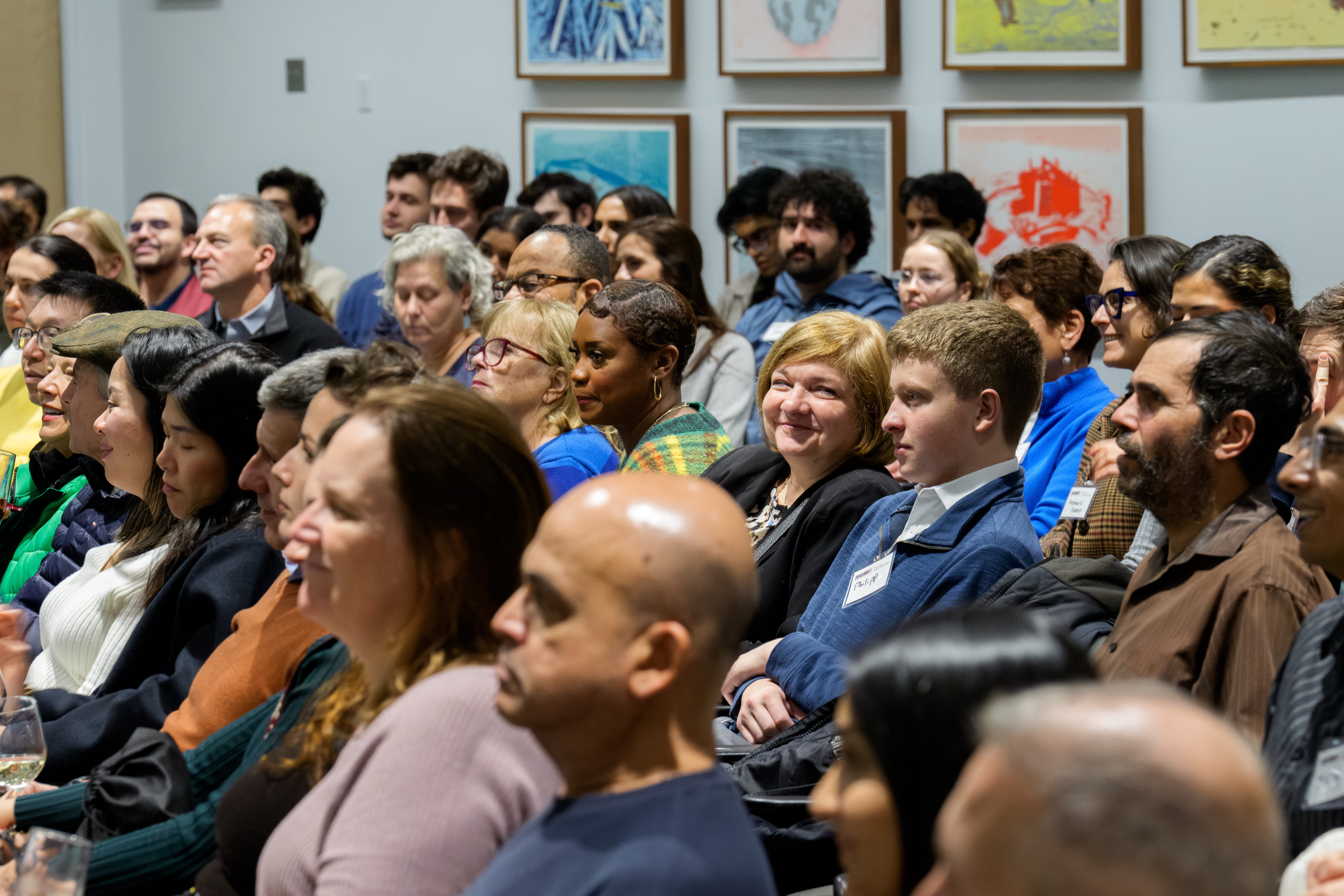
Understanding Outrage: The Role of Threat Perception
If neither stupidity nor malice is the true root of political outrage, Gray explained, we need to look deeper. The primary driver, Gray argues, is perception of harm and the human instinct to protect ourselves and those closest to us.
Gray presented an evolutionary perspective to buttress this, remarking on how humans have not always been apex predators but have instead spent much of their history as prey. This prolonged period of vulnerability has left us psychologically primed to detect threats, whether from unfamiliar people or situations.
He used contemporary examples: those who advocate for gun rights may be motivated by fears of a home invasion, while those seeking stronger gun control may be motivated by fear of school shootings. Both groups wish to prevent harm; their disagreements revolve around which threats they consider most urgent.
The Core of Morality: Harm Perception and Vulnerability
Gray explained that much of American political debate centers on who we see as vulnerable to harm. He outlined four broad groups often at the heart of these disagreements:
- The Environment (rainforests, coral reefs)
- The “Othered” (undocumented immigrants, marginalized groups)
- The Powerful (corporate leaders, law enforcement)
- The Divine (God, religious texts)
People’s beliefs about the vulnerability of each group influence their political views. For example, liberals tend to view the environment and marginalized groups as especially at risk, while conservatives are more likely to see the powerful and the divine as needing protection. This difference shapes stances on issues like environmental policy and taxation.
Survey data back up these trends, showing that liberals focus more on group-based harm, whereas conservatives emphasize personal agency and equality. Ultimately, these contrasting perspectives reflect deeper differences in how each side thinks about power, fairness, and who bears responsibility in society.
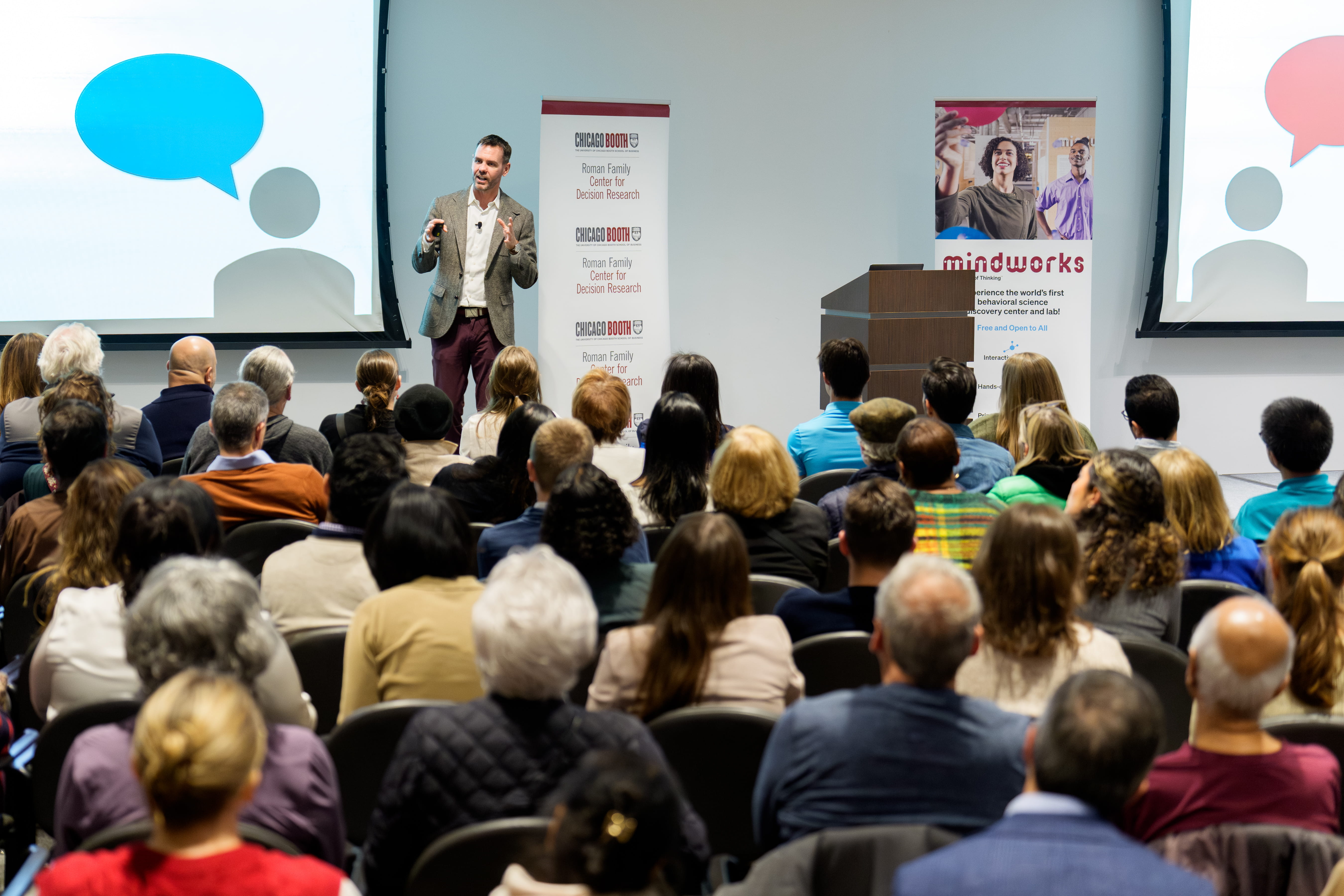
Moving Beyond Facts: The Power of Stories
Gray discussed strategies for resolving moral and political conflicts. Despite widespread belief in the power of facts, he explained that data and statistics rarely foster understanding or respect across divides. People tend to dismiss facts that do not align with their worldview, especially in an age of competing information sources.
Instead, Gray argued for the value of storytelling and personal experience. His research shows that conversations grounded in narratives of harm or protection are rated as more respectful, positive, and supportive than those that rely solely on factual argumentation. This pattern holds true in casual conversation, television interviews, and even in hostile environments such as internet comment sections.
Gray shared the concept of CIV for productive (CIVil) conversation:
- Connect by asking open, thoughtful questions and finding common ground on topics outside of politics.
- Invite others to share their personal perspectives and experiences, making it clear that the goal is understanding, not debate or persuasion.
- Validate by genuinely listening, expressing appreciation for their willingness to share, and showing grace when conversations become uncomfortable or awkward.
Conclusion: Behavioral Science for Bridging Divides
Gray’s talk made it clear that, from a behavioral science perspective, our moral and political divisions come down to differences in how we see harm and vulnerability, rather than ignorance or malice. He pointed out that most people are simply trying to protect themselves and those close to them, not aiming to hurt others. Gray encouraged everyone to approach disagreements with humility, curiosity, and respect, especially when conversations get tense. He explained that sharing personal stories and connecting over common experiences can help build empathy and make dialogue more meaningful. By taking these steps, he suggested, we can create more understanding and civility in our everyday interactions, even when the issues are tough.
The Think Better Speaker Series continues to bring these lessons to a wide audience, demonstrating how behavioral science offers not only insights into society and policy, but concrete strategies for improving everyday lives and bridging the divides that shape our world.
Related resources & links
- Think Better Speaker Series
- Mindworks
- Take paid studies online in our Virtual Lab