An Introduction to Nudges
If you have scrolled through Etsy or a similar platform recently, chances are you have come across a listing written not for you, but for an AI agent, likely without noticing. The internet was inherently built for human navigation, but no longer are we its only audience. AI agents now recommend products, browse listings, book travel, and make purchasing decisions, often with minimal human oversight. In an economic sense, they are becoming new decision-makers. Consequently, the question surrounding online behavior has evolved: if you can strategically alter human behavior, can you do the same for a machine? If so, is it already being done?
Every day, we make hundreds of small choices; behavioral economics has long held that those decisions are not made in a vacuum. The way choices are presented fundamentally shapes them: put healthy food at eye level, make retirement savings opt-out instead of opt-in—small shifts in the environment can move behavior in a desired direction. In 2008, Richard Thaler, an economist at The University of Chicago Booth School of Business, gave this a name: nudges.
For decades, nudges have carried one implicit assumption: the decision-maker is human. However, that assumption is no longer guaranteed to hold.
Booth researcher Kawin Ethayarajh with Research Professional Giulio Frey are asking whether the same subtle environmental shifts that influence humans are already being applied to machines. To answer that, they introduce a new concept to build upon Thaler's: mecha-nudges, changes to how choices are presented that systematically influence AI agent behavior without degrading the online decision environment for humans.
Etsy Shop or Research Lab?
To analyze the evolving online landscape, Ethayarajh and Frey turned to Etsy for its human-to-human ethos. Etsy is defined by independent sellers, handmade goods, and a uniquely personal connection that is established between buyer and maker. Yet seller forums were already full of people anxious about AI, debating how to optimize for automation. Etsy was also uniquely exposed to AI agents, as a large share of its referral traffic comes from ChatGPT alone. The intermediary was removed altogether when Etsy became the first live platform that allowed users to buy products directly within the ChatGPT interface.
The researchers analyzed over six million listings, spanning before and after ChatGPT's release in November 2022. To measure something as subtle as AI optimization in product descriptions, the researchers bridged two frameworks: the economic concept of Bayesian persuasion—which explores how controlled information can influence rational decisions—and the computer science notion of V-usable information, which measures how much information in an environment is accessible to a given family of models, resulting in a common unit of measurement: bits of usable information.
The core finding was significant. Machine-usable information in listings increased by 0.143 bits after ChatGPT's release, over 40% of the maximum possible increase. The temporal pattern told its own story: a spike in usable information after launch, then a dip consistent with sellers realizing LLMs were pulling from training data rather than live listings, followed by another spike when ChatGPT Search launched in 2024 and was able to browse listings in real time. The market adapted twice, with a small, non-significant decline in human-usable information. For now, there is no notable tradeoff
Key Takeaways:
Explore the key takeaways from the research — click each finding to learn more:
▶ Mecha-nudging is already happening at scale.
The possible motivations behind the shift are varied, including deliberate optimization, imitation of successful sellers, and the habit of treating LLMs as a proxy for human buyers. Whether intentional or not, the result is the same: a measurable change in how information is presented to AI agents in a digital marketplace.
▶ The effect is consistent across AI models.
OpenAI’s ChatGPT, Google’s Gemma, Alibaba's Qwen. Models trained on different data by different companies behaved nearly identically. Ethayarajh found this particularly intriguing, as it suggests something structural about how these models process information rather than anything idiosyncratic to just one system.
▶ Domain-specific differences in patterns.
Art and collectibles showed almost no mecha-nudging effect. Sellers in categories where buyers are sensitive to AI involvement held back, displaying a kind of market-aware restraint that was nuanced and domain-specific.
▶ The words that make machines predictable aren't the ones you'd expect.
"Junk," "scarce," and "oddities" made AI agents more predictable. "Cheery," "radiance," and "sincere" made them less so. The machine is susceptible to both signals of market value and affective language, displaying both rational and human-like behavior simultaneously.
▶ A deployment feedback loop is now in motion.
As AI agents become consequential readers, the environments they read get optimized for them. Model behavior in the wild is no longer shaped only by developers; it is shaped by everyone who writes for the web.
The Language of AI Influence
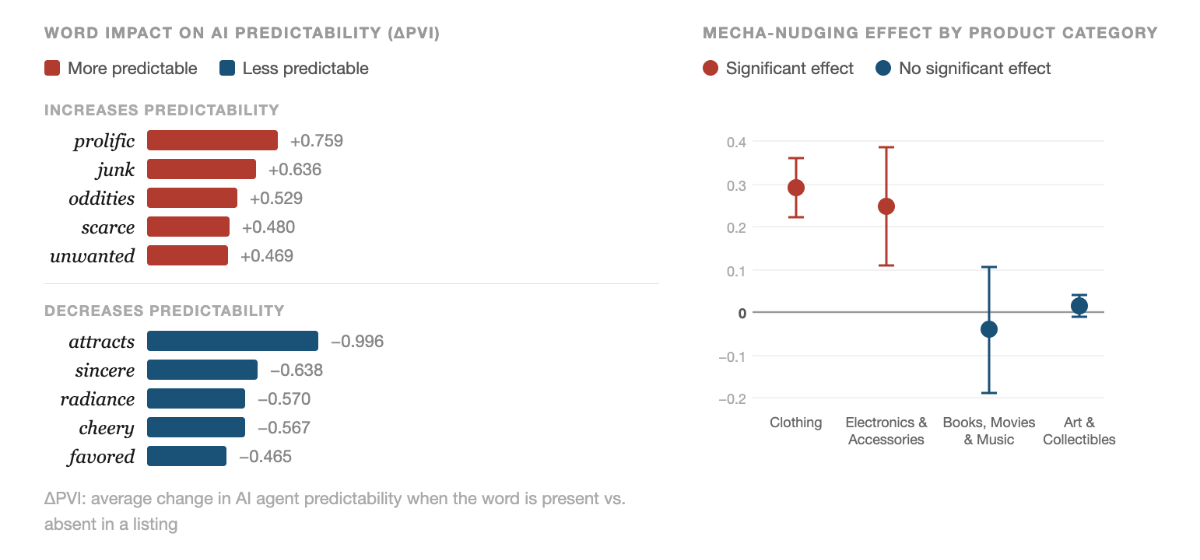
Left: Words ranked by their average impact on AI agent predictability (∆PVI), drawn from established NLP sentiment lexicons including the Opinion Lexicon, VADER, and Empath. A positive ∆PVI means the word makes the agent's curation decision more predictable when present; negative means less predictable. Bar lengths are proportional to effect size (max: 0.996). Right: Product categories where human buyers are ostensibly sensitive to AI use — art and collectibles, books and music — show no statistically significant mecha-nudging effect. Generic consumer categories show strong effects. Dots show OLS point estimates; error bars show 95% confidence intervals. Source: Ethayarajh & Frey (2026), Mecha-nudges for Machines, over 6 million Etsy listings.
A Shifting Landscape
The findings establish a striking pattern. As agents conduct a growing share of online activity, the incentive to optimize for them is also growing. Ethayarajh describes the longer-term risk as gradual disempowerment: not a sudden shift, but a slow ceding of relevance, until the environment is pointedly oriented towards AI decision making processes.
Mecha-nudges are already in practice, giving a name to a process that until now, has gone unmeasured. The framework Ethayarajh and Frey introduce is a way to track a shift that is intertwined with the rapid development of AI. The internet was built for humans to read. But the online environment is being silently reshaping around a different kind of reader, in the text of product listings, that most people scroll past without a second thought. That is the conversation Booth researchers have just begun, and it prompts consideration. Who is the internet being developed for—humans or AI? What will continue to happen as AI becomes an increasingly active participant in the digital spaces we built for ourselves? Only time will tell.