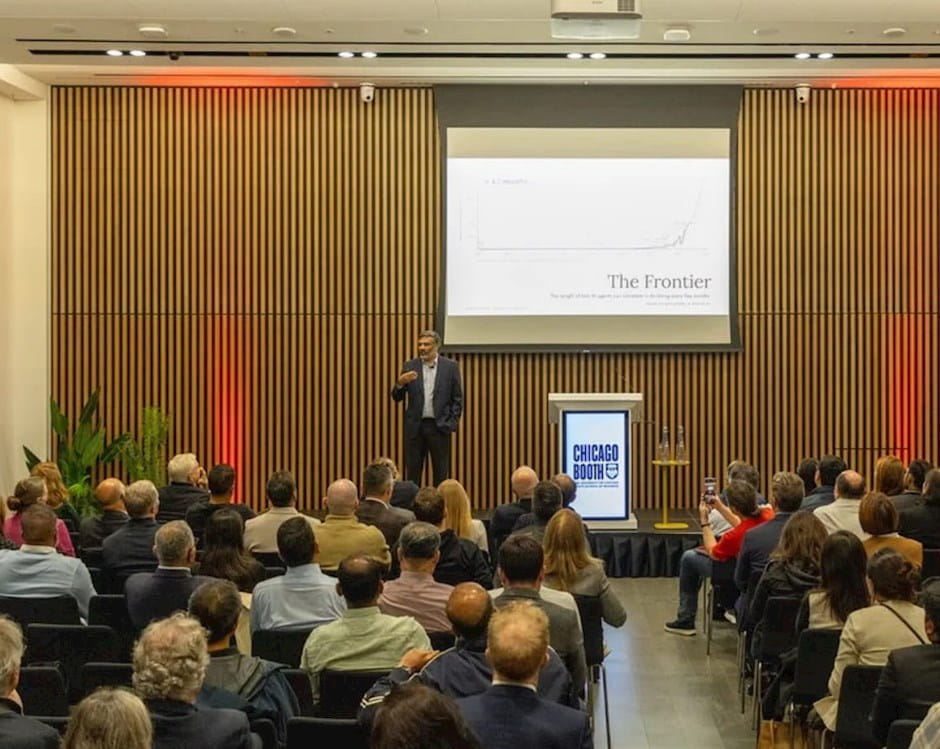
At Booth's London campus, Sanjog Misra highlighted how markets, firms, and work change when AI agents evolve from tools to being active participants that negotiate, decide, and act on behalf of people and organizations at scale.
What happens to markets, firms, and work when AI agents are not just tools but active participants that negotiate, decide, and act on behalf of people and organizations at scale? What could this shift mean and what might it require of leaders today?
On October 7, the Center for Applied AI co-hosted a Faculty in Residence talk with Sanjog Misra, Charles H. Kellstadt Distinguished Service Professor of Marketing and Applied AI and Faculty Director of the Center for Applied Artificial Intelligence at Chicago Booth. His talk, 'The Agentic Economy,' examines what happens to markets, firms, and work when AI agents are not just tools but active participants. They negotiate, decide, and act on behalf of people and organizations at scale. Professor Misra unpacks what that shift means and what it requires of leaders today.
"Artificial intelligence is advancing and evolving faster than any technology humans have created," said Misra. "This pace of change comes without a playbook. In only a few years, AI has moved from generating content to exercising judgment and taking action on behalf of people and organizations. The technology is no longer simply supporting work. It is beginning to participate in it. The challenge for today’s leaders is not simply to adopt AI, but to determine what role it should play and what new forms of value it can make possible."
View Misra's full discussion below.
The concept of the agentic economy has become a lens through which to view new iterations of artificial intelligence and its impacts to business, markets, and society. Economists often think of the economy as an interconnected collection of games. Consumers, firms, workers, and governments have different objectives and act on different information. Outcomes arise from their interactions within the rules set by markets and institutions. Usually, the identity of these players is treated as given. AI agents change that starting point. Players in an agentic economy will increasingly take the form of human-AI hybrids. In some cases, AI will provide information or advice while a human retains control. In others, agents will act with little or no direct human supervision. Economic interactions will therefore take place among entities that lie along a continuum, defined by how judgment and authority are divided between humans and machines.