

Clara Choi (MBA '27) Reflects on How to Grapple with Changing Technology.
- June 21, 2026
- Center for Applied Artificial Intelligence
TechCon 2026 was the result of more than four months of collaboration with my fellow TechCon organizing team. As the lead of our team’s marketing efforts, my goal was to shape how attendees engage with the conversation, connect with it on a personal level, and find value in it. This meant being intentional about how we framed the theme and curated the right mix of voices into a cohesive experience.
Throughout the process, we centered on one question: how is technology becoming embedded in daily life, and how can we present this topic in a way that resonates with today’s leaders?
This question led us to the theme “Co-existing with Technology.” Rather than asking if technology will transform our lives, we explored how it is already shaping decision-making, product development, and institutional impact.
Other panels dove deeper into nuanced subjects like AI governance, hype versus adoption, entrepreneurship and strategic building with AI, platform, product, and portfolio development, and technology as it relates to social welfare. We were grateful to hear from panelists across different areas of industry, including leaders from companies such as Google, Waymo, NVIDIA, Capital One, Cisco, LinkedIn, Amazon, TRON DAO, WovenX Health, and NEAR Foundation. Together, we discussed how to better understand where technology fits and where it creates value.
Our keynote speaker, Ram Katuri, emphasized that historical revolutions have not been driven solely by technology. Instead, they are shaped by systems, infrastructure, education, and human judgment, which collectively enable meaningful adoption. Real change requires support from multiple sectors of society.
Ludmilla Lomba, one of the Outreach leads of TechCon insightfully shared: “One of the most impactful sessions for me personally was the keynote presentation by Ram, AI and Digital Transformation Leader Senior Principal from Google Cloud. Earlier this year, during BoothHacks, my team and I launched an AI project focused on agentic systems at a moment when the market still felt highly fragmented and difficult to interpret. There was enormous excitement around agents, but also enormous ambiguity. Much of the conversation felt speculative, abstract, and disconnected from operational reality. Ram’s presentation helped ground many of those ideas in a much more concrete way.”
Attending Booth Hackathon was also an instrumental experience for me. Using vibe coding to build a product I had wanted for a long time was a particularly meaningful moment, and it gave me more tangible understanding of how rapidly AI is evolving. The technology now allows people to build without a traditional technical background, which could become a significant shift in the business world. Entrepreneurs are now able to prototype, build, and visualize ideas in ways that were previously far less accessible.
This idea continued to resonate while moderating the “Entrepreneurship and Building with AI” panel, where what stood out most to me were the often-overlooked areas where real value is quietly being built.
Panelist Elliot Braem noted: “Defensibility in AI rarely comes from the model itself. Instead, sustainable advantage depends on distribution, user access, and the ability to learn continuously from real-world use. Building and activating user networks early remains one of the most critical aspects of creating long term value.”
Again, what this brought me back to was the idea that building with AI ultimately ties back to the users, the people who will interact with these products in their daily and professional lives. What resonated with me most was the idea that lasting products are built around communities, behaviors, and culture that form around them. This reflection also brought me back to the role of business leaders in bringing people together.
A class at Booth, “Strategy in the Era of AI and Technological Disruption” taught by Professor Gary Silberg, gave me significant insight into the type of leader I want to become in this era. We spoke with founders, investors, and product leaders working in AI and learned how they navigated ambiguity while building in spaces where there was no established path to follow.
One speaker who particularly stood out to me was Don Burnette, Co-founder and CEO of Kodiak Robotics. His work applying AI within the trucking industry introduced me to a completely new perspective, and the concept of different industries operating at different “clockspeeds” when absorbing technological change became one of the most important ideas I took away from the class.
I learned that being a leader in a fast-changing world requires both courage and intellectual humility. Building on that, I believe it is important to remain humane in understanding people and communities, while also allowing space for both ourselves and others to learn through failure and uncertainty. The questions of purpose and accountability are ones technology cannot answer on its own.
TechCon reinforced for me that the future will not be shaped by technology alone, but by the people willing to guide it with responsibility and heart. That is the core of what it means to coexist with technology.
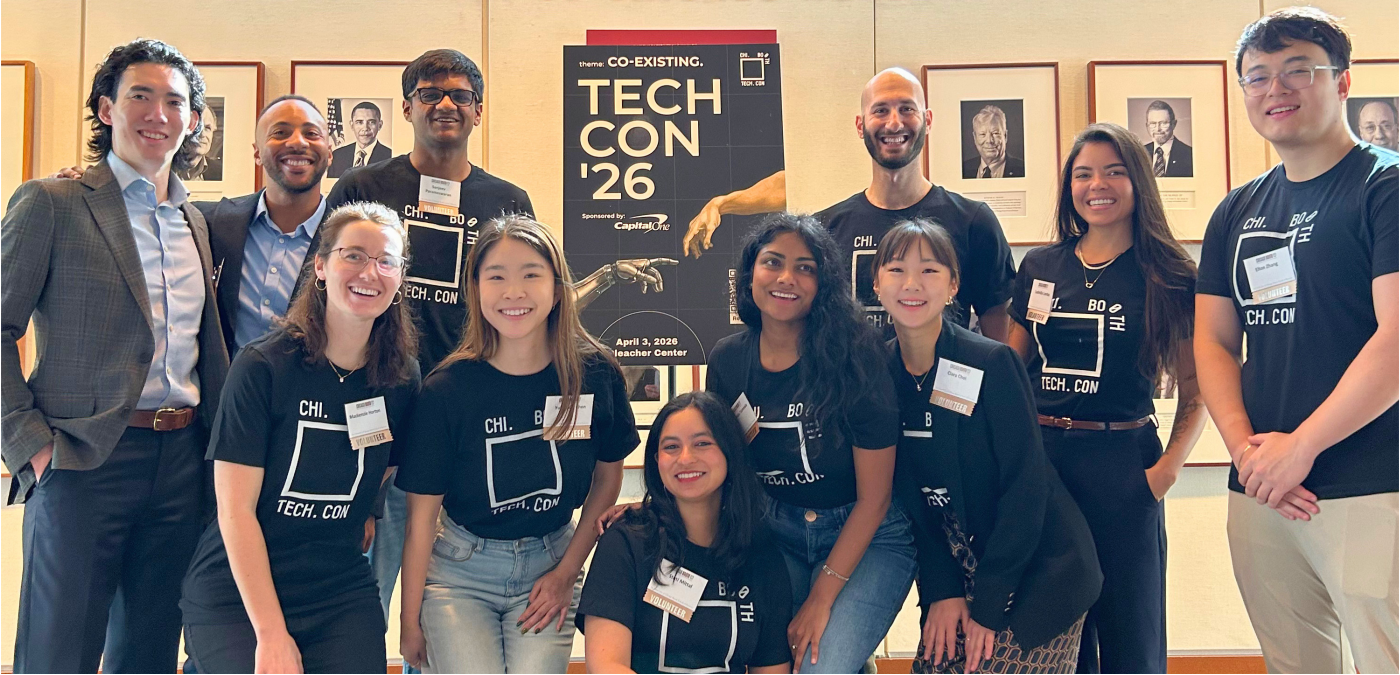
Beyond bringing together students from across Booth for a common cause, the theme of our event led me to reflect on my own personal ways of coexisting with a changing world. Our teams across Co-Chairs, Finance and Sponsorship, Marketing, Operations, and Outreach came together to shape the conference from different perspectives and areas of expertise. Working closely with people who each brought unique insights on technology and execution became one of the most meaningful parts of the experience for me.
More than anything, TechCon reminded me that even conversations about technology ultimately come back to people: the communities we build, the ideas we share, and the ways we learn from one another. I want to express my gratitude to everyone who helped make this conference possible, and I would like to close with reflections from my fellow TechCon organizing team members.
Seth Konner: “The Tech Conference was an amazing experience to be a part of. As operations chair, seeing everything come together and seeing people engage with all the speakers while learning about new ideas, methodologies was very rewarding! Being a part of an event where real connections and ideas got shared was great. With so many diverse perspectives, the speakers really make you think introspectively about your future role in the workplace and how you can make the most impact!”
Ludmilla Lomba: “As part of the TechCon organizing team, the areas I, together with other outreach leaders, Ben Hursh, Joe wang and Ryan Woods, helped lead was speaker outreach, panel theme development, and question design. Throughout the planning process, one of our biggest priorities was ensuring that the real concerns students currently have about AI, careers, and the future of work were genuinely reflected in the conversations happening on stage.”
Ryan Woods: “I loved being the engine of Tech Con, putting our heads and networks together to help curate a good event was a great feeling.”