

Think Better with Nicholas Epley
- By
- October 26, 2026
- Think Better Series
Nicholas Epley:
I want to welcome you all to the event tonight. Thanks so much for coming friends and colleagues and former students and folks. Friends I haven't quite met yet. So I'm looking forward to meeting with more of you after this event. I also want to welcome the folks who are joining us over Zoom and watching this over video. We'll do our best tonight to have you participate in this session as well, as best we can.
So the Roman Family Center for Decision Research is the home of the PIMCO Decision Research Labs. What we do here at the University of Chicago is we run all of the research infrastructure for the kinds of research that you're going to see in this presentation. I'm going to show you tonight. I'm going to show you lots and lots and lots of research of the kind that frankly is only possible to be collected at a place like this. It's very hard to do so at other places. We have amazing resources here.
We run four different labs. We have a pop-up lab that can run experiments anywhere in the city of Chicago. We have a lab on campus, just over here behind us at the Booth building at the Harper Center. So if you're an undergraduate or a graduate student here, would like to make a little bit of extra money on the side, come over and participate as a guinea pig. You'll enjoy it and make a little bit of money. We also have a virtual lab, an online lab, where we do some research. I'll show you some of that tonight as well.
And then also Mindworks, down on Michigan Avenue, which is right across from the Art Institute. It is the only space like it on the planet, a public facing behavioral science research lab. Come on in, learn something about your mind and win some swag as well, by participating in some research there. If you haven't been, it's well worth checking out.
This Speaker Series here, this Think Better Speaker Series is our effort to take the kind of research that we do in our research labs here that usually we're publishing in journals, occasionally in books, like the one that some of you have in your hands tonight, that I've written and try to present it in a way that's publicly accessible, to show you what it is we're doing in behavioral science that we think is interesting. That we think is important and meant to make the world a little bit better place.
This is the first Think Better talk of this year, but we have two more coming as well and I hope you can join us for those. I'm very excited about the next two that we have as well. Liz Dunn, a professor from the University of British Columbia will be joining us to talk about her new book, Leave the Lights On: How Joyful Decisions Can Save Our Species. She's a psychologist who studies happiness and wellbeing.
And then in the spring, on April 28th, Nir Halevy is going to be joining us to talk about his book on hierarchy and power called Level Up: Why Hierarchies Are Broken and How to Fix Them. So keep an eye out for those announcements. We will do them again live and also over Zoom. I believe both of those will be down at the Gleacher Center.
So what we do as behavioral scientists in our research labs are the same kinds of things that every one of you does in your daily lives. Everybody here is a behavioral scientist or a psychologist by birth. You look out in the world and you ask yourself two questions, the same kinds of two questions that we ask ourselves as well. One is why? Why the heck is all of this stuff happening? And the second question we often ask is what if? What if something was different? Would that matter in some way?
And I asked myself those two questions in a way that kind of changed both the way I live my life and my research career. One morning when I was on a train ride coming in from the far south side of Chicago, over here on the Metro Electric into Hyde Park. I take this train every single day into my office over at the Booth School.
And I'd been riding it at that time ... This would have been around 2010. I've been riding the train at that point for years already, every day and noticed things and so on. But this day I looked at it with eyes that were a bit afresh. I remember it so distinctly. I was in the midst of writing one of the early chapters in my first book titled Mindwise. And in those early chapters, I describe how we have a brain that's uniquely equipped for connecting with the minds of others. We seem to be especially good at engaging in social cognition. We think about the minds of others more than any other species on this planet that we know of. How we're made happier and healthier by reaching out and connecting with other people. How we live longer lives, in fact, when we're well-connected with other people.
And yet I sat there and I looked up on that morning and I had almost like a bat to the face kind of experience, where I noticed what seemed like a really painful paradox. And that is, here are all these highly social creatures sitting here on this train with brains uniquely equipped for connecting with each other, made happier and healthier ostensibly as I was ostensibly writing. Made happier and healthier by connecting with each other and yet you could've heard a pin drop that morning. There wasn't a single person talking to another person. Why? What the hell is going on here?
That struck me like a really interesting paradox. Why would highly social creatures like us choose to sit here by ourselves? Well, one possibility is that we know what's good for us and talking to strangers ain't it. It sucks. And maybe that's why people are keeping to themselves because we know, we know that connecting with other people works great in some context. Talking to family members, friends, building connections that are already rewarding, that's great. Strangers. No, thank you. Maybe that sucks.
Another possibility though is that maybe we're wrong about this. I've been studying for about a decade and a half by that time, all the ways in which we misunderstand each other a little bit and ways that can sometimes create social friction in our lives. So on that morning, I asked myself the question, what if, what if this was different? How would it go? Now there's just one person. I decided I'm going to experiment with myself on that train commute that morning. And so a woman that morning sat down next to me. I'll never forget this. She was in her mid 50s, roughly, I would've guessed. She was dressed very professionally for work. She had this amazing red hat on, that I'll never forget, it looked totally awesome. And she was also carrying this massive mom purse, you know the kind that looks like you're maybe moving out of your house in any moment. You got everything you could possibly need in there.
And she sat down next to me and of course, she wasn't talking to me and I decided, "Well, I'm going to try something different here. I'm going to turn her, I'm going to try to have a conversation. I'm going to try to get to know her a little bit." So at that moment, I felt all kinds of reasons why I shouldn't be doing this. My brain started screaming at me that this is a bad idea. All kinds of reasons not to do this. Clearly she doesn't want to talk to you. If she wanted to talk to you, she'd already be talking to you, so you shouldn't do this. She'll probably misunderstand why you're talking to her, maybe think you're a creep trying to hit on her or something. And besides, what do you have in common with this person, who's 20-ish years older than you from a very different walk of life? Just keep yourself, just stick to your phone.
But I didn't do that. Instead, I came up with an opening line, of course, it was brilliant. I turned to her and I said, "Hi, my name's Nick. I love your hat. I have one just like it." And she was polite in the way that you guys are right there. She laughed, she turned to me, and then we just started talking. And as conversations often do, it just unfolded pretty easily. Once we started paddling the canoe, the canoe started moving and it went along pretty well. We didn't have an earth-shattering conversation, in terms of the content that we talked about, although it was frankly earth-shattering for me and the impact it had on my research career and also on my own life.
We talked a little bit about what she did for a living. She wasn't real happy in her job. I remember her telling me, but she was raising some kids and so she needed to stay in the job until she could find something else that she wanted to do. I told her a little bit about the experiment that I had unwittingly enrolled her in without IRB approval. She thought people these days don't talk to each other so much because of the phones they carry in their pockets and such. That's a reasonable hypothesis.
By the time we got into Hyde Park over here, the time had gone just like that. I get up to leave and she ... As I'm stepping over the mom purse, she gets up a little bit and she holds my wrist on the way out and she says, "Thank you so much for taking the time to talk with me today." Of the serious kind, that was a better 30 minutes than it would have been otherwise. And I felt that way too. I felt that way too. And I was struck by two things when I walked off that train.
One was that wasn't just good, that was surprisingly good. And noticing that part is maybe something that as researchers, we're perhaps a little bit more inclined to pay attention to is that surprising part. It didn't just go well, it went surprisingly ... It was better than I thought it would be. The conversation was easier. It was smoother. We had more in common than I imagined it would. She was more interested in talking to me, once I actually opened up and said hello to her than she would be. And it's that contrast between my beliefs about how this would go and how it actually went that was striking to me.
And that gap matters because if I want to predict what you're going to do at any given time, I don't just want to know what your experience is likely to be. In fact, that's not very helpful. How do you know what it's going to be like if you haven't experienced this particular thing? I want to know what you think it's going to be like, what your expectations look like because we tend to behave in line with those expectations. And I would've gotten this wrong. My expectations would have led me to keep quiet when in fact that 30 minute trip was better when I engaged.
And then I remember thinking too, when I walked off the train that I think this might be something I'm doing a lot, not just a little bit but a lot because social connection after all isn't something that just happens to you. It's something you choose to do to some extent. You choose to do when you, for instance, walk into a brown bag seminar today and sit next to my friend and colleague Alex Todorov here, rather than sitting to myself, because you approach somebody or you keep to yourself. When you're sitting on a plane and you decide ...
The person's over here scrolling on their phone with their earbuds. Do I still try to say hello or do I hold back and avoid them? Once you're talking, you've got a choice to make. How deep do you go in conversation? Do you stick to small talk? Do I type to you? Do I pick up the phone and talk to you? I have a kind thought, do I pass it along to you, connect with you in that way? I feel grateful to you. Do I share it? I need help. Do I ask for it?
We're in a relationship. I need to be honest with you for our relationship to grow and develop. Do I tell you the truth? Do I tell you like it is or do I sugarcoat it and kick that can down the road a little bit more? This is something that we do a lot, I thought. But of course, I'm just one guy and who cares? What difference does it make? The answer is nothing. So a guy has a nice conversation on training. That matters nothing. Those are anecdotes, those are case studies. You can get your MBA in some places by studying those. Sorry, that's a joke we'll edit out of the video later.
But that's not what we do as researchers. As researchers, we want to run an experiment to see, "Is this something that's general to people beyond just me? Is this something that seems replicable?" So on average, this is an effect. This an effect. We see we need to run an experiment. And so that's what we did. So I went back to the train line that comes into Hyde Park here, the Metro Electric. I actually live in Flossmoor, the far south side of Chicago. We couldn't run it there because the train situation, it's an above ground platform. It's cold in the wintertime, so we couldn't run it there. You don't want to freeze your research assistance to death, word to the wise. And so instead, we ran it in the Homewood Station, which is the train station just to the north. There's an underground entrance. And we recruited people for a commuter survey and we asked them ... We randomly assigned them once they had agreed to participate in the experiment, and that's important. We asked them to do one of three things on the train that morning.
One condition, we told them to just keep to yourself, just enjoy your solitude, just focus on your day ahead. Second condition, we asked them to just do whatever you normally do, which is mostly keep to yourself. Third condition, we told them to do something kind of radical. We told them when somebody comes and sits down next to you, do what I did on the train that morning. Try to have a conversation with this person, try to get to know this person a little bit, try to make a connection. We then handed them an envelope, sent them on their way with a five dollar Starbucks gift card, as thanks for participating in the experiment.
And then at the end, they pulled that out and they told us essentially how the commute went. We had a number of different questions there. The first three were the ones we really cared about. We asked them essentially, how positive was this commute? We asked them how happy did you feel after the commute, how sad, and also how pleasant was the commute compared to normal? We reverse scored the sadness item and averaged it into a composite. And then we can find out what happened across these three conditions. Did talking to a stranger suck? Was it unpleasant? And the answer is no. In fact, it didn't suck.
Those in the connection condition actually reported having the most pleasant commute, whereas those in the solitude condition reported having the least pleasant commute overall and those in the control condition were roughly in the middle. So that's interesting. It didn't look to be, at least in this one case, that reaching out and engaging with a stranger was unpleasant. That's kind of consistent with decades and decades of research in psychology. This shouldn't have been a surprise to me. But then it raises a question, if that's true, why are the trains completely silent? Why does nobody talk?
It could be that even though this is in fact pleasant, if you don't believe it will be, if you believe just like I did that morning. She doesn't want to talk to you. You got nothing in common with her. The conversation isn't going to go very well. She's going to misunderstand why you're engaging with her. You wouldn't try it and you wouldn't ever find out you were wrong. So to find out if that might be going on, people's expectations might be creating a barrier to reaching out and connecting with somebody else. We ran another experiment where we told them about these three conditions and had them predict how they would feel in each of these three conditions. Now that's not assessing how people actually feel, of course, that's me measuring how they think they would feel, but that's the kind of thing that predicts people's behavior.
And when we did that, this is what people thought ... How people thought they would feel on their commute. They thought they would in fact have the least pleasant commute in the connection condition and the most pleasant commute in the solitude condition. Their expectations weren't just wrong. They were backwards. But notice if you had those expectations, you'd almost never talk to somebody sitting on a train. Rarely would.
It's not just on the trains where we see this. We've replicated this now in lots of other places. After this, we went to the buses in downtown Chicago. If you think there are weirdos on our trains in Chicago, try riding some of our buses. And yet, we see exactly the same pattern of effects here, experiences that run counter to people's actual expectations. And again, why does this matter? It matters because these figures on the right here, those expectations are the things that we live our lives by. And if those are off for some particular reason, in some particular context, we might not be living as wisely as we could be.
Former Nobel laureate and my former colleague at Booth, Gary Becker said in his Nobel Prize winning address, he said, "The rational analysis assumes that individuals maximize welfare as they conceive it, their behavior is forward-looking." And indeed, on this definition, people are behaving rationally on the train. They're behaving in line with their expectations. They are looking ahead and anticipating ... They're maximizing their wellbeing as they conceive it. It's just that their conceptions are off. Rationality doesn't necessarily require omniscience. It requires consistency, people are being consistent.
This experiment proved for me just to be the tip of what was a massive iceberg. We have now for the last 15 or so years, since this first experiment. We've now published more than 120 experiments involving more than 30,000 people and counting. I was working on one, in fact, today. And we'll get back to it tomorrow. And we've observed this kind of phenomena over and over and over again, not in every circumstance because these effects are predictable and we now understand to some extent why these emerge, which also allows us to understand the context in which they won't emerge. It allows us to predict variability. And that's when you really understand something. When you understand why something happens, you can predict how it will vary across different contexts.
And the insight that really has been driving all of this research is this one, which is that social connection is in part a decision making process. It's a decision making problem. It's a choice you make. Not always, but often. That's at least the margin that we have to drive our own lives a little bit. And it's a choice that we make in lots and lots of different contexts, decide whether to reach out to somebody, how to reach out to somebody, what to do when we're reaching out to someone. Do we say hello? Do we talk to a stranger? Do we reach out and express support to somebody in need? We're in a relationship. We need to talk about that hard thing. Do we choose to actually have that conversation, to talk about that hard thing or do we hold back and avoid it? Do we discuss things that we disagree with? We're in the throes of massive division ostensibly in the United States. Do we talk about some of those hard things that divide us or do we hold back and not talk about them?
Once we've decided to engage, we have to figure out how to do it. What's the best way to do it? Modern technology gives us choices our ancestors never had. We now have to decide, "Do I talk to you or do I lean back and type to you." Do that with anybody around the world? Do I interact with you in a context that actually involves a real interaction, where we go back and forth in live dialogue or do I post a monologue on Facebook that you then respond to over here in some way as much social media is moving to? Do we go deeper in conversation? Once you're having a conversation, do you stick to the shallow end of the conversation pool or do you go deeper?
There are lots of different ways in which psychologists have learned, we can increase our wellbeing by lifting other people up in some way, connecting with them in a way that lifts them up and makes them feel better than they might otherwise, not just civil or deep or meaningful conversation, but do you share kind thoughts? Do you pass along a compliment? Do you feel grateful to somebody. Do you share that thing? You need help. Do you ask for it? Allow that person to be kind to you in some way. Do you perform an act of kindness for somebody? All of these tend to increase our wellbeing and yet these are all choices that we choose to make.
And over and over again, we have found predictable, I think reliable and robust gaps across these different contexts that emerge in predictable places. And what I'm going to do tonight is to try to explain why these things show up, try to answer this question and have you think about, what if you did something differently? What if you lived your life a little bit differently? No research I've ever been involved with has changed the way I live my life more than this. Once you learn about this work, it changes the way you see other people. It changes the way I think you see the opportunities that you have to enrich or improve your life because you notice things you were missing before. So I'm going to ask you to think about tonight, what if you did things a little bit differently?
But I'm going to start by going deep into one line here that we've actually collected probably the most data on just because they're the easiest experiments for us to do. And so we've got a ton of data here. So I'm just going to walk you through one of these in particular, this one here about what happens when we go deeper in conversation. What happens when we go deeper? Now, I've done this in lots of different ways. How many MBA students do we have in here who have done the orientation event with me? all those hands here are going to be in this data that I'm going to show you in just a minute. So I've now done this with many, many, many, many different people. A little over 6,000 people. And here's the way this goes. All of our incoming MBA students at the University of Chicago's Booth School of Business now do this with me as part of their orientation session and they have for the last five or so years.
What we do, second day of the orientation is I put up some questions on the board and I tell them, "In just a minute, I'm going to pair you up with another person in this room to have a conversation about these questions." If I were to become a good friend of yours, what would be most important for me to know about you? What in your life do you feel most grateful for? Please tell me about it. And can you tell me about one of the last times you cried in front of another person? Now for the Booth MBAs, when I do this with them, I add another question. I add this question, "What do you feel most anxious about right now starting this program at Booth?"
And when I put these questions up on the screen, you can imagine ... I was going to do this to you right now. How are you feeling about this? This is mostly how people feel. They have a momentary heart attack, everybody's looking for the exits, kind of wishing they hadn't come today. Not sure that they really signed up for this, but here they are. We batten down the hatches. Before they go off into their conversation, I go back to the moment that I had on the train. The moment when you are actually making the choice to reach out and engage with somebody or avoid it, you're deciding, "Do I actually do this or not?" Before they go into the conversation, I ask them to predict how they think they're going to feel in this conversation.
And then at the end, they come back and they tell me how they actually feel. So they report how they think they're going to feel. I then pair them up, send them off. Then we struggle desperately to bring everybody back, who has wandered all the way around campus or elsewhere, depending on what the venue is. Then they come back, tell me how they actually feel. Here's what the results look like. This is just a simple demonstration experiment here. I've now done this with about 6,500 people. And these are all kinds of different folks, ranging from high school students at a boarding school in Indiana, to senior citizens at a retirement center up in Milwaukee. Employees and executives and massive financial services firm, human resources firms.
I did this at a big market research conference in downtown Chicago a while ago. A couple weeks ago. I was at the Teach For America annual summit, their conference. I did it there. I've done this for international construction firms, lots and lots and lots of different folks. And this is what it looks like. They answer these questions, tell me how they think they're going to feel and how they actually feel on scales that go from 0 to 10, not at all. This thing or to variant and a lot of this thing. And these are their expectations here in these black bars.
They think on average across all these folks, it's going to be sort of moderately weird, going to feel moderately awkward. They're going to feel a somewhat strong bond. They're going to like the person somewhat, enjoy it a little less than they're going to like the person and have kind of a moderate amount in common, not a ton. There's a lot of uncertainty here. Not quite sure how this is going to go. When they come back, tell me how it actually went. This is what they tell me. It turns out, it's not nearly as awkward as they think, feel a stronger bond than they thought they would. They liked the person a lot more than they thought they would. They thought it was going to be around a six here on the 0 to 10 to scale. It's more like an 8 or a 9. They actually enjoyed it a lot more than they thought they would and they have more in common than they thought they would.
These gaps are not small, in terms of effect sizes. Many of the effect sizes that we observe in the behavioral sciences corresponds to an effect size of 0.2 or 0.3, maybe 0.5 is pretty big and that describes how big the difference between means are relative to the standard deviation around those means. So it's about half a standard deviation is a big effect. These are effect sizes that are closer to two or three, that the means differ by two to three standard deviations from each other. These are big effects.
And this is how this pattern looks. If you look across people's expectations in the black line here, compared to their experiences in the red and what you see ... And this has to happen whenever you get a mean level bias of the magnitude that I showed you, the people that are the most mistaken here are the people who are most pessimistic to begin with. People who have been most likely to avoid it to begin with. If we just ask people directly how they felt about it, were you surprised by this? And so I asked them, how did this go compared to your expectations as expected, much worse than expected or much better than you expected on the scale that goes from minus five to plus five? And here's what I see across ... I didn't give this to all 6,000 folks, this is about 5,300 folks. And this is the response I see.
Not everybody has a great time. Some people are disappointed by this. In fact, about two percent of people are disappointed by this. But overwhelmingly, this goes better than people thought it would. They report feeling surprises. They can report on this directly. All of life is a gamble, folks. You're having to bet on the outcomes of your choices. This is not much of a risky gamble, that leaning into this particular conversation a little bit more will go pretty well. And why does this matter? It matters, I think, because our beliefs about the world, our expectations about the world guide our choices. Those black bars that I showed you a moment ago is what we live our lives by.
And so for a good chunk of them, about 3,000 folks. I asked them beforehand, "What would you rather do right now?" So after filling out all the survey items. I asked, "What would you rather do right now? Have this conversation or take a break." About 34% say, "I don't want to do this right now. I would rather go to the bathroom, please." Now you can imagine what would happen if I actually allowed them to do that. A third of the class would up and leave, probably another third would follow and we'd be left with just a few super friendly folks. That's not what we allow them to do, of course. Instead, we have everybody do this. When they come back, I then have them tell me, "What do you wish you would have done? Do you wish you would have had a break just now or do you wish you would have had a conversation? And when they come back, only about seven percent say they would've preferred a break. This is across everybody.
These numbers, by the way, bounce around a fair bit. Up and down, depending on the audience that I have. So when I was ... You'll see that in a moment when I show you some online data. When I did the market research conference downtown, 63.5% of those people said, "I don't want to do this. This is not what I signed up for. I would rather take a break right now." When they came back after that, only 15% of folks did. In general, my MBA students are among the more excited to talk. Usually about a quarter of them say they would, rather take a break.
Now, lots and lots of questions we can ask. This is just a demonstration, kind of an experiment, lots of different explanations for why this might happen. We're asking lots and lots of questions about our research now, beyond even what's in the book that I put together to describe this 15 years of research. One question we're starting to ask is, how does this show up in places where you might imagine that there's some variability? How does this show up around the world? One thing I should say before we continue, we know something about how this varies across people, across individuals. There are extroverts and introverts in this sample and maybe folks who are extroverted enjoy these experiences more than introverts do. And the answer to that is yes, that's right a little bit, but extroverts also expect that they will enjoy it much more than introverts do. Such that the gap between expectations and experiences, if anything, is larger for those who are more introverted.
Extroversion and introversion predicts people's beliefs and expectations better than it does their actual choices, if we see any effect at all. But that gap is constant or bigger among introverts and extroverts, but we can ask them. What happens around the world. Maybe you go to some parts of the world, places where people seem to be a little more shy, maybe a little more reserved, a little less extroverted perhaps. Maybe we see different patterns of data there. Does this replicate? Does this seem to be robust? With one of our PhD students, Nick DiMaggio and Thomas Talhelm, one of our former faculty members. We went to China. In fact, we went to Thomas' lab in Wuhan, China. A City you might have heard of. We went to Wuhan and we conducted an online experiment. So these folks aren't coming into the lab in contrast to all the data I just showed you. These people are online.
And actually what we do here is we have them engage in both deep and shallow conversations. I'm just going to show you the deep condition here, just for simplicity's sake, just so it maps onto the last one that I showed you, but we see similar effects in the shallow condition. I'll show you what those look like in a little bit with another data set. And we basically have them do exactly the same thing. They're slightly different questions that are comparable across cultures, but they're similarly deep, intimate, meaningful questions. And again, we ask them of all the same questions. I'm going to show you awkwardness and enjoyment here again for simplicity's sake.
And what we see is pretty similar expectations going into this conversation, between our participants in the US and those in China, and again, pretty consistent gaps between our US and our Chinese participants. They think it's going to be more awkward than it actually is. And in terms of enjoyment, they think they're going to enjoy this a little bit. They tend to enjoy it more than they thought they would. We see some comparability here. The data we've been collecting so far suggests, if anything, these effects at least are fairly robust and general. We might need something else to explain why we're seeing variability, perhaps to the extent that we are in day-to-day behavior. That's something that we're currently working on very hard.
We also see though similar shifts in preferences towards conversation after people have them. Most people are preferring to take the break here, 65% say, "I'd rather take the break in the online study." About 70% in China. After the conversation, there's a shift down, a preference away from the break. They say, "I would rather have had the conversation there." That is kind of a comparable shift between the two cultures. These are folks participating in online experiments for money, so they'd rather take a break than continue working at a higher level. But you still see a similar kind of shift after they have the conversation. They seem to enjoy it more than they thought they would.
And we can see this also showing up, I think, in how people choose to spend their time. So our beliefs and our expectations about each other also guide the choices that we make about how we spend our time, how we spend our money. In this study, we set up a situation where we could look to see whether people might be spending their time wisely in this little moment that we gave them. So in this experiment again with Nick DiMaggio and Stav Atir, one of my former postdocs here at Booth, who's now at UW-Madison. Booth of the North, as we now like to call it, because of a couple of other PhD students and postdocs who are up there.
We gave them 20 minutes in an experiment. We told them in this next 20 minutes, you do whatever you want in those 20 minutes between having a conversation with another person, spend time talking with somebody else. These are online. These studies are over Zoom. Or you can take a break. You can go do whatever you want. You need to stay around the computer, so we can call you back, but you can surf the web. Do whatever you want for this 20 minutes. How do you want to spend those 20 minutes?
We've got a few different conditions here. In one condition, this is what we call our flow condition. We have people tell us how they'd like to spend their time, but then once they're in the thing, they can choose to stay in it or leave, however they want. We tell them ... We give the choosers here who have the ability to switch out of the experiment, we tell them how to use the secret button, the Bat Phone button to call the RA. They just click a button on the Zoom window to notify the RA that they'd like to leave. So it's totally private, that signal. So it's easy to switch out if they want. And we manipulate whether they get the conversation first or the break first.
First off, this is the initial ... They tell us how much time out of the 20 minutes they'd like to spend. And on average they say, "I'd like to spend about 8 out of the 20 minutes in conversation, but I'd like to spend more time taking breaks." So they'll take a little bit of time in the conversation, but most of it in the break. We then let them go. They go for as long as they want in that situation before they choose to switch. Some people start in the conversation, some people start in the break.
And what you can see over here on the left is when you start in the conversation, you tend to stick with it. They're spending almost 20 minutes in the conversation. Once they're in it, they stick with it to the end. If you start in the break, you spend about as much time in the break as you expect, a little more time in fact, but you're not spending that much time in the break. We then ask people, "How much time do you wish you'd have spent in conversation?" So these people did not spend a whole lot of time. They did not get a whole lot of experience in conversation. These people perhaps were spending their time unwisely. Once they actually got in the conversation, they realized they would've preferred to spend more time in it than they had.
In fact, that is what they say to us. They say, "This is how much time they say they wish they had spent in the conversation." Some folks say, "Well, maybe that went a little too long. I really could've used a bathroom break, frankly. I didn't need to spend 20 minutes in it." But these folks are saying, "I wish I'd have spent more time. I wish I would've allocated more time in the beginning," is what they're doing to conversation than they actually did. These people are too, but the gap is smaller because they didn't actually experience much time in conversation. They didn't actually get the chance to get the conversation going.
And this is then how much time they say they would want to spend in another conversation if they came back to the lab to do it again. These folks who actually got experience in conversation are learning and they're saying, "I'd rather spend more time in conversation next time than these people." Over in this condition, these are people who get what they asked for. So they are basically spending as much time as they asked. They're not spending nearly as much time in conversation over here, but even they say, "I wish I'd have spent more time. I wish I would've allocated more time in conversation than I did beforehand and I would like to allocate more time in the future." But these effects are a little bigger over here on the far left than they are on the far right.
These are all the ways in which we have found gaps between our beliefs about how reaching out to engage with another person will go and how they actually go. And the question then is why? Why do we observe these gaps? What's the underlying psychology? Lots of different explanations for this. If you can't explain why, then you can't predict variability, but I think we can. And we've done this in lots of different places. We've got a few published review papers and Chapter 3 of the book that many of you have in your hands goes into detail on this and many of the chapters unpack the explanations for these effects as we go through it. I'm going to unpack them now and I'm also going to try to make you feel them a little bit.
So the first powerful mechanism I think is that these social phenomena are hard. They're fundamentally hard because there are two minds involved. My mind, I'm thinking about reaching out, engaging with you in some way, passing along a compliment to you, expressing gratitude to you. Reaching out to say hello, having a deep conversation with you. There's another mind involved. I'm anticipating not just how I'm going to feel about this, but how you're going to respond to this. That's a hard problem. It's a mind reading problem, in fact.
The problem with these kinds of mind reading problems is you got two perspectives involved and if you have a different perspective on one side of this interaction than on the other, then you're going to see the very same thing differently. We tend to assume that other people see the world as we do, but if we're seeing it from different points of view, we're going to misunderstand how another person might respond. I think one meaningful divide between how we think about ourselves and how other people think about us, particularly when we reach out to them, is a gap between how we think about ourselves in terms of competency versus warmth.
There are multiple different dimensions that we evaluate each other on. The big two, as psychologists typically refer to them, they're probably more as my colleague Alex Koch here at Booth has shown, but these are two that are big. One is competency. How capable, how effective, how agentic, how smart, how intelligent are you? And the other is warmth. How friendly, how kind, how warm, how sincere, how honest are you? Those two dimensions. And of those two, we tend to think about ourselves mostly in terms of our competency. We kind of take our warmth for granted. We're trying to do things out there in the world. We're agents. What's top of mind for us when we're doing something is what it is we're trying to do. When someone comes and sits down next to you on a plane, you're thinking about, "Well, geez. What am I going to say to this person? How am I going to carry on this conversation?"
All of you sat down right now to a chair and on the back of this is a letter. I want you to pull that out now. I want you to pull that out and I want you to pull out that card. That card is a thank you note. It's a thank you card. And what I want you to do is I want you to think about somebody in your life who has done something really meaningful for you, somebody who you feel grateful to, but to whom for whatever reason you just haven't expressed your gratitude. You just haven't reached out and explained to them why you feel so grateful to them.
And what I want you to do is I just want you to think about their name. And at the top of that card, I want you to write dear, whoever it is, and then stop. Now this is the moment where you're making the choice. Do I continue to write this letter? Do I actually do this and send this or do I not? And what we find when we put people in situations like this and ask them essentially what's on their mind, what they tell us is on their mind is stuff related to competency. Like, "How am I going to get the words just right?" You're thinking about, "What am I going to say in this letter? Is now the right time to send it? Is this the right format? I haven't told my high school band director how much I cared for him and how grateful I am to him for 30 years. Why can't I do it now?" That's weird.
When we ask people to do this, the letter writers tell us they tend to be thinking first and foremost about their competency. Am I going to get the words this right and how articulate am I going to be? Your recipients, when they get this, when we measure what the recipients do when they're evaluating this, they say the first thing that comes to their mind is how kind and how loving, how warm it is. They're paying attention to a different aspect of this same letter.
But if you're reaching out to somebody in an inherently kind and uplifting way, in a way that makes them feel great, but you're focused on your competency, which is harder, you might underestimate how well they're going to respond to this thing. And indeed, when we ask letter writers, these are folks in my ... MBA students in my Designing a Good Life class. I now had thousands of students do this, and have them predict how the recipient is going to evaluate their letter in terms of competency over here on the left, the extent to which they got the words just right, how articulate they were, those are competence, and how warm it is, how warm the letter's going to be and how sincere it is, which is another warmth trait.
These are the results we get. People think that they're going to be seen by the letter recipient as less competent than they are warm. For the recipients, it doesn't really matter. They rate the letter positively across the board, and of the two, competency tends to predict expectations, whereas warmth tends to predict experiences here. So that's one gap. When you got two minds, you have the potential to be seeing it from different points of view. If I'm paying attention to my competency, but mostly you care about, "Do I seem like a friendly, kind person?" Then when I'm reaching out to you in a friendly, kind way, it's going to create a potential gap, has the potential to create a gap. So that's one.
A second one here is not only do we have two different minds, but we also have a gap across time, between where we are when we make the choice and what happens when we're actually experiencing it. Our choices are guided by our expectations, but our expectations aren't perfect reflections of what actually happens. What happens unfolds slowly over time. It happens over a series of times. An interaction is an interaction. It's dynamic. It goes back and forth, but our expectations are simplified snapshots, simplified representations that are likely to highlight some things that are going to be top of mind and to overlook other things that might be very important in the nature of the interaction, but because they're complicated, they're escaping our attention.
We find that people's expectations are highly sensitive to static features of the interactions they're going to have, things that are easy to represent in your expectations. Like, "Who am I talking to? What are we going to talk about?" Those are easy to measure. Those are kind of static in an interaction. And so this is an experiment here, where we had people have deep conversations or shallow conversations. Deep conversations, the kind I showed you before, shallow things like, "What'd you do last Halloween? Can you tell me about it? When was the last time you walked for more than an hour?" Not particularly deep.
And what you see here, in terms of people's expectations is that people think that the type of conversation they're having, the topic they're talking about is going to matter a lot, particularly in terms of awkwardness. They think the shallow conversation is not going to be that awkward. They think the deep one's going to be very awkward, much more awkward. It doesn't really matter here, in terms of how connected they think they'll feel to the other person. When we look at people's actual experiences though, it turns out the topic doesn't matter as much as they think it will. What really matters is are you having the conversation or not? The deep conversation just isn't nearly as deep as you thought it would be. The red bars are more similar to each other than the black bars are. Expectations are highly sensitive to the topic we're going to be discussing, experiences, less so, because other stuff is going on.
Here's one where we had people in downtown Chicago, in Millennium Park have a conversation, a deep conversation with a friend or with a stranger. What you see is that people though it'd be a little more awkward. Sorry, this was not a deep conversation. This was just a conversation with a friend or a stranger. They though it'd be a little more awkward to have a conversation with a stranger than a friend, but they though they'd enjoy it more and feel happier in the end talking with a friend than a stranger. They thought the type of person they were talking to would matter quite a lot. Those are their expectations.
In their experiences, it didn't actually matter that much. And so what is it that people are missing? I'm going to try to make you feel that as best I can right now. I'm going to have you have a conversation with someone where we manipulate how you're having that conversation a little bit. So what I need you to do is I need you to find somebody sitting around you, ideally somebody you don't know, but find somebody around you and turn to them if you would. You can stand up. That's okay. Now's the time when you can stand up and move, if you would like. And I could have somebody here ... Chris, why don't you come and do this with me? I'll do this for the folks on Zoom. And for the folks on Zoom, if you've got somebody with you, pair up with them. And if you don't have somebody with you, then just watch Chris and I talk.
Okay. All right. So here's what you need to do. Now that you are paired up, you need to figure out ... This is the hardest thing you're going to do tonight. Who is person A and who is person B? Figure out who's person A, and who's person B. All right?
Chris:
I'll be person A.
Nicholas Epley:
Okay. I'll be person B. Okay. All right. Now here's what I need you to do. I need everybody to think about something interesting that's happened to them over the last month or two months or something like that. Think about something interesting that's happened to you, an interesting story that you could tell to another person. Each of you is going to do that. And what we're going to do in the first round is person A is going to tell their story to person B. So Chris said he was person A in my group. Person B, what you need to do is you need to turn your back to person A, so that person A is talking to the hair. All right? Ready, set, go.
Chris:
I'm going to tell you about ... Halloween is coming up. And so my little princess, [inaudible 00:45:57] a lion for Halloween, inherited a costume that my nephew wore 10 years ago and my mom made by hand 10 years ago and saved this whole time in the basement. And so the other day we tried it on [inaudible 00:46:09] and sent my brother a photo of him and they sent us back a photo of my nephew and he was wearing it ten years ago.
Nicholas Epley:
Okay. All right. You got it? Okay. Okay. All right. Everybody hold off now. Don't worry. That person you're talking to right now isn't going to go very far. You can finish that story later. Now what we need to do, person B needs to turn to person A. Now you can talk face to face. Person B, tell your story to person A. Ready, set, go.
All right, all right. Okay. Again, that person is not going anywhere, not going anywhere. You can share your conversation. You can share your interesting experience with that person later. We can go ahead and take a seat now. All right, let's get a quick show of hands. How many of you preferred the first conversation talking to the hair? One person over here, all right. Most of you preferred the second conversation. Of course. Now, why? What was happening in that second conversation when you were talking face to face that wasn't going on when you were talking to the hair?
Speaker 3:
Feedback.
Nicholas Epley:
Feedback, I heard. What do you mean feedback? Who said feedback? Yeah. What do you mean? What kind of feedback?
Speaker 3:
Facial.
Nicholas Epley:
Okay. So you see some facial expressions in real time you're saying something and they are responding to you in real time with facial expressions. And you don't see that when you're talking to the hair. So we got facial expressions responding in real time. What else do we have going on?
Speaker 4:
Eye responsiveness.
Nicholas Epley:
Eye contact. Okay. So you're able to look each other. Why does eye contact matter?
Speaker 5:
Interest.
Nicholas Epley:
Okay.
Speaker 6:
[inaudible 00:48:54].
Nicholas Epley:
Okay. So you said interest, You can tell if somebody's interested in you. If you and I are talking and I'm doing this, it suggests I'm not with you right now. So it allows me to signal to you that I'm interested in you and that I'm paying attention to you. And we can go back and forth that way. So eye contact is one, but you actually don't even need the eye contact part. There's subtle stuff that's happening with your voice too. Did anybody catch that? When one person is speaking, what does the other person do? I just heard it over here.
Speaker 7:
Respond.
Nicholas Epley:
Huh?
Speaker 7:
Respond.
Nicholas Epley:
How are they responding?
Speaker 8:
Nodding.
Speaker 7:
Nodding.
Nicholas Epley:
Verbally, how are they responding? It's not just eye contact, right? There you go. Right. Uh-huh. Right. Yeah, yeah. That's what psychologists refer to as back channeling, and that also signals interest. It also signals clarity. Am I understanding what you're saying or uh-uh, I don't quite get it. And that is what allows the conversation to go back and forth. That responsiveness is actually what connects people because it allows me to tell that you're interested in me. It allows us to grow together. We get reciprocity out of that and we get responsiveness and research makes it clear that when we can see the other person responding to us, when we can see reciprocity happening, that's what tends to connect us.
In fact, reciprocity is the most powerful, dominant social norm on the planet. When I smile at you, what do you tend to do back to me? Say hi to you, what do you do back to me? Say hi. I wave at you, you tend to wave back at me. If I'm having a nice conversation with you, talking with you, you tend to say hello and talk back with me. Being able to do that allows us to connect with each other. And all of those things, all of those cues and processes are dynamic. They're happening moment to moment to moment over the course of a conversation that actually allows us to synchronize together in conversation, actually to synchronize our thoughts together and to synchronize our emotions as well. And that's what creates a sense of positive connection in a conversation, those dynamic processes.
But as obvious as it is to us here, when we experience it, we find in our research that it's not so obvious to people when they're about to interact with someone in a way that manipulates how they're actually having it. So here's an experiment where we had people have ... We manipulated both the type of person folks were talking to and the type of interaction they were having. Whether they agreed or disagreed with this person about some major political issue and whether they were having a dialogue with a person or a monologue with the person. A dialogue was having an actual conversation, this was online about major issues. Like support for Donald Trump or immigration reform or gun control or abortion rights.
You were talking with somebody who agreed or disagreed with you, having a dialogue or you were talking to the hair, you were having a monologue. Where one person says what they believe about it, the other person says what they believe about it, and then you watch the other person's recording. No responsiveness, no dynamic interaction there. No reciprocity in that.
In people's expectations, they told us the only thing that's going to matter here is the type of person I'm talking to. If I agree with the person, it's going to be a more positive experience than if I disagree with the person. They didn't think that whether I was having an actual dialogue, essentially talking face to face or talking to the hair was going to matter. They didn't think it would matter at all. In fact, it mattered a lot, particularly when you disagreed with a person over here.
So when you were having a dialogue with someone you disagreed with, people actually ended up reporting just as positive an experience, this is an aggregate across a number of measures, just as positive experience as having a dialogue with someone you agreed with. And the biggest gap then was in this context here, where you were paying attention to the wrong variable and overlooking the right one, the one that was really important. Having a monologue with someone you disagree with, that's expectedly mediocre. You kind of learned that the person's not quite as crazy as you imagine, that's why it's a little more positive than you thought, but that gap is actually pretty small. And this suggests that what we're overlooking in social interaction is the power of reciprocity, those dynamic forces.
I'm going to skip over that. The third mechanism is imperfect learning. Some beliefs ... This comes from Robin Hogarth, former Roman Family Center for Decision Research directors. Some environments allow us to learn well and others don't. It turns out some beliefs are self-fulfilling. Avoidance is a self-fulfilling belief. If I believe talking to you is not going to be pleasant, if I'm pessimistic about that, I'm not going to learn, I might be wrong. Approach turns out to get corrected.
So I'm going to skip over this data quickly and then we're going to consider what if we change things a little bit. So why is it we find that people, I think, consistently underestimate how well some of these interactions are going to turn out. It's because we're paying attention to the wrong dimension of ourselves, the wrong aspect of the situation, and some beliefs are self-fulfilling. Pessimism can be self-fulfilling. So we find that folks who have frequent experience with interaction aren't miscalibrated. It's folks who routinely avoid these that are.
What if we tried to live a little bit differently? It's very hard to move from behavioral science research like this to your individual lives because I don't know where you're at in your lives. What we do in our research, where we test some of the psychological barriers that I think keep us from connecting with each other, some of the things that guide our decisions. But I don't know where those decision points are in your life. What if we took some of these question marks and we turned them into actions instead, try to do some of these things, what might your life look like?
So in addition to that thank you card, there's another card that was at your seat, when you sat down today, and this is what I'd like you to think about, about how you might try this in your own life in a way that might matter. And this is what I suggest you think about. Recognize easy opportunities routinely. Let's start with the first. Recognize. A lot of these situations, these conversations, these interactions we avoid are things we're not even necessarily noticing. You can look back on your day yesterday, for instance, and think about over the course of your day or maybe over the course of a typical day, are there opportunities where you could reach out to somebody and engage with them but are choosing not to?
Those are the moments where you could potentially act a little bit differently, where you could choose to reach out and just test it, just see how it goes. Start running the experiment on yourself. Easy. Every behavioral scientist knows that if you want to get something done, make it easy. So there are things that you can do, either to select a task that's particularly easy for you or to make it easier for you. If you'd like to write more thank you cards, for instance, but you don't have thank you notes around, you could buy some thank you cards. If you'd like to have more conversations with folks out in the world, maybe you could leave your phone at home or in your backpack or somewhere else, so that you're not distracted or not put your earbuds in.
Or you might try practicing the 10-5 rule, which is when somebody's 10 feet away, you ... You smile at them, when they're five feet away, you say hello. So is there an easy thing you can do to get things started? Opportunity. Opportunity involves opportunities we have to add social value that we often miss. So there are lots of things we're doing that could be social, but we don't construe them as social. We interpret them too narrowly. So we're driving home. You're driving home by yourself. You could call up one of your kids or a friend. You could make that time social time. You could add some vitamin S to it, as psychologist sometimes call it. Do you ...
You're walking around exercising. Do you call up a friend to talk to them during that time? You're going down to get coffee, could you ask a neighbor next to you in the office to go down with you? That's what I mean by opportunity. Are there places where you could add some social interaction to something that you're already doing? And then finally, routinely, are any of those things that you though about, things that you could do on a regular basis? Because none of this is going to change the way you live your life if you do it just once. It's got to be something that you do routinely.
I make a habit, for instance, of practicing the 10-5 rule, every time I walk into the door at the Chicago Booth Business School. In the morning when I walk in, I smile and say hello to people as I'm walking up to my office. A very simple thing. I do it every single day. I've met lots of people by doing that. It's become a routine. I don't even think about it anymore. And then on the back of that card, I'd like you to think about when, where and how you're going to actually do these things. And if you can come up with one of those activities, that's the place to start. That's the place to just test it. You don't have to believe our data here. You can go out and try it on your own and see how things go.
Now, don't try something just once that's a terrible experiment. Try it multiple times and see how it goes. I think you might be pleasantly surprised by the results. Thank you all so very much. Really appreciate your time here tonight. I can take just a couple of questions. I went a little bit long, but we can take a couple of questions and then we'll leave ... We'll be done here in a few minutes. Yes, ma'am.
Speaker 9:
Thank you so much for your time today. I am an MBA student, so I did hear about The Metro talk. Since then, I try talking to people in a random cafe and everything, but most of the times the conversations go great, and my question is more on how to sustain the relationships you had through that. Sometimes I gave them my contact, sometimes I didn't. It just becomes kind of awkward afterwards if I should keep in contact.
Nicholas Epley:
Yeah. Yeah. One thing that I think is important to recognize is that the positive affect that you feel over the course of the day, like are you in a good mood or not, is often a function of the frequency of positive acts you have. Like social acts, not necessarily the intensity of them. And it's okay to have ... If you think about these interactions, you're just brightening a moment. You don't have to maintain friendships with anybody. That's hard.
Easy is to have momentary conversations, and every now and then you'll meet somebody who is your neighbor, and then it turns out it's easy to stay in touch with them. But the second attribute there is easy. It's hard to stay in touch. I talk with people on planes all the time. I think of those as single serving friendships and that's okay. We took a few hours and we made that moment better. And emerging research is suggesting that kind of repeated conversation with people doesn't necessarily create close friendships with all those people. Certainly not. It's hard to do that. But it can change your view of what people in general are like. Increase your generalized sense of trust, reduce some of your fear, but it's okay if that's just a moment. That's okay.
Speaker 9:
Thank you.
Nicholas Epley:
Yeah.
Speaker 10:
I'm really curious around your thoughts around how phones, smartphones in particular, are contributing to some of those people who were adverse to social situations or more on the interverted side. Are there any trends that you're seeing or predicting, especially with large language models?
Nicholas Epley:
There are lots of different experiments that touch on this. What we can do with experiments are small things. So we can look at how likely you are to interact with somebody when you've got a phone on the table versus not. And no surprise, having the phone there is a distraction for almost anything and you're less likely to interact with other people when it is present. None of that's a surprise. How this affects you long run is a little ... We can't run experiments on that nearly as easily. There are folks who do phone free weeks or months or whatever and look at outcomes of that.
I think though the data on the long-term effects are pretty clear. If you look at how people are spending their time, we are spending our time increasingly alone. Technology allows us to make the choice to be independent in ways that our ancestors were never able to do. You had to connect with people, just in the course of daily life to get stuff done. You'd go to the grocery store or the bank. Before then, you'd be out in the field working or harvesting things. Even mountain men who went out, extirpated the beavers from the mountain west. They didn't go out alone in the 1800s. They were out in groups of 20 to 40 men out there. They were never lonely. They had people around them all the time.
Now technology is increasingly enabling isolation. I wrote about a woman in the book, who lived in Italy, who was found in her home after a storm had gone through. Police were looking to make sure that people were okay. And they came across this woman. She was not okay. She had died in her home, sitting in her living room chair and they estimated, the police did, that she had died two years before then. Now it is hard to fathom that happening many decades before this. It's hard to fathom that would be possible.
The mayor of the town noted that the tragedy of this woman's life wasn't her death. It was that nobody knew that she was alive. And so yes, I think what phones are doing, they're allowing us to make the choice to isolate ourselves more than we used to. It's making the consequences of these mistaken perceptions I think even bigger. And I think that's something to push back on in your own life. Mm-hmm. For sure.
Seba:
Hello, sir.
Nicholas Epley:
Hi.
Seba:
My name is Seba from the public policy school right next to here. I'm curious from a public policy lens, if you look at public space in general, I'm personally from the Netherlands and I know that there's a lot of these silent coupes in trains, for example. And in your book you also know that that's happening here in the metro. I'm just curious if you were the designer of trains or buses here in Chicago, how would you change them to make it more easier to be social?
Nicholas Epley:
So how would I do it? First off, I should note there are different ways to think about intervening on our lives, depending on whether you're adopting kind of an individual approach, which is what I wrote the book for and what I do as a psychologist and what I was encouraging you to think about in your own life. Then the policy perspective, which is, we'll focus less on changing beliefs and more on circumventing them. That is designing context or spaces or changing situations, so that you get around those beliefs. Just bring people into proximity with each other more often than they would be otherwise. What I would do is I would on the trains have one car that is the quiet car because you need it. Some days, dang, I just got to sit down and be quiet. I had a bad day. I got to get work done, whatever. Fine. Maybe even two cars, fine.
The last five, I would make the bar cars. That's what I would do. Sandwiches, beers, wine for everybody. In the morning we'd serve coffee. People would get off thrilled. That's what I would do. Now that gets around it because you're then naturally around other people in a context that makes conversation easily. I would think about it that way. Yeah. All right. Thank you so much for coming everybody. I really appreciate it.
On October 21, 2026, behavioral scientist Nicholas Epley joined the Think Better Speaker Series to explore the unexpected power of choosing social connection and how to better understand and overcome common barriers to connecting with others.
A Quiet Train and a Red Hat
Epley opened with a story from his daily commute to Hyde Park. While writing his first book, Mindwise, he was describing how humans are built for connection. Our brains are tuned to think about other minds, and connection makes us happier, healthier, and live longer. Yet on that morning, the train was silent. Nobody was talking to anyone.
That struck him as a paradox. Perhaps people avoid strangers because they believe interaction will be unpleasant. Or perhaps they are simply wrong about how the conversation would go. So he ran a small test on himself and spoke to the woman who sat down beside him. She wore a striking red hat, so Epley said the first thing that came to mind: “I love your hat. I have one just like it.”
The conversation was ordinary, but it left a mark. When he got up to leave, she thanked him for making the ride better. What stood out was not that it went well, but that it went “surprisingly” well. Epley’s expectations had told him to stay quiet, and those expectations were wrong. And if he was wrong in this everyday case, was there a chance he (and all of us) were wrong a lot of the time when avoiding social interaction?
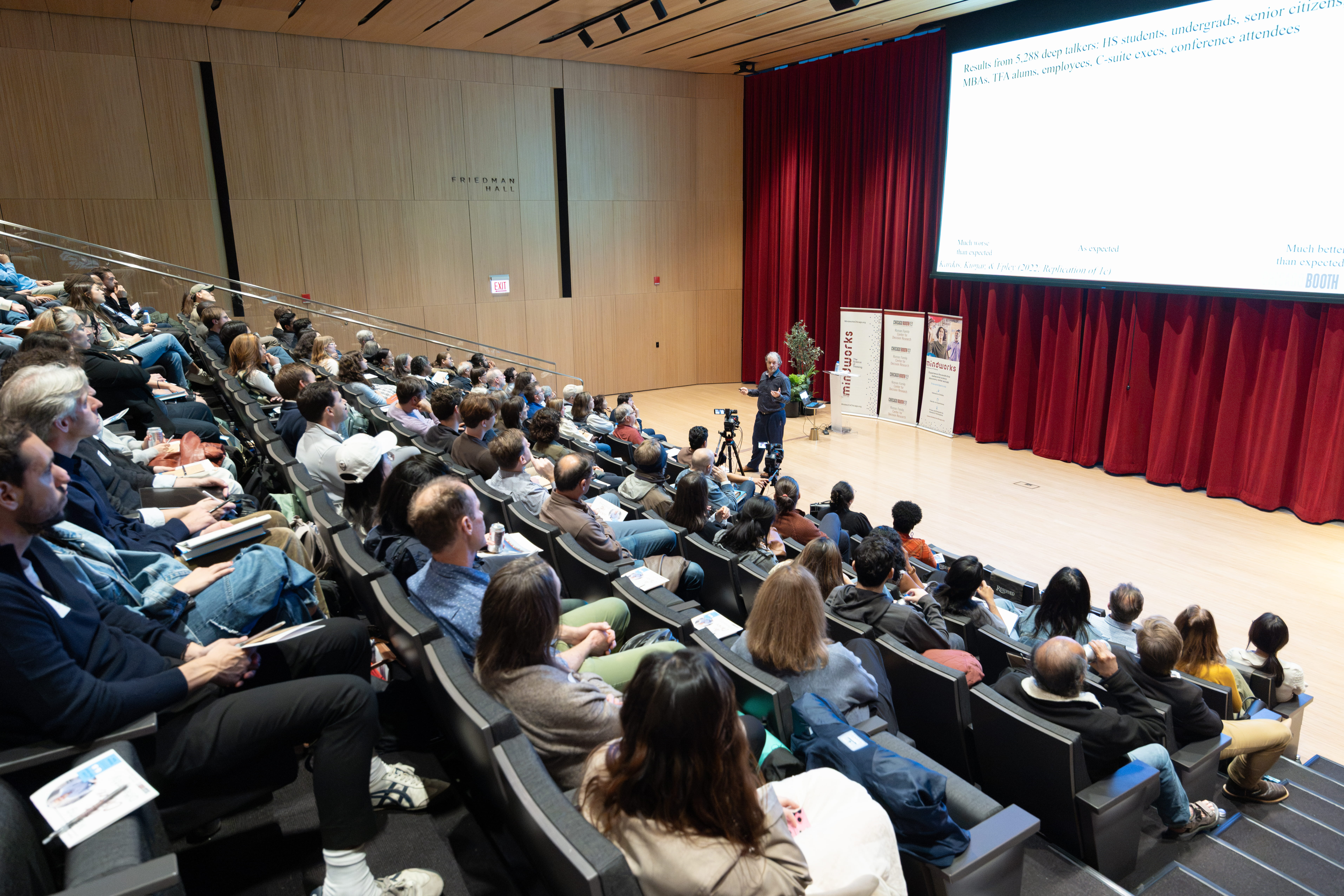
Connection as a Decision
Epley’s central idea is that social connection is partly a decision-making problem. We choose whether to say hello to a seatmate, how deep to take a conversation, and whether to send a kind note, ask for help, or have a hard talk. Technology adds more choices, like whether to call or text. But all of these decisions are driven by expectations, and as Epley’s anecdotal experience revealed, those expectations can be overly pessimistic, leading us to miss opportunities for beneficial interactions.
The Train Experiment
To test the idea, Epley’s team recruited commuters and randomly assigned them to one of three conditions:
- Solitude: enjoy time alone and focus on the day ahead
- Control: do whatever you normally do
- Connection: start a conversation with the person who sits next to you
The connection group reported the most pleasant commute, and the solitude group reported the least. A second group was asked to predict how each condition would feel, and their expectations were exactly backwards. They believed solitude would be best and connection worst.
The pattern held on Chicago buses and in many other settings. Epley noted that people are behaving rationally given what they believe. Their beliefs are the problem, not their logic.
Since this first experiment, his lab has published more than 120 experiments involving over 30,000 people. A clear pattern runs through them: people’s expectations about social interaction are often more pessimistic than reality.
Going Deeper Than Small Talk
Epley shared an exercise he has now run with thousands of participants, including University of Chicago Booth students during orientation. Participants are paired up and asked to discuss unusually personal questions such as:
- What would I need to know about you to be a good friend?
- What are you most grateful for?
- When did you last cry in front of another person?
- What do you feel most anxious about right now?
Before the conversation, people predict how it will feel. Afterward, they report how it actually went. The results were consistent:
- People expected more awkwardness than they felt.
- They bonded more strongly than they predicted.
- They liked their partner far more than expected.
- They found more in common than they thought they would.
These gaps were large, with effect sizes around two to three standard deviations, far bigger than most findings in behavioral science. Only about two percent of people were disappointed.
Preferences shifted too. Before the exercise, about 34 percent of participants said they would rather take a break than have a conversation. Afterward, only about 7 percent wished they had.
Two other findings stood out. Introverts and extroverts both underestimate how good these conversations will be, and the gap is, if anything, larger for introverts. And an online study in Wuhan, China, showed similar patterns, suggesting the effect is not limited to one culture.
Why We Get It Wrong
Epley offered three explanations for the gap between expectation and experience.
- Differing Perspectives: Self vs. Other's
Connecting means predicting how someone else will respond, and that is hard. A key example is the gap between competence and warmth. When we reach out, we focus on competence, such as whether we are saying the right thing. The other person focuses on warmth, such as whether we seem kind. In his thank-you letter exercise, writers worried about getting their words right, while recipients mostly noticed how caring the letter felt. - Mismatched Construal: Expectation vs. Experience
Expectations are snapshots, but conversations are dynamic. We predict based on easy-to-picture features, like the topic or whether the person is a friend or stranger. But real conversations unfold moment by moment. Epley demonstrated this live by having audience members tell a story to someone’s back, then face to face. Almost everyone preferred the second. Eye contact, facial expressions, and small verbal cues like “mm-hmm” signal interest and understanding. This reciprocity is what connects people. - Imperfect Learning: Kind vs. Wicked Environments (Hogarth, 2025)
Some beliefs are self-fulfilling. If someone expects an interaction to go badly, they may avoid it altogether. But avoidance prevents them from learning that the experience might have been positive. In contrast, people who do engage get feedback that can correct their expectations. Pessimism, in this way, can become self-fulfilling.
What If You Tried Something Different?
Epley closed the main talk with a practical challenge built on four ideas:
- Recognize: Notice moments in your day when you could reach out but choose not to.
- Make it easy: Buy thank-you cards, leave your phone in your bag, or try the “10-5 rule” (smile at someone 10 feet away, say hello at five feet).
- Find opportunities: Add a social element to something you already do, such as calling a friend on a walk or asking a coworker to join you for coffee.
- Do it routinely: One attempt will not change much, so build it into a habit.
He asked attendees to write down when, where, and how they would try one of these, and to run it as a personal experiment more than once.
Audience Questions
- Sustaining new connections. An MBA student asked how to keep in touch after pleasant conversations with strangers. Epley said you do not need to turn every encounter into a friendship. Positive mood often depends on how frequently we have good social moments, not how intense they are. He calls brief encounters, like those on planes, “single-serving friendships,” and they still brighten the day and can build a broader sense of trust in people.
- Phones and isolation. Asked about smartphones and large language models, Epley said phones are a distraction that reduces interaction. He added that technology now lets us isolate ourselves in ways earlier generations could not. He shared a sobering story of a woman in Italy who died in her home and was not discovered for two years. The town’s mayor said the tragedy was not her death but that no one knew she was alive.
- Designing better public spaces. A public policy student asked how he would redesign trains. Epley said policy approaches work by circumventing beliefs rather than changing them. His answer, with a smile: keep one or two quiet cars for those who need them, and turn the last five into bar cars.
Conclusion
Epley’s message is both simple and hopeful. We are social creatures who often underestimate how much we will enjoy reaching out, so we skip small moments that could improve our days. Social connection is shaped by choice, and even small shifts in those choices can improve everyday life. By noticing missed opportunities, lowering the barriers to engagement, and testing our assumptions through action, we may find that other people are not as difficult, distant, or uninterested as we fear. We may also find that a better life is often closer than we think, waiting in ordinary moments where we decide whether to reach out or stay silent.
Related resources & links
- Think Better Speaker Series
- Mindworks
- Take paid studies online in our Virtual Lab
- UChicago students: Take paid studies at our Campus Lab