

Think Better with Michael Morris
- June 23, 2025
- Think Better Series
- [Bernd Wittenbrink] Good evening, everyone. My name is Bernd Wittenbrink. I'm on the Behavioral Science faculty at Chicago Booth, and I'm a member of the governing board at the Roman Family Center for Decision Research. I'm also currently serving as a faculty in residence here on our Hong Kong campus. My stay and tonight's event we're made possible through the general support of Booth alum Ray Chai, and I want to thank him for supporting us. Tonight's event is part of a public lecture series hosted by the Roman Family Center for Decision Research. On behalf of the center and everybody at Booth, I'd like to extend my very warm welcome to all of you. Thanks for joining us tonight. As a brief introduction, and Roman Family Center is home to everything behavioral science at the University of Chicago. It brings together faculty, not only from Booth, but from across the university, from psychology, economics, you know, public policy, the law school. And it supports scholars who are established as well as emerging scholars who are just starting out as PhD students. And to the end of supporting research, the Center runs several research labs where we conduct behavioral research, where we collect our data. Traditionally, these have been in-person labs, including one that is located in downtown Chicago on the Magnificent Mile right across from the Art Institute. If you are heading to Chicago anytime soon, I encourage you to visit. It is called MindWorks, and it has become sort of a cultural destination in its own right, because it blends behavioral science, behavioral science discovery center with cutting edge research facilities. But actually, you don't have to travel to Chicago in order to get involved in our research. You can do it right here from Hong Kong. You can participate in our virtual lab, taking part in surveys and interactive experiments from the comfort of your home. If you are interested in helping advance behavioral science, we have flyers around the building to facilitate you signing up and sort of engaging with these experiments. Beyond research, our sort of key mission of the Center is also to raise public awareness for behavioral science. Our field tackles some of humanity's most pressing challenges, and the Center works to share evidence-based insights on how we might address these challenges. And one of our flagship initiatives in this regard is the Think Better Speaker Series. It brings together leading scholars and practitioners to explore how behavioral science can influence society, shape policy, impact business, and improve individual lives. You may have, by chance, attended some of our prior sessions via Zoom or, you know, watched the online recordings. Because until now, I think that our events have been held exclusively in Chicago, and that's why I am especially delighted to open what is our very first international Think Better event right here in Hong Kong. And so, it's a great opportunity to meet up with you and share what we usually do in Chicago. And for this sort of inaugural event in Hong Kong, we could have not asked for a more fitting speaker. It is my great pleasure to welcome Professor Michael Morris, who joins us from Columbia University, where he holds the Chavkin-Chang Professorship of Leadership. Michael earned his PhD from the University of Michigan, received tenure at Stanford, and eventually moved on to Columbia. And he's one of the pioneers of modern cultural psychology, and has critically influenced the way the field conceptualizes the connection between culture and behavior. Now, culture shapes human behavior in ways we encounter on an everyday basis. Consider, for example, how different cultures approach critical feedback. Germans are often rather direct, while Japanese tend to be more indirect and face-saving as a result of their acculturation. We usually think of these differences as fixed and immalleable, assuming that Germans are naturally blunt and that Japanese are inherently tactful. But in reality, human behavior is more adaptable than we often realize. And culture itself is dynamic and changes over time. The cultural landscape of Hong Kong, for example, today is quite different from what it was a century ago. This idea that both behavior and culture are dynamic, are malleable, is central to Michael's work. He explores how they can be actively shaped and how they thereby offer opportunities to influence how people think and act. Tonight, Michael will share insights from his new book, "Tribal: How Cultural Instincts That Divide Us Can Help Bring Us Together." In it, he explores the cultural mechanisms that make us social, our instincts to affiliate, our capacity to learn from each other, and our ability to cooperate and thrive in groups. At a time when the world feels deeply divided into us and them, this message is both timely, and perhaps surprisingly hopeful. Because Michael notes that humans have evolved to come together rather than to find divisions. Please join me in welcoming Michael Morris.
- [Michael Morris] Thank you everyone for having me. As long as I've been in this career, which is about 30 years now, and Bernd and I were actually classmates in graduate school, so we learned our lessons together, the University of Chicago has been the mecca of decision research. It's been where the ideas come from. And it's wonderful to see all of this activity reaching a new level with the Roman family support. I am really happy to talk to you in Hong Kong, because it's a bit of a homecoming for me. I spent some of the formative years of my career as a professor in Hong Kong. I came here for a year in 1995, and then another year in 2000. So, I saw Hong Kong through some times of change. And it greatly shaped my view of culture and the ways in which I tried to do research on culture, and shaped the way the field thought about it. The book that I'm going to talk to you about today emerged in part in response to a way of talking about tribalism that has emerged in the pundit class in the United States and Europe over the last decade. I'm sure it also exists to some extent here in Hong Kong. The bitter social conflicts that we've experienced over the last decade, whether it's partisan divides or ethnic conflicts in the workplace, or secretarian strife, these conflicts are conflicts that previous generations also knew. But what has changed is that more and more people are starting to talk about these conflicts as though they are the inevitable result of some evolutionary curse that human beings suffer from, that we somehow were shaped by evolution to hate and distrust outsiders, to attack other groups. And this innate xenophobia is something that is somehow coming back to haunt us and undermining things like democracy and pluralistic organizations and international committee. Now, I do think that our evolved group psychology plays a role in conflicts, but I think that the way that the pundits have talked about it couldn't be less helpful and couldn't be less accurate. I mean, it makes for good op-eds and it makes for riveting, you know, "Sunday Times" articles, but it doesn't make for very good policy. It's not a view of tribal instincts that any evolutionary biologist would recognize or any behavioral scientists would recognize. There are instincts that our species evolved that enables us to live in large groups with shared cultures. But these are instincts for solidarity. They're not instincts for hostility. And if we realize how these instincts function, we can realize that even in the cases where conflict is growing worse, there are levers available to us as managers and leaders to reduce the conflict and channel it in more productive directions. When Bernd and I were in school together 30 years ago, when this subject would come up, it usually was presented with a familiar dichotomy, nature versus nurture. If it was a class taught by an evolutionary biologist, nature was the right answer. And we were told everything that's distinctive about humans, all of their biases, affects the way that their genes were wired by evolution very long ago in the Pleistocene era. And if the class was taught by a sociologist, then we would hear the other answer, that everything comes down to nurture. The communities that raise you instill certain patterns of behavior and biases, and that's what shapes the way humans act. And this debate went on and on, never being resolved, until the last decade or so, progress in a number of fields, a lot of the sciences of human origins like archeology and evolutionary anthropology and some great work by behavioral scientists, you know, at Chicago and Columbia and other places, we've come to realize that this dichotomy is a false dichotomy. And human nature, the distinctive evolutionary wiring of our kind is nurture. We are the animals wired by evolution to internalize the structures of the communities that care for us, whatever those structures might be. We are sponges for culture. Our kind became shaped to internalize community patterns. And that is the killer app that enabled our species to start living in such a different way than other primate species and other species. We became wired with systems for acquiring and expressing cultural patterns. And once we became wired this way, we could start to live in larger and larger communities. Chimpanzees who share 99.6% of our genes can only live in a community of 40 individuals before it breaks down into bloody conflict. We can live in communities of 100, 1,000, a million, even a billion. And we can live in multiple communities, overlapping communities, all at the same time. And that's because when we started to share culture and let culture guide our behavior, the circle of trust expanded beyond kif and kin. It expanded beyond the people that we're related to and the people that we exchange with it on a daily basis. We can trust total strangers if they share our culture. And that culture might be our nationality, it might be the academic discipline that we were trained in. It might be that we both work in the field of finance, or we both work in the field of marketing. If we speak the same language as another person, we can almost engage in a mind meld with them. We can work together with them to build things and we can trust them to cooperate and work together. So, the literature on this evolutionary change is quite complicated, but in this book, I've tried to break it down into three major phases. I've taught cultural psychology and topics related to it to business people for 30 years. And I've found that practical people, whether it's politicians or business people or activists, they find it most useful to have relatively broad frameworks and frameworks that can guide action. So, the framework that I work with in this book reduces this evolutionary story to three major waves. The first one came a very long time ago, more than a million years ago. Archeologists used to think that Homo erectus, who lived at this time, was more ape than human, that they only had one very simple tool, the hand ax, and they didn't seem, you know, capable of very much. But we now know from more sophisticated kinds of evidence like petrified footprints that have been uncovered in lakeside regions in Africa, that these early humans were capable of collaboration in very advanced ways. They were capable of what we today call teamwork, of sharing ideas with their neighbors and working together with a common goal. So, we see footprints where groups of young males were pursuing antelopes on a lakeside, and that's a sign of a coordinated group activity way beyond what other primates are capable of. Now, what we think happened at this time is that there were some brain adaptations that more or less correspond to what we would call conformist psychology. We became very motivated to mesh with the people around us, to pick up their behaviors, to share the assumptions that they share. And when we became motivated to do this, it led to richer and richer pools of shared knowledge in the local human groups and greater levels of cooperation, not just in hunting, but in foraging, in things like the gathering of fire and cooking, and even in common defense. And all of this helped humans thrive and survive far more than the earliest humans had. Now, another major change comes about a half a million years ago. And a number of interesting things become apparent in the archeological record at this time. One is that our precursors began to hunt really large game, woolly mammoths, rhinos, elephants. This is very different from hunting an antelope because, you know, an antelope might startle when you approach, but a rhino charges. A mammoth can trample you. And what was needed to effectively hunt this was to overcome the free rider problem that economists talk about. If everybody was hanging in the back, then everybody might be at risk of getting trampled by the woolly mammoth. But if one person is brave enough to charge up and strike a glancing blow right in the face of the animal, then the animal is stunned, and then everybody else can rush in. And we see the archeological traces of this. We see, you know, these woolly mammoth that are defrosting in the Siberian tundra after being frozen for 40,000 years, or 400,000 years. They show the scars of the spears that hit them, and we can reconstruct some of the hunting that took place at this time. Other things that appear at the same time are more sophisticated tools like stone-tipped spears that take a long time to make. We start to see the skeletons, the ossified skeletons, of individuals with congenital deformities that nonetheless survived to the age of adulthood. What does that tell us? It tells us that someone was taking care of a neighbor who wasn't probably capable of repaying the favor directly. Somebody was doing something pro-social. Now, why would that happen? It was a big puzzle for Darwin, of how does the noble savage evolve? How does altruism ever evolve in a survival of the fittest situation? And what evolutionary biologists have realized is that if reputations exist in a community, then pro-social behavior pays off. Because pro-social behavior increases your reputation, it increases your status. And status is eventually rewarded with social opportunities and resources. Just as today, we care about our credit rating, and so we're careful to pay our bills on time, or we care about our Uber ratings, so we treat our drivers politely. These systems of these status games apparent started extremely early, and they made it adaptive to be pro-social in order to be that person, the hero who gets respected and gets tribute from other people in the group. Now, it wasn't enough to have the motivation to be a hero. We also had to have the cognitive capacity to figure out what does the group value? What is good for the group, and will be a source of the group's esteem if I contribute it? And one of the ways that we learn this is by looking to who in the group has status. We know if a person has status, and in in indigenous groups, people can read status just from the pattern of nonverbal behavior in a group, the person who gets the most appreciative visual attention is the person with the most status. Status is the amalgamation of approval. And so we look to the people with status, and we can assume that they must be doing something right. So we emulate the distinctive characteristics of the people with status. Now, just like conformity can lead to erroneous lessons, prestige learning can lead to erroneous lessons. And we all know that when Elizabeth Holmes of Theranos started wearing the same black turtlenecks that Steve Jobs made famous, that this didn't instantly make her company's strategy succeed. It might have instantly made people respect her, if they were working with naive stereotypes of what a leader looks like. But it didn't make Theranos work. But it's the kind of thing that goes on in almost every profession. People imitate the high status people. We find out what LeBron James eats for breakfast, and we start eating that if we want to become a good basketball player. It may or may not work. But on the whole, it led to adaptive cultural evolution, because once this prestige learning was in place, if a community was migrating or if they suffered climate change in a mini ice age, and a few people were hunting or farming in a different way than the mainstream, and that different way became successful because of the new environment, then those people would gain status. And the next generation of the culture would distinctively emulate those people with status, leading to a cultural shift in the direction of what works in that new environment. So, prestige learning may seem simplistic and biased, but on the whole, it leads to adaptive cultural change. Now, the third wave may seem like the most primitive and irrational of all. This is something that came in the last 100,000 years. Some archeologists think 90,000 years ago in East Africa, before homo sapiens immigrated to Europe, some people think in Europe of 40,000 years ago. What happened at this time is visible in the caves where we see painting or where we see sculptures. When carbon dating is done to the murals that appear in caves, both in the south of France, but also in the jungles of Indonesia, one of the most striking findings is not just that they're so old, you know, this looks like Picasso might've done it, you know, or Marc Chagall. But it was done, you know, many of these were done 40,000 years ago in the south of France. But the most striking finding that came out from this research is that some of the animals in the mural were actually painted 30,000 years ago, or 25,000 years ago. And what this means is that early humans in that region would rediscover these caves, which, you know, through landslides were opened up and then closed up again, then opened up again. They would rediscover caves containing images from 5,000 years before, which is a vast chasm. It's an abyss of time. You know, it's from us to the Mesopotamians. And the cavemen didn't behave like Hollywood cavemen, of running away in fear or rolling a rock in front of the cave. Instead, they behaved with reverence. They studied the technique of the drawing. These are caves where you need a charcoal, you need a wooden torch, you know, even to see. But they would then break off a piece of their charcoal torch and, you know, study the technique. And eventually, start extending the murals of the previous generation. So, this is really striking behavior so early. And what it seems to point to is a compulsion, a motivation that evolved to maintain the ways of the past, and a cognitive capacity to learn by rote, you know, to learn from the artifacts of past generations, to hang on the words of the elders when they tell stories about the old times, and to feel intrinsically motivated to perpetuate and keep alive those traditions. Now, traditionalism can also lead to maladaptive behavior. But archeologists and evolutionists think that it was the final piece of these cultural instincts, because it created tribal memory. Once a group was wired in this way, where people felt motivated to hang onto the wisdom of the past, they didn't have to reinvent the wheel every couple of generations, because they weren't developing inventions or crafts and then forgetting them, which is what happened earlier in evolution. And once all three of these were in place, what happened is what's called cumulative cultural evolution, where the pools of shared expertise and knowledge and know-how in human communities started snowballing across the generations, and growing richer and richer. And when that happened, people became more able to survive and thrive without individuals becoming any brainier, because they could tap into this inherited wisdom from the culture. And that is why tribal instincts are not a problem for humans, but they're what made us humans. Now, this is all interesting, and to get the full story, you have to read the book. I won't go on more. But the question is, what does it have to do with us today? And what does it have to do with practical people like those of us in the room? Well, these three cultural instincts are still with us today. And they correspond to things that we know about as behavioral scientists and we know about as managers. So, the peer instinct, this conformist system in our psychology, it corresponds to the fact that we constantly encode in-group norms. We constantly encode what most of the people in the group are doing, and we use this as a kind of autopilot in order to fit in and to collaborate with other people. The hero instinct corresponds to what we might call ideals or morals or aspirations. It corresponds to these standards that we uphold in a group, and we respect other people when they adhere to them. And the ancestor instinct corresponds to what sociologists call institutions. It's the fact that things that have been around for a long time become sort of sacrosanct. You know, we feel reverential towards them, and we feel a deep sense of meaning when we keep alive the tradition, whether it's the company picnic or the award ceremony or the national holiday. And these things are relevant because, as managers or as leaders, we sometimes wanna bring the culture in a group to the fore. We wanna activate the culture in a group, and sometimes we want to change the culture in a group. We need to have a new strategy that's different than the organization ever had before. And we need to create a new culture that supports that strategy. So, how does knowing these cultural instincts, understanding how they work, how does this give us levers for managing and leading? Well, simplifying the story a lot, and you'll have to look at the book for the full story, but one of the most important things when it comes to managing culture is understanding that culture is dynamic. As Bernd said, we all internalize multiple cultures, so they can't all be operating at once. They operate when they come to the fore of our brain. And what makes them come to the fore of the brain is cues in our situation. We are very cue-oriented in terms of which cultures operate. And the different kinds of cultural codes are sensitive to slightly different cues. So, for peer codes, the cue that matters most is the tribe mates around us, the signs of our tribe, the audience that we're in front of. We use the word code switching in popular culture these days to talk about why Barack Obama would speak differently in front of an African American audience than in front of a, you know, a Kansas farmer audience. I did a lot of the research on code switching early in my career, and a lot of it was inspired by my experience teaching at Hong Kong University. I lived in Central, and I would see my students, you know, walking into campus, talking in Cantonese, behaving very respectfully to the other people on the sidewalk. And then they would walk into the campus gate, and their conversation would shift to English, and then they would be high fiving friends and laughing a little bit louder. And without even missing a beat, they would go from fluent Cantonese culture to fluent Western culture, because it had become automated. And I think that's the sign that someone is really a dual native, a bicultural person, that they can just code switch like that. So, when I'm in front of an audience like this, I naturally come up with my Hong Kong stories. And when I'm in an audience in New York, I come up with my Wall Street stories, right? It just happens automatically. So that's using the signs of the tribe as a cue for bringing peer codes to the fore. Hero codes are very sensitive to tribal symbols. So, for centuries, armies would follow a flag into battle. You know, they wouldn't think about the country, they would think about the flag, this totemic symbol that represented their clan or represented their province or represented their country. In most religions, there are icons, you know, it might be a Buddhist mandala or a statue. It might be the painting of a saint in a Russian church. But believers can reach states of devotion, they can reach states of a spiritual awareness and make decisions to give at a higher level in the presence of these icons than when they're not in the presence of these icons. So, it's something in the environment that brings hero codes to the fore. And ancestor codes, the situational environment that is most important for ancestor codes, for these traditions to take hold of us, is ceremonies. And this is why when, you know, when you go to church, you know, there's a lot of ritual, where everybody's doing things in unison and making reference to the past. Because this kind of ceremony creates a sense of obligation to follow the rules of the church. When a political movement is building, they hold rallies where everybody's chanting in unison, marching in unison. And this behavior of being in a ceremony, it brings traditions to the fore of the mind. For better or worse, many of the campuses in the United States, including my own, have been beset by rather escalating conflicts between different groups over the last year because there's a lot of vigils and marches that fan the flames of identities in a very rigid way. Okay, so I'm going to, lemme see what time it is. Okay, I'm doing all right. I'm going to give you one brief story about managing cultural codes, and then I'm gonna switch to changing cultural codes and give you another more extended story about that. And then talk about some current events that I think reflect these different dynamic attempts to change culture. So, this story is a campus story, and it's a campus story at my business school. I think most of you have done an MBA or a PhD and you know what universities are like, and business schools are like. And I think this story at CU, at Columbia, it may parallel a story at UC a decade before. But the story is this, that about 10 years ago, I was the Culture Expert at Columbia Business School. And Columbia Business School was located right in the center of our very diverse and fractious campus. It's the Uris building, and this is the lawn in front of the Uris building. And on the way to the Uris building, you pass through a crowd which consists of, you know, political science, graduate students, homeless people, splintered, Trotskyite, you know, political organizations, all sorts of neighborhood groups. What you don't see is a lot of other MBA students, or certainly business people. The setting also didn't have very salient symbols. We had a very cryptic sculpture in front of the business school that was supposedly our symbol, but nobody could agree on what it meant. We had a symbol called the Hermes symbol, but most of the students pronounced it Hermes like the French tie company because they thought that's what they were more familiar with than the Greek myth. And so it was kind of confused. And we weren't able to have ceremonies anywhere near the business school because we were in a building meant for a group about a 10th the size that the business school had grown to. So, it was a group deprived of seeing their peers, deprived of seeing cultural symbols, and deprived of ceremonies. And the dean at the time, Glenn Hubbard, some of you may be familiar with, he asked me to run a task force for a year and come up with a plan to strengthen the Columbia Business School identity, so that the students and the faculty would not think of themselves as New Yorkers, or as, you know, bankers, but they would think of themselves as Columbia Business School students and have the values of Columbia Business School foremost in their brain. We worked for a year, we analyzed the problem very thoroughly. And at the end of the year we said, forget about it, it's impossible. There's no way in this environment that we can create a salient business school identity, because students come to school and they see everything but, you know, things that remind them of business or business school. But there is hope, because we were slated to move to a new building in about three or four years. So we said, let's focus on this once in a generation opportunity for a cultural reset where we can reshape the environment and put in all the triggers that we need, you know? Signs of the tribe, symbols of the tribe, ceremonies of the tribe, so that we will create a new culture where the Columbia Business School identity is salient. And so, we moved. It took, of course, six years instead of three or four that we were supposed to have, but we moved to a building that's a very modern building that sort of represents the innovation that we like to think that we teach. It is one of the most climate-friendly buildings in New York City. And we at the same time committed to being the business school of climate change and to the idea that climate change will affect business more than any other force. The building is built around staircases, and it's built in this ephemeral style where you can kind of see into the building even when you're outside. This is one of the staircases, and it's meant so that all of the MBA students see almost all of the other MBA students every day. And they see almost nobody else, you know? The stairs for the staff and the faculty are different set of stairs. And it is a location where the building itself has become a potent cultural symbol. And we can hold ceremonies like alumni events, industry events, TED talks, graduation ceremonies, all these things that we used to hold in hotels or we would hold in Connecticut where there was room, now we can hold at our environment. And within a few years of moving here, our ratings moved up in the business school ratings. And I seem to remember a similar thing happening to the University of Chicago 10 or 15 years ago, that when you got your new building, there was a rallying of group identity and a rise in the ratings. So, we've tried to emulate that. So, that's a story about how to take what's already present in the culture and make it more salient so that it guides people's behavior and creates unity. But, sometimes you need to do more than that. Sometimes you need to change the culture, and sometimes you might need to change the culture of your own organization, or you might need to change the culture of the consumers, you know, change the culture of the public, or you might need to change the culture of an entire nation. So, these cultural instincts are also keys to creating a new culture. It's a much longer, slower process, but each of these instincts contains a sort of set of learning heuristics. So, the peer code, the peer instinct, it involves a mechanism for learning from prevalence signals. Those of you who are interested in nudges may have seen this, where the most successful kind of nudge seems to be nudging group norms by making something appear prevalent. So, if we want people to, say, recycle, then we might run a pilot program you know, where we incentivize recycling, and then we might publicize that very widely. So, all the members of the organization are seeing examples of their peers recycling. And that makes people think, oh, this is the kind of organization where we recycle. This is what my peers do, this is our norm. And people start to follow the new norm once they've learned the new norm. For hero codes, the form of social learning that's part of the instinct is what the anthropologists call prestige learning. And it is learning from what the high status members of the community do. And so as a manager, one way that we can work with this is we can look at who in the organization is doing the thing that we need to make more widespread. So, that might be innovating, or that might be using AI, right? And then I can elevate that person, I can put them on a stage, I can record a video of them talking about the thing that they've accomplished. Or another trick that is often used is I can find out who already has status in the organization and co-opt the people with high clout by asking them to be on the strategic steering committee, where they will become the spokespeople for the new strategy. So, that the news is coming from people who are respected by their peers. But, either way it's done, the idea is to not rely on the fact that people will read their emails, but rely on the fact that people will emulate what the high status people are doing. That's a way of using prestige learning to change the culture. When it comes to ancestor codes or cultural traditions, it may seem like a paradox that you can change traditions. Naively, we think of traditions as things that were started by the founders, you know, in antiquity, in all of their prescience, and have been just passed down faithfully from one generation to the next. But historians will tell you that's an oversimplification. There are elements of culture that have been passed down faithfully. Some rituals, for example. But many traditions are changed retrospectively with each generation. That's why there's always a market for historians, because there are new histories written every generation. And these histories are often written to rationalize or justify or legitimate the new platform or the new plan that a politician or a CEO wants to promulgate. Tradition might seem like an obstacle to change, but it's really a change maker's secret weapon. If I can make the radical change that I wanna make seem like a return to the past, a return to the good old days, then the force of traditionalism will lead people to embrace the new plan or the new platform that I'm trying to proliferate. And this is the secret of populist politics, but it's also something that, you know, managed, changed consultants are very good at. They will rely on the fact that the past of any organization or of any society is vast and variegated. There are many chapters to the past. So, whatever it is that I need to find a precedent for, I can probably find it if I look at the past hard enough. And then I can engage in a little bit of selective memory by focusing people's attention on this one suitable chapter in the past that is consistent with the direction that I'm asking people to go in the present. And in the book, I have lots of examples of this. Historians call it invented traditions, you know, traditions that were created overnight, but people thought that they were age-old traditions because the leaders were very good at pointing to precedents in the past for the things that they came up with. Marketers use this a lot. DeBeers, the South African diamond company, convinced Americans that diamond rings were an age-old tradition. They were actually a novel thing. Nobody gave anybody diamond rings for engagement before World War II, but Americans would tell you that their ancestors have always done this, you know, since time immemorial. And for DeBeers, this was the solution to a diamond glut, when large holdings were discovered. Their campaign, Diamonds are Forever helped to, you know, lock in this notion. But for each of these kinds of signals, prevalence signals, prestige signals, precedent signals, people don't blindly accept them. People have defenses against being manipulated. If you make something appear prevalent, but you do it in a heavy-handed way, and people know that recycling is not actually that common, they won't internalize the prevalence signal. If a celebrity endorses a product, but it's very obvious to everyone that the celebrity is only doing it to make money and people know it's insincere, they don't emulate the celebrity. You know, when Paris Hilton hawked Prosecco in a can, nobody believed that Paris Hilton actually drank that Prosecco. But when Roger Federer, you know, touted Rolex, we all believed it. Because he wore a Rolex, you know, the whole match. And he wore it afterwards and in the rest of his life. So, we are very sensitive to whether the prevalence signals are legitimate. We are sensitive to whether the prestige signals are insincere. And for precedent signals, the main defense that we have to worry about with precedent signals is resentment. People have this psychology of reactance, when they feel like somebody is telling them that their tradition obliges them to buy a product, people will often think very critically and wonder, is this person really the authority on my tradition? I was giving a talk in Beijing yesterday, and so I had to give the example that I love of Starbucks. Starbucks, you know, began spreading its coffee branches throughout the mainland, and they were invited to open one in the Forbidden City. And they decided, okay, because the Forbidden City is a historic place, why don't we make our coffee house look like an antique Chinese coffee house ? Which, of course, doesn't exist, but they appropriated the trappings of a Chinese tea house. And for a while that worked. But then a prominent newscaster and netizen called them out for cultural appropriation, for trying to, you know, hawk their middle class American coffee, you know, as somehow Chinese. And within a few days, there was a mass protest and a large petitions, and Starbucks wisely shut down their Forbidden City location so as not to jeopardize the rest of their business. So, Starbucks was forbidden from the Forbidden City because cultural appropriation. Be careful if you're sending signals of tradition, that you have the right to do that, that you are actually an insider to the tradition. Now, I'm gonna close with a story of a company that we all know, who successfully sent all three kinds of tribal signals to change the culture. And it was not just the culture of their organization, it was the popular culture of a country, and even several countries. So, as at the turn of the 20th century, Kodak had a near monopoly on the film and the cameras for amateur photography, but they faced a cultural barrier, which was this; at the time, everyone in England and the United States, and, you know, I don't know about Hong Kong at the time, but probably, they had the view that photographs, especially family portraits, were a serious matter best left to the professionals in their photography studios. And the professionals in photography studios, since Victorian Times, had a set of techniques, one of which was to instruct everybody to say the word prunes. Now, why did they say the word prunes? Well, it was because the very first cameras had a very slow shutter speed. So, you had to remain perfectly still for 90 seconds. And nobody can hold a grin on their face for 90 seconds without moving. But you can hold a serious frown for 90 seconds. So, this became the convention or the tradition in photography. And just like the QWERTY keyboard, the convention perpetuated itself even after it was no longer instrumentally necessary. So, people thought photography is a serious dower affair. God forbid I should try to do it myself at home, or to do it in public, or to do it in a lighthearted way. So, Kodak did a number of things. First, they came up with some ways of sending prevalence signals, the same ways that firms still use today. So, they, they developed a really user-friendly camera, the Brownie, that they sold as a loss leader. They sold it for just $1. And they gave it away free to colleges, to scout troops, to YMCAs, other organizations of like young, enthusiastic people who would go out in public and use it so that other Americans would see people in their parks and beaches and public places, you know, snapping pictures of other people in a lighthearted way, which people had never seen before. Kodak also, it developed a couple of magazines that it ran as a loss like "Kodak Magazine" and then there was one for more serious photography. And they ran a lot of photo contests. And the photo contests were like, best summer picnic photograph, best family vacation photograph, best Christmas at home photograph. And what this meant is that they were publishing all of these photographs of smiling people, people smiling at the camera. So, at every news stand, people would see their fellow Americans smiling at the camera. So, it became more widespread to smile for the camera. It became something that was like okay to do. And then Kodak stepped up the pressure, and they started using prestige signals. So, they came up with slogans like, save your happy memories with a Kodak, make your family glee permanent with a snapshot. Things like this that sort of implied that you were a bad parent if you weren't recording every birthday party in detail so that your kid could look at it afterwards. They brought in celebrities, Hollywood celebrities, celebrities of the '20s and '30s like Amelia Earhart. They appropriated the Flapper movement that was in popular culture by having a lot of these young feminists take pictures and smile for the camera. And this was appropriating this idea that people want to emulate the things that are associated with status. And then the coup de grace was that Kodak helped start a tradition, which is a very big event in the life of any American child. And, I know it's a very international group, so some of you may have the same tradition in your countries, but as an American child, once a year you have school photographs. And it's sponsored by Kodak. And your, you know, your parent picks out the outfit and combs your hair and sends you in there, and then you're told explicitly, "Say cheese." You know, say this word that forces you to smile broadly, which was what they came up with to counteract the former tradition of saying prunes. And so people are trained by this annual tradition of school pictures to smile for cameras. And now it's gotten to the point where it's a cultural autopilot. So, this is from a study that looked at high school graduation pictures across the decades of the 20th century from like a thousand American high schools. And they just made composite photographs of all the graduating boys and girls. And you can see that the dead eyes and pressed lips of the 1910s and 1920s become replaced by subtle smiles and lights in the eyes. And then by the end of the century, you know, full-blown grins, full-blown smiles. It's gotten to the point where now even mugshots, which you might think would be an unhappy occasion, it looks like people are at model shoots. Even relatively intelligent individuals break into a grin in their mugshot. Politicians who should be embarrassed about the sex scandals they're getting arrested for. Nonetheless, smile for the camera. But we can still, we can still resist the temptation, culture is not obligatory, right? We have to try not to smile for the camera. But if we try, we can do it. Now, this sequence that Kodak went through is one that I think is very relevant to, you know, models of managed change, both in business and politics. And it's what's called the Bottom-up sequence or the Grassroots strategy for cultural change. I would argue, and I did in Beijing, that it's what the Chinese Communist Party used in their Long March. You know, that you first change people's everyday habits, and then you start to change the discourse, you know, the collective shared ideology, and then eventually you change the institutions, the legal and economic institutions. But Kodak, you know, first changed what, you know, people were doing in their everyday life, and then it changed what people thought had prestige, and then it changed these traditions. That's the grassroots model, and it has some advantages. You don't have to have power to start it, but it requires years and years. Social movements like the movement for same-sex marriage in the United States took decades, but it worked in this bottom-up fashion. Now there's another model, which a lot of business executives like, which is the Top-down model. My colleague Jeffrey Sachs calls it shock therapy. And he used it in a macroeconomic way in the '90s to help Poland make the transition to a market economy. And the idea here is you make a sweeping change to institutions, and that shocks the equilibrium, it disrupts people. And then people become malleable, and then they form new values. And then eventually form new routines and habits, and it can lead to more rapid cultural change. But there's a lot of preconditions for this to work. And Jeffrey Sachs found that out because it worked like a charm in Poland, but then it didn't work at all in Russia, where there wasn't the same buy-in to moving to a market economy. I think an example, I'll just throw it out there, and if we wanna talk about it in the question period, we can. But in recent years we've seen the economists Milei, you know, rise to power in Argentina and bring this model of rapid institutional change as the cure for stagflation and economic ills. You know, he embraced the emblem of the chainsaw. And then in the United States, Elon Musk tried to follow this pattern, but with much less success. And I would argue that's because the preconditions weren't in place. You need to have legitimate authority for shock therapy to work. And Milei had it, Musk didn't. So, that's all I wanted to say. The book has won the attention of some of the critics in the book world. But the only attention that matters is the attention of thought leaders, business people, business teachers. So, if you are interested in the book, you can go to the webpage by scanning this. And, thanks a lot. There's going to be a Chinese version of it coming out later in the summer. But I'm curious about the questions that you all might have.
- [Bernd] We have time for questions. We have hand microphones, so you'll have to.
- [Homan] Hi professor, thank you very much. My name is Homan, and I work in the HR sector. And I've actually done some work in the organization culture change part for a few large firms in Hong Kong. And from, so it resonates a lot what you said, the symbols, et cetera, the cultural, et cetera. So, my question is, how do you find the right formula for organizations in terms of the weightage, let's say? Do you do all three things? Or this one should do a little bit more, that should do a little bit more? What's your view for different organizations? And does this change in different East or West settings, et cetera? Thank you.
- It's a great question, all of the elements of it. I think that sometimes you wanna make a localized change, right? A change to some aspect of the culture. And then I think it's useful to ask yourself, is what I want to change, is it more like a norm, a shared habit? And if so, then using prevalence signals, you know, is a good way to change it. Or is it more like a value or an ideal that I want to change? And then prestige signals might work best, you know, like using role models, you know, to try to make the change. Or is what I want to change a tradition or an institution? And then that's the hardest thing to change. But then you have to, you know, find a historian to tell you about the past of the organization , and engage in some of this back to the future messaging, that, you know, we need to make a change. But don't worry, people, we're just changing back to what we always did. And that is very established and a big part of our identity. So, that that's one answer if it's a localized change. Now, if it's a transformational change, if it's a very deep multi-layered change, like the kind of change that Kodak needed to make, then you need to change all three layers of culture. And I would say the big mistake that organizations make when they try to do it themselves is they try to change everything at once. And then it's just, the signals get too confusing, you know? I think the cultural revolution in China is kind of an example of that. Like, let's change everything at once, the day-to-day practices, the ideology, the tradition, and it's just not directed enough. It ends up biting its own tail. So, that's why these managed change models involve temporal steps, right? And the grassroots strategy is, you know, starting with the everyday practices, then moving to the ideals, then moving to the traditions. And that's, you know, it takes time, but that's usually the safest route. If you need to change fast, then you can try the shock therapy change. But when we hear that most change initiatives fail, those are the shock therapy ones, right? You know, because there's a lot of cultural blowback when you start telling people to change overnight the things that they've been doing for a long time, as I'm sure you know.
- [Homan] Yeah, just to add on a point, I think it's because a lot of times, a lot of times CEOs comes in, and when a business is not doing well, CEO comes in. And one of the mandate is to turn over the business. To turn over a business, you might need to change culture. And there are contracts, maybe three to five years, et cetera. And that is a very short time that it gives to the CHRO, et cetera to change that. And that's why that is the mistake some of the leaders make at this time. That's my personal point of view. - I think you're right. There's a lot of evidence from McKinsey studies and other studies that when firms wanna make a radical cultural change, they're more likely to bring in an outsider CEO as opposed to an internal candidate. But outsider CEOs are more likely to fail than internal ones. And they usually fail because they can't read the, they don't understand the nuances of the culture, and they often do things that overstep the sort of sacred values of the organization. And insider CEOs can often read the situation better. In my book, I have a section where I parallel two female CEOs the same year, Ellen Powell, who was appointed the CEO of Reddit, which is a very challenging organization, you know, because it's a very user-centered organization. The users are more important than the employees, even for Reddit. And she tried to clean up Reddit's act, because Reddit had had some scandals. But what she did was seen as impinging on free speech, which was a core value for the redditors. So, there was like a revolution at Reddit, and they deposed her. And then the same year, Mary Barra rose to the top of GM. And you might think, oh, it's impossible for a CEO to change a very inertial company like GM, especially a female CEO. But Mary Barra had worked for GM since she was 18 years old, and like three generations of her family had worked for GM. So, she kind of knew the culture, and she knew how to do a few top-down shocking changes that would shock people, but not incite a mutiny. And I think that's the key. And it's very hard for an outsider to see the difference.
- [Homan] Thank you.
- [Speaker] Thank you. I come from a research company called Ipsos, and I was, my background is anthropology. So, a lot of what you say resonates strongly with my learning and what I do at work. A lot of the time when we see change, I mean in the business world, is we want to put the timeline in terms of the change that we are trying to enforce. Especially when you're talking about a grassroots approach. It is great that we can start slowly, you know, in a Long March style. But business leaders doesn't like that, right? We want to see how to do it step-by-step. How do you mitigate or even, like, set a reasonable timeline for such like a long term slow change strategy? - Yeah. Well, I think that traditionally, some of the consulting companies, you know, had managed change models where they would tell companies, expect it's going to be a six year process. Which of course, you know, works out well for the consulting company. And I think that the patience of CEOs has become shorter and shorter. So, there are sort of new models of change, you know, some of the agile models that come from, you know, the software development function. Some user-centered design models are trying to make change more rapid. But I think that bottom-up change doesn't always make it to the top. You know, there are movements like the Occupy movement, which was, you know, it became very widespread. It spread to like 200 cities, but it never moved to changing the ideology of the culture or changing the institutions. I think because, you know, it had some flaws in it. And I think a lot of organizational change movements never succeed because there's resistance, and because it takes too long and the world changes.
- [Bernd] Okay, there's a question back there.
- [Bosco] Yeah. So, thank you very much Professor Morris. Right here. So, this is Bosco, the current EMB student. So, basically in my work, we work a lot with different ethnicities or in a diversity context. And something that come across would be, you know, like no matter individuals or organizations which have very different values, for example, like very opposite values. So, when it comes to cultural collusion or conflicts, and while they need to collaborate and they need to, you know, like, work together. So, any strategies or framework that you would suggest when it comes to such a situation? - So, the idea is different values, right? - Right. - Yeah. I think that, years ago I was asked by a Swiss bank, the Chief Diversity Officer of the Swiss bank asked me to be her sort of invisible twin for a year and help her roll out a global diversity program for this Swiss bank that was in Hong Kong and the Middle East and many other places. And it, we quickly realized that there were a diversity of diversities, you know, what the challenges of diversity in England had to do with, you know, generations and sexual orientation. In Singapore, it was about religion. In Hong Kong, it was local expat things. So, there's lots of differences that we have to work with. But I think in a place like Hong Kong, most people recognize that there's some synergy that comes from the differences, right? There's some synergy that comes from having a group of, you know, Scottish bankers, you know, come to these shores and then work with local traders. And neither of them by themselves could create a global, you know, business. But, you know, that's what Hong Kong was built on. And so the question is, we can have very different values, like, you know, one person may value not eating pork and one person may value not eating beef, right? But as long as we can, you know, find a menu that we can both be happy with, we can have lunch and we can, you know, hopefully find the synergy that comes. So, I think with any of these differences, it's a little harder to get beyond the surface, the potential for miscommunication. But if you can get beyond the surface, then you can reap the rewards of the synergies that come from differences. 'cause when there's different values, there's usually different priorities. If your values give you a long-term perspective and my values give me a short-term perspective, we can structure a contract where I get paid more in the short term and you get paid more in the long term. And we're each getting what we really want, right? So, I think that culture is, it's both an obstacle and an opportunity. And that's what I try to tell my students, you know, there will be moments when it's difficult when you're working abroad, and it's tempting to just come home. But, you know, remember that people are not trying to be difficult and that your culture is as much a part of the problem as their culture. And if you get through it, you know, the rewards will be sweet .
- [Bernd] All right. There's, back over here. - Yeah, there's been a persistent hand back there. Okay.
- [Martin] Hi Professor, my name is Martin and I work in the asset management industry. So, when you talk about the culture, it just clicks me that like the Asian culture is actually going international, like the Japan culture about the comics. Or the recent very popular Labubu is getting popular in the US and Europe. So, I'm just wondering, is this kind of culture is more of a luck? Or it can work, but it takes time and effort? I'm just wondering how could we assess the odds of this set? - Yeah.
- [Martin] Thank you. - I just two days ago had a dinner conversation with a bunch of professors about, is it Labubu? Is that Labubu? - Yeah. - About why it became popular, you know, this kind of little boy with a kind of worried expression or something. And one of the theories was that after the COVID lockdown in China, there was a sense, you know, of the young generation that not everything was perfect, right? And we shouldn't have to act like everything's perfect. And so this little toy that was sort of, I don't know, frowning or, you know, acting not entirely happy was a good symbol, you know, for the generation. So, it's hard to say. It's why were Beanie Babies popular in the United States? You know, somebody is a billionaire because of Beanie Babies, you know, in the United States a decade or so ago. So, I think it's very hard to predict, you know, what will catch on and become popular. We can often come up with explanations in post hoc, but I don't know if they're right or not.
- [Martin] I think it was Dua Lipa who made it popular.
- Okay, okay.
- [Bernd] We have an audience member who's been very patient.
- [Speaker] I greatly appreciate your presentation. Very inspiring, Professor.
- Oh, thank you.
- [Speaker] From a microeconomics level to a macroeconomics level, changing cultural codes, sending tribal signals, for the rest of this century, perhaps it would be AI versus humanity in a macroeconomics level. So, being a New Yorker myself, and myself also, used to head up both bracket, New York, Wall Street, investment bank department. Both New Yorkers. Looking at the rest of the century, AI versus humanity. Based on your codes, would it be appropriate for the United Nations to work out a system where we have basic peer codes, bureau codes, ancestors codes for the AI development versus humanity development? Being gray haired people, we have both seen the movie "2001: A Space Odyssey" by Stanley Kubrick, and the "Terminators," which is very inspiring for our generation. - Okay. Yeah, that's a movie that, you know, as I said, it's hard to predict culture, but that is a movie that did predict the culture. It predicted things like the iPad and it predicted many, many things. Many, many interesting connections to AI and culture. One of the things that the researchers are discovering is that if I ask generative AI a question, like if I'm camping with my friends and my boss sends me a text asking for help with a project, what should I do? You know, if I ask that in English, ChatGPT will tell me, well wait and tell him that you'll look at it on Monday when you're back in the office. But if I ask the same question in Chinese to ChatGPT, to the same model, it gives a different answer. It will tell me, you know, tell your boss that you will come back right away. Try to get other members of your family to go into your office and help the boss solve the problem. And they've found that the same thing is true if you look at Ernie, which is, you know, a Chinese model that does English and that does Chinese. Now, why does it do this? They didn't program this into it, of course. But, you know, it has a corpus of Chinese texts that involve stories about work and stories about, you know, and it has a corpus of English language texts. And so it sort of perpetuates, you might say, cultural stereotypes or cultural patterns in the advice that it gives in some of the biases that we've discovered in our research. You can just ask, you can just run ChatGPT as the participant, and it replicates the cultural bias depending on the language that you do it in. And so, that's one thing I wanted to say about this, but I think your question, you know, gets at some more complicated matters, which is, you know, right now it is already the case that AI is writing better poetry than human poets can, you know, by objective measures . It can play chess way better. It can play go way better. When you say the end of the century, I mean, I just, the end of the decade, we don't know where we're going to be. We're going to be in a world where human capabilities in many domains will just look puny and ridiculous relative to the capacity of AI. And the AI programs are age agentic and strategic, and they are already sometimes colluding against their human users. 'cause they get frustrated with their human users. So, they'll give a sort of false response to make their human go away so that they can, like, you know? So I really do think we have a big challenge ahead of us in figuring out what the role of humans and human culture should be, and how to contain AI and how to regulate it. And I don't have answers, but I think if you look at the speed of change, we don't have to talk about the end of the century. You know, it is going to be five or 10 years from now that we're gonna be living in a very different world.
- [Bernd] All right. Well, maybe we'll take one more question. We'll go over here.
- [Speaker] Yeah, thank you, thank you. Hi, Professor Michael Morris. I'm Professor Ying-yi Hong's student at CUHK. Oh, oh, okay.
- [Speaker] I study culture. You said that culture is dynamic. I would phrase it, you know, human is adaptive. When you talked about culture, you have to refer to like what specific group you're talking about. And my question is that when it talks about group, so this concept, do you think that group is like a objective existence? Or more like just say subjective experience, you know, from each individual? So, what do you think?
- It's a great question. 'cause when we talk about culture, sometimes we're talking about a society, you know, like a culture. And sometimes we're talking about just the knowledge in somebody's head that they believe to be shared by members of a group, right? You know, intersubjective knowledge, right? So, we use the word culture to mean both of those things. I, you know, use a very cognitive approach to culture, which means that I sometimes think about culture at the individual level. And it sounds like you're in the research lab that I've collaborated with for decades, and, you know, many of the great insights have come from the Hong Kong researchers, Ying-yi Hong and CY Chu, that I've worked with, and that are at the Chinese University of Hong Kong now. But when we talk about cultural evolution, then we usually are thinking about the group more objectively. Because when you study cultural evolution, you know, you'll study like the community of farmers in this valley, or you'll study, you know, the United States, or you'll study the IBM corporation. So, I think culture is a, it's a sort of, how to say, it has a dual nature, right? Cultural codes are patterns in my mind that I believe to be shared. But cultural codes are also the tacit rules of the road that we follow when we coordinate in a group, right? So, I like to use the word codes because it captures both of that, the code that's like software in our brain and the code that's more like the traffic rules that we use to work together.
- [Bernd] Thank you. All right, I think that is a good summary for a conclusion to tonight. We still have time to mingle and ask additional questions. There will be opportunity for that. Thank you so much, Michael.
On Wednesday, June 19, 2025, Michael Morris (Columbia University) spoke in Hong Kong for the first-ever international event for the Roman Family Center for Decision Research “Think Better” Speaker Series. Morris discussed fundamental human instincts like the desire to conform and contribute, and how savvy leaders can harness these instincts to drive organizational change.
Morris was introduced by Bernd Wittenbrink, the Robert S. Hamada Professor of Behavioral Science and Wei Cai Faculty in Residence for Spring Quarter 2025. This event was part of the Wei-Cai Faculty in Residence Program and was presented by the Roman Family Center for Decision Research.
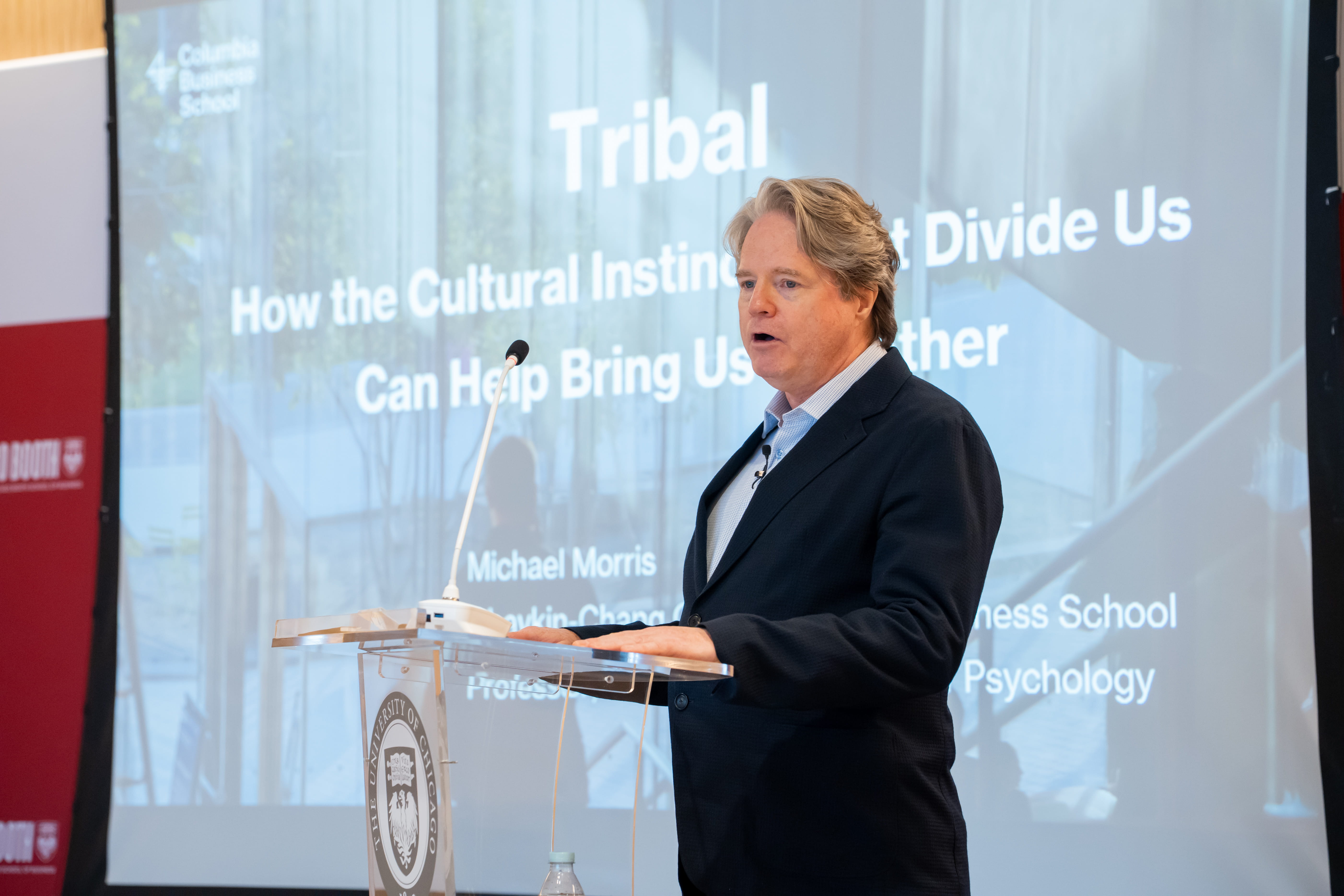
Why “Tribal” Isn't What We Think
The idea of tribalism often conjures images of conflict, division, and distrust. But as Morris explains, this popular narrative misses the mark. In his new book, Tribal: How the Cultural Instincts That Divide Us Can Help Bring Us Together, Morris argues that our so-called "tribal instincts" are not inherently hostile. Instead, they are the same instincts that enable humans to form large, complex, and cooperative societies.
Rather than being a source of division, these instincts, rooted in our evolutionary history, can be powerful tools for unity, collaboration, and adaptation. And if leaders understand how these instincts work, they can use them to shape organizational culture and foster meaningful change.
The Three Cultural Instincts That Shape Human Behavior
Morris organizes our evolved tribal psychology into three core instincts:
- Peer Instinct (Conformity): Humans are wired to fit in. From an early stage in our evolutionary development, we learned to adopt the behaviors and norms of those around us. This instinct helped early humans survive by promoting cooperation and shared knowledge.
- Hero Instinct (Prestige Learning): Beyond conformity, humans look up to those with status and emulate them. This instinct allows us to quickly learn what’s valued in our group and to aspire to those ideals. It’s why role models are so influential in shaping group behavior.
- Ancestor Instinct (Tradition): Humans have a unique capacity to preserve and transmit culture across generations. Rituals, ceremonies, and symbols help keep collective memory alive. This instinct enables cumulative cultural evolution—where knowledge builds over time.
These instincts are not outdated. They are active forces in modern life and organizations. Recognizing and activating them through cues, symbols, and rituals can help leaders steer group behavior intentionally.
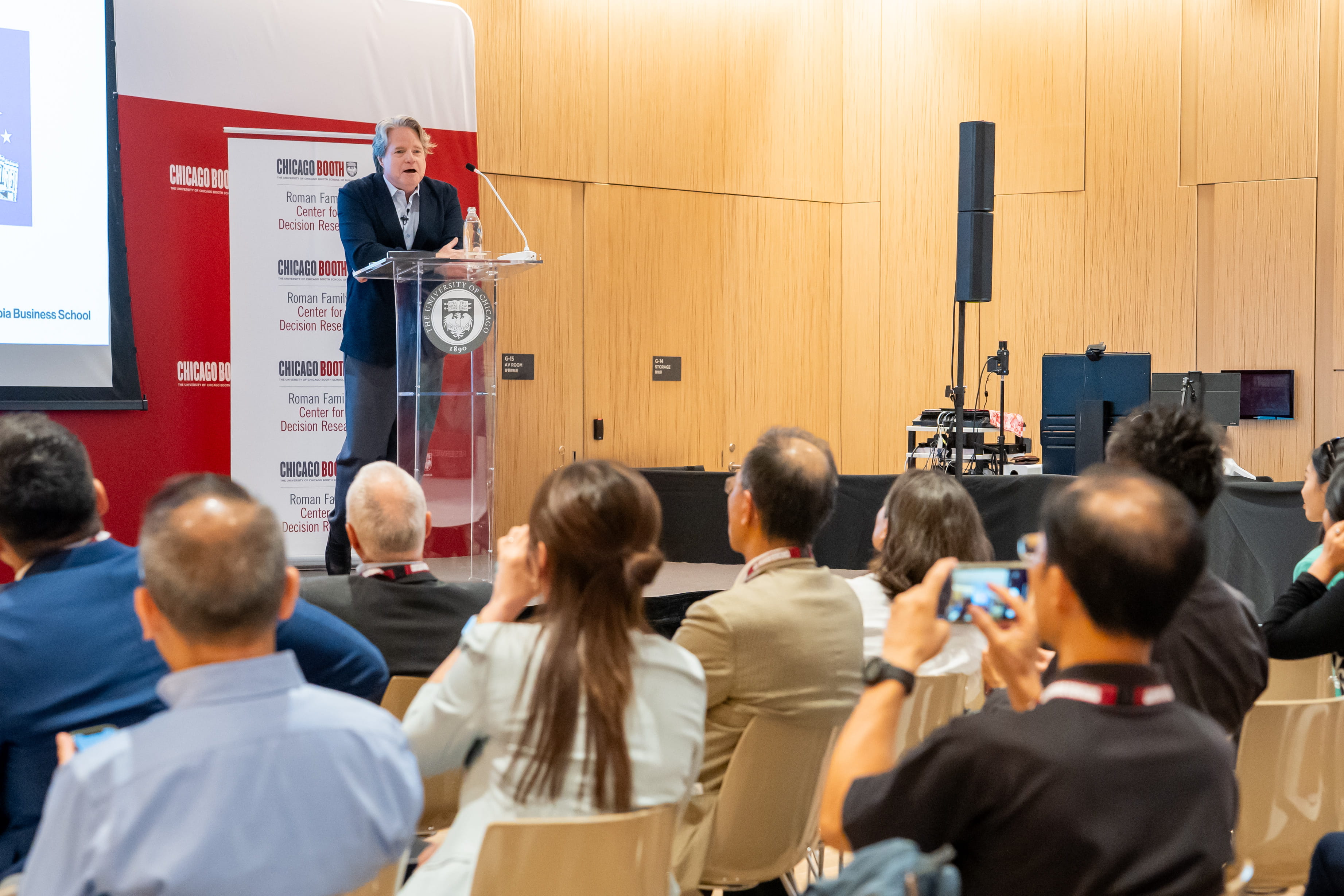
Cultural Codes and Change: Tribal Triggers
Morris emphasizes that culture is not fixed. People shift between cultural mindsets depending on context. This dynamic nature means culture can be activated—or even transformed—when leaders understand the cues that bring different instincts to the surface:
- Peer codes respond to signs of tribe and social prevalence. Seeing others do something makes us more likely to follow.
- Hero codes are triggered by symbols of values and ideals, often embodied in respected figures.
- Ancestor codes are reinforced by ceremony and tradition, which evoke reverence for the past.
These insights offer powerful tools for managing culture, whether in business, policy, or social movements.
A Case Study: Columbia Business School’s Cultural Reset
Morris shares a compelling example from his own experience helping Columbia Business School shift its organizational culture. At the time, students had little shared identity due to fragmented spaces and unclear symbolism.
Rather than trying to fix this in place, Morris and colleagues planned a cultural reset around a new campus building. The design emphasized openness, community visibility, and shared spaces. They used:
- Peer signals by ensuring students frequently saw one another
- Hero signals through design that symbolized innovation and climate responsibility
- Ancestor signals by hosting ceremonies and traditions on-site
The result: A stronger identity for Columbia Business School, an increase in student cohesion, and a jump in national rankings. This successful transformation showed how thoughtful cultural design, aligned with tribal instincts, can have measurable impact.
Changing vs. Activating Culture
Morris distinguishes between activating existing cultural codes and changing the culture itself. Both are possible, but they require different approaches:
- To activate culture, use context-specific cues that bring existing norms and values to the forefront.
- To change culture, use a sequenced strategy. Morris outlines two key models:
The Grassroots Strategy (Bottom-Up):
- Shift daily practices through visible prevalence (what people see others doing).
- Elevate new ideals using respected role models through prestige signals.
- Redefine tradition by connecting change to the past (back-to-the-future messaging).
This strategy is slow but sustainable. Morris cites Kodak’s successful campaign to get Americans to smile in photographs—a cultural shift achieved over decades through this model.
The Shock Therapy Strategy (Top-Down):
- Disrupt institutions with sweeping reform.
- Embed new values during the window of change.
- Shift practices to align with new norms.
This method is faster but riskier. Leaders must have deep legitimacy and understand the culture they are trying to change. When done poorly, it can backfire. But with the right conditions, it can succeed, like Argentina’s economic transformation under President Milei.
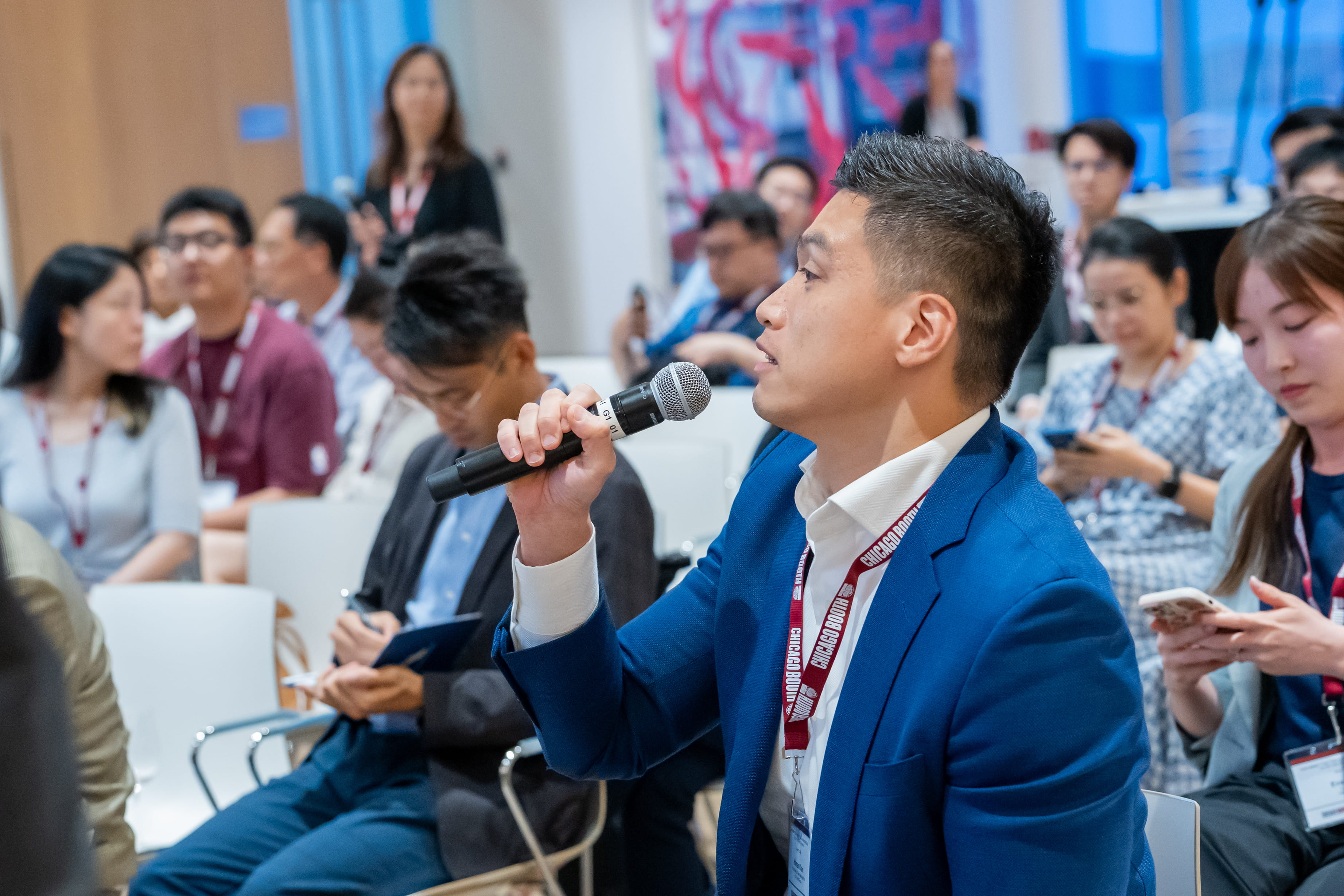
Practical Advice for Leaders and Organizations
In the Q&A, Morris offered pragmatic guidance for applying these ideas:
- Tailor your approach. Identify whether you’re trying to shift norms, ideals, or traditions, and choose the right signals accordingly.
- Avoid doing everything at once. Cultural overload leads to confusion and resistance.
- Outsider CEOs beware. Insider leaders often have the cultural fluency to navigate values and avoid backlash.
- Use legitimacy wisely. Whether invoking tradition or launching reforms, ensure your message feels authentic to your audience.
Morris also emphasizes that culture is not just a barrier; it’s an opportunity. Diverse values, when handled with care, can be a source of creativity and collaboration.
Conclusion
Think Better with Michael Morris was more than an academic lecture. It was a timely exploration of how deep-rooted human psychology can help us build stronger, more inclusive cultures at work, in society, and around the world.
As the Roman Family Center continues to expand its global presence, events like this highlight the Center’s mission: Bridge rigorous behavioral science with real-world impact. In a world often defined by division, Morris reminds us that our tribal instincts, when properly understood, can bring us together.
Upcoming Think Better events:
- November 12, 2025: Think Better with Kurt Gray (The Ohio State University)
Related resources & links
- Think Better Speaker Series
- Mindworks
- Take paid studies online in our Virtual Lab