Appian Capital Advisory LLP
Mining for the Future
What can the mining industry do to make itself greener and still turn a profit—all while being the linchpin in our path toward sustainability?
- By
- April 16, 2025
- Climate Change
Picture a society powered by renewable energy. What likely comes to mind are fields of wind turbines, banks of solar panels, heat pumps humming away on buildings, and electric vehicles plugged into charging stations.
These images are worlds away from scenes of heavy machinery at mine sites. Yet mining is integral to achieving a low-carbon goal for the sake of the planet. As governments and businesses pursue dramatic reductions in carbon emissions to fight climate change, the mining industry is providing the materials needed to transition the world’s energy sources—from copper in electrical wires to lithium and nickel in batteries. The path to a sustainable future begins on top of mountains and deep underground—and some speculate it may even require digging in the vast depths of the sea.
“The shift to a low-carbon economy significantly increases the demand for minerals and metals, making mining a critical sector in the scalability of green technologies,” says Manuel Hallivis Perez, MBA ’14, general counsel and head of compliance for Americas Mining Corporation, a division of Grupo México.
While mining is generally safer, cleaner, and more efficient today than it was in the past, nothing can change the fact that it alters its surroundings: Mining practices may remove mountaintops or carve giant holes underground to extract metals and minerals. Using chemicals to leach ore out of rock can limit the scarring effect on landscapes but risks leaving behind toxic substances.
Scientists, policymakers, energy consumers, businesses, governments, and, yes, mining companies are grappling with the inherent tension between the desire to preserve the environment by building renewable-energy infrastructure and the reality that the materials for this infrastructure have to come from somewhere.
“We all want an increase in renewable energy, but these projects have environmental side effects that we don’t like to talk about,” says Lisa Pinsley, MBA ’09, fund head of the African Transition Acceleration Fund at African Infrastructure Investment Managers, or AIIM, Africa’s largest infrastructure investor, and a former partner at global investment firm Actis. “What’s important is that mining companies are also focused on reducing emissions.” As a climate investor, Pinsley is interested in commercial solutions to enable that change.
There are hopeful signs that mining has evolved with the times. Mining companies today concern themselves with environmental, social, and governance practices and involve local communities in planning. Indeed, mining has changed dramatically in the past 30 years, says Guillermo Kaelin, MBA ’05, managing partner at Appian Capital, a private-equity firm based in London that invests in mines that are not usually a target for major mining companies. He applauds clear rules in place in Australia, Canada, and Chile to ensure safety and reduce environmental harm, as well as the companies investing in ESG.
“Most mines are located in remote settings where the population is sparse and community resources are limited,” he says. “Mining operations bring infrastructure, education, and healthcare to these areas, with the intention of transforming the well-being of the communities.”
Mining companies are applying technology to streamline their processes and using data to reduce water usage, shorten truck-hauling routes, and find valuable mother lodes. They’re utilizing electric vehicles in their fleets and renewable energy to power their operations. Meanwhile, governments are putting money toward projects that enable former mining sites to produce renewable energy, and the cleantech investing sector is seeking regulatory changes that could help attract low-cost capital. Whether it will all pay off is a question with serious implications for the future of our planet.

Manuel Hallivis Pérez, general counsel and head of compliance at Americas Mining Corporation, a division of Grupo México, at Southern Peru Copper Corporation’s Cuajone copper concentrator.
Fundamental Materials
Most clean-energy scenarios are made possible by mining. Solar and wind power have to be transmitted through electrical lines, which require copper—a highly conductive metal that is in short supply today because very low prices a few years ago discouraged companies from extracting it. Known as “the metal of electrification,” copper is used for generating, distributing, and storing electricity, making it a fundamental material for the energy transition. An electric vehicle can use two to four times as much copper as a car with a traditional internal-combustion engine.
Copper production depends on a network of mines in Latin America—which accounts for nearly half the world’s supply—and elsewhere around the world. Grupo México, a top copper producer, operates 14 underground and open-pit mines in Mexico, Peru, and the United States, with exploration projects underway in Argentina, Chile, and Ecuador. It also supplies metals such as gold, zinc, and molybdenum, a metal used in alloys that some consider the backbone of renewable energy.
Other valuable materials for the clean-energy transition include nickel, lithium, and cobalt, which are needed to manufacture the lithium-ion batteries used in electric vehicles and to support the renewable-energy storage that offsets fluctuations in wind and solar power. (For more, see “Saving the Planet: A Primer.”)
These minerals are in high demand, but getting a new mine approved can be a lengthy and challenging process—and once in operation, mines are expensive to run. Prices for these natural resources gyrate wildly based on short-term influences, but establishing a new mine is a long-term proposition. In the United States, mines take an average of 29 years to begin producing, according to S&P Global. The process isn’t much faster internationally, stretching an average of 23 years. Permitting delays, obstacles to building infrastructure in remote locations, and other factors slow things down.
What’s more, mining companies often face resistance from policymakers and local communities. In part to smooth these relationships and as a result of tighter regulations, some companies have intensified their work on ESG issues, addressing concerns about environmental damage and labor practices in an effort to earn the approval of shareholders and community leaders and to follow the letter of the law.
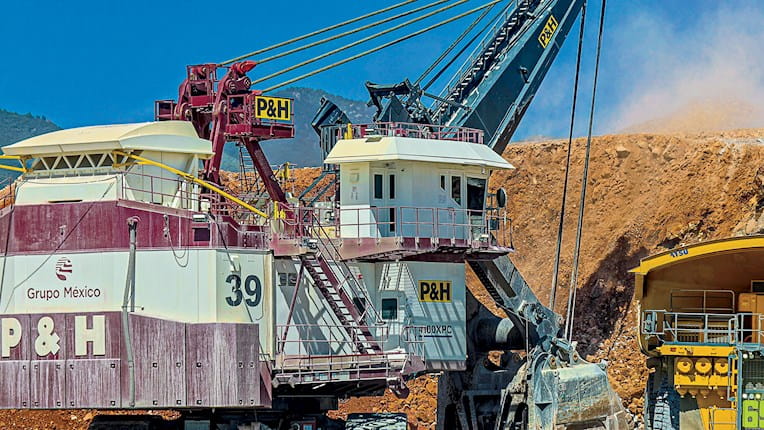
An electric shovel and 400-ton truck in a Grupo México open-pit mine, one of 14 underground and open-pit mines the company operates as the fourth largest copper producer in the world. Photograph courtesy of Grupo México.
Out with the Old
Even as mining expands to support renewable energy, production of traditional fossil fuels continues. Although coal mining has shrunk dramatically in the United States, which has shifted to oil and natural-gas production, the global demand for coal set an all-time high in 2024, according to the International Energy Agency’s Coal 24 report, which points to China as the main driver. The IEA predicts that oil will reach its peak in 2030. Global oil demand is largely a result of petrochemicals, used in thousands of products in our daily lives, and refined products, such as jet fuel.
Meanwhile, the AI boom is causing a surge in electricity usage, precipitating an increased demand for natural gas. According to a May 2024 report from Goldman Sachs, AI data centers are expected to account for about 8 percent of total US electricity consumption by 2030, up from 3 percent in 2022, and European demand for power could grow by 40–50 percent by 2033, in part thanks to the power demands of these data centers.
Although big tech companies are investing in renewables and nuclear-power generating capabilities, neither form of energy is yet equipped to run these enormous power hogs. An April 2024 report from Goldman Sachs suggests natural gas will supply 60 percent of the power demand growth from AI and data centers through 2030. Pinsley feels optimistic, however, that over the next several decades we will see significant growth in nuclear energy that could carry this load. She points to the investment in nuclear plants and nuclear technology that Amazon is making as one example.
Nevertheless, “this is a big challenge,” says Ellis Eckland, MBA ’01, lead portfolio manager for UBS Asset Management’s climate action investment strategy. “We’ve never actually fully phased out the preceding energy sources. Now, we plan to phase out all of those and replace them with renewables.” (For more from Eckland on the clean-energy transition, read “The Challenge of Cleaner Shipping.”)
Both extracting fossil fuels and mining for metals take a toll on the planet. It’s difficult to make direct comparisons between the environmental costs because the processes are so different, says Scott Odell, a program scientist at the MIT Environmental Solutions Initiative. The percentage of coal derived from extracted material can range from about 40 to 90 percent, while copper may represent less than 1 percent of the ore extracted.
But the volume of fossil fuels the world currently uses is massive. More than 7.5 billion tons of coal were mined in 2021 alone, dwarfing the estimated 30 million tons of minerals that may be needed by 2040 for the clean-energy transition, according to the International Energy Agency.
In the end, the costs of continuing to use fossil fuels for our primary energy source far outweigh the drawbacks of the clean-energy alternatives. The question as we’re tapping into new sources of energy: Can we do better this time around?

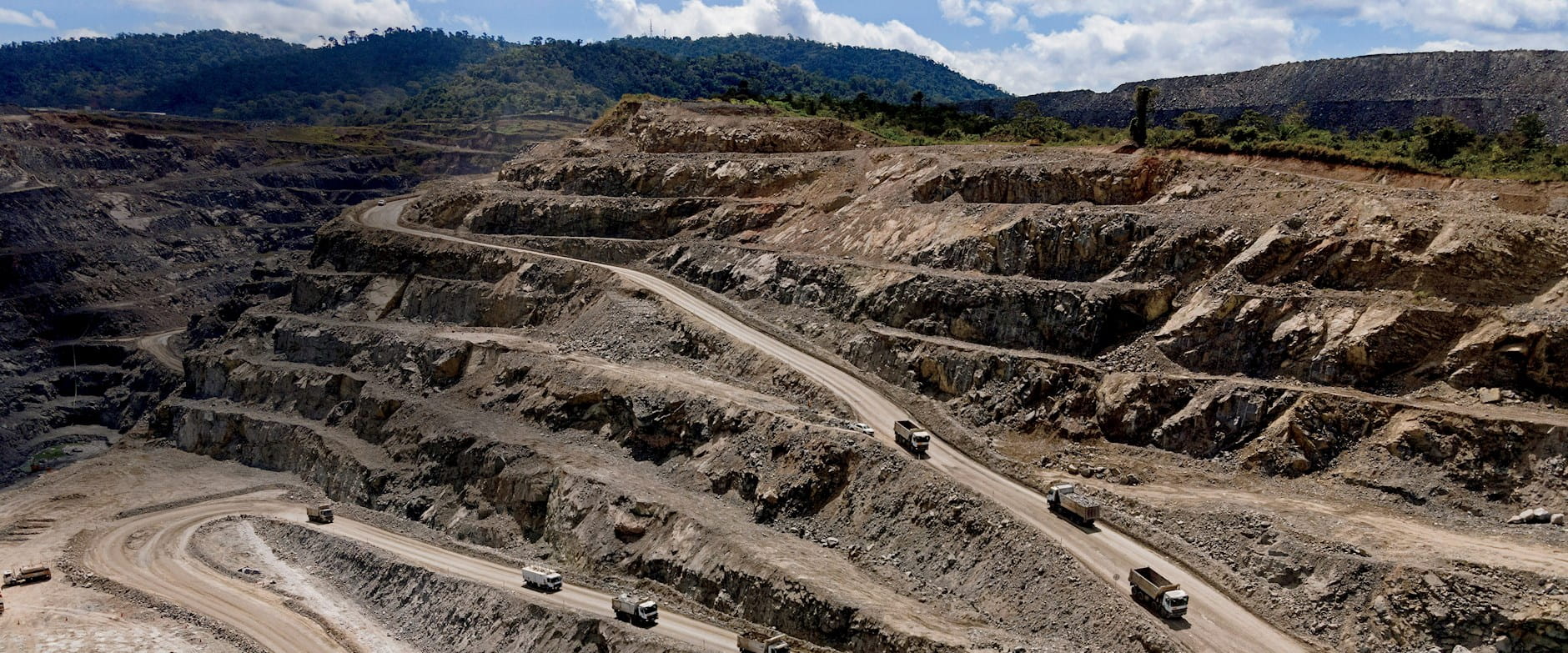
Atlantic Strategic Minerals purchased the Concord Concentrator plant in Virginia in 2024. In partnership with Appian Capital, ASM restarted the mine to retrieve high-grade mineral sands, including ilmenite and zircon. Photograph courtesy of Appian Capital Advisory LLP.
Cleaner and Greener
Some mineral-mining businesses are employing new technologies to reduce greenhouse gas emissions, improve water management, and extract more useful material with less waste. For example, Grupo México aims to reuse 83 percent of mining-operations process water by 2030, up from 74 percent in 2022, Hallivis Pérez says.
“All of our stakeholders are constantly focusing on our water usage,” he explains. “When there is a dry spell in any community where we operate, we will be one of the first that others point their fingers at, saying we shouldn’t be using the water.” Copper mining and processing use a lot of water—about 1,600 liters to produce the amount of copper found in a conventional midsize car, according to the Commonwealth Scientific and Industrial Research Organization. That’s about the amount of water the average American family of four uses in a day, the US Environmental Protection Agency estimates. And all-electric vehicles need much more copper.
Governments are watching closely: In 2023, Mexico passed amendments to mining and other laws that require companies to submit monthly water-consumption reports and curtail water usage during droughts.
Appian Capital is investing in green renewable energy in its mining operations, not only to reduce the carbon footprint but also because in some jurisdictions it’s cheaper to run your own solar plant than be connected to the grid, says Jürgen Uhlmann, MBA ’21, vice president at Appian. “In this way, it’s a circular economy,” he points out. “To build a solar plant you also need mining.”
Other innovations are helping miners get more material with less effort. At Rio Tinto Group, one of the world’s largest mining corporations, scientists have developed a technology—30 years in the making—that uses microorganisms to leach copper out of rock.
Tim Wilcox, MBA ’10, is managing director of business development at Rio Tinto. He says the new process can be used on tailings—piles of waste that previously would have been discarded. It also is more efficient than traditional mining, which separates valuable metals from rock using the energy-intensive operations of smelting and refining. Rio Tinto is using the technology as the basis of a new venture, dubbed Nuton, which is partnering with other mining businesses.
“Technology advances are helping our geologists find new deposits, unlock previously unviable resources, and extend the life of existing assets,” Wilcox says.
Large, modern mines have become safer thanks to automation, but as the work becomes more sophisticated, requiring greater training and reliance on experts, local residents sometimes question whether they will benefit from the new jobs. Residents also can point to a long history of toxic spills and polluted water.
Mining executives say projects cannot move forward without a “social license to operate”—trust from the local community. Rio Tinto operates in 35 countries with 57,000 employees, mining copper, aluminum, lithium, and other materials. In the past three years, the company says, it has improved its procedures for handling grievances from local residents, aligning with the UN Guiding Principles on Business and Human Rights. It has also provided employee training on these updated practices. “You can’t disentangle the need for metals and minerals from the need for impeccable ESG,” Wilcox says.

Tim Wilcox, managing director of business development at Rio Tinto Group, at a mine site in Mongolia, Oyu Tolgoi, which has one of the world’s largest known copper and gold deposits.
Reaping the Wind
Along with producing the metals and minerals needed for the energy transition, mining companies are using more renewable energy themselves. Setting up a mining operation is like building a small city—it needs its own roads, housing, and medical facilities. And once the mine opens, unearthing and refining large quantities of natural resources uses a great deal of energy.
Mining companies face the same pressures as other businesses, from oil companies to airlines to manufacturers, to reduce their carbon emissions. In a 2020 sustainability report, McKinsey & Company estimated that mining companies are responsible for 4–7 percent of global greenhouse gas emissions.
Rio Tinto has set targets to decrease emissions from its operations by 50 percent by 2030 and to be net zero by 2050, Wilcox says. (See “Saving the Planet.”) Replacing fossil fuels with solar and wind energy is one way the mining company is moving toward these goals. To get there, Rio Tinto plans to have spent $5 billion–$6 billion on decarbonization by 2030.
In Africa, mining companies are taking active steps to procure renewable power. For example, Anglo American has partnered with the French power utility EDF to invest in solar and wind plants that sell power back to the mines, says Pinsley, the climate investor. “Mining companies are power hungry, and if they can source power that is more reliable and cheaper than the grid, and it’s green power, it’s a no-brainer,” she explains.
While renewable energy can help companies meet their power needs and emissions-reduction targets, the switch can produce its own complications. One challenge in building large wind or solar plants is protecting birds and other wildlife.
Pinsley recalls working on the deal that created the Kipeto Wind Power Station, which uses 60 wind turbines to power about 250,000 households in Kenya. Kenyan president William Ruto has said he wants the country to run entirely on renewable energy by 2030. The Kipeto wind farm also stood to benefit the local Maasai population, who own the land the project is built on and who could continue to use the land to graze their cattle. But nongovernmental organizations that work to protect wildlife and conserve nature worried the wind project’s rotating blades would harm two species of critically endangered vultures inhabiting the area. Pinsley helped work out a win–win solution in which on-site ornithologists sponsored by the wind farm track the birds and can ask for specific wind turbines to be turned off when priority species are in the area, dramatically reducing the number of collisions. Additional funding from the project supports local biodiversity organizations in other conservation efforts as well.
“We brought the biodiversity community closer to the renewable community by being innovative and solving problems together rather than covering them up,” Pinsley says. “For example, we structured a financial instrument for the project from NatureVest, a division of the Nature Conservancy, to further strengthen the Kipeto project’s ability to maintain its conservation goals.” Mining companies aim to show a similar collaborative mindset to get more support for their operations.

Lisa Pinsley (second from right), fund head of the African Transition Acceleration Fund at AIIM, at the Kipeto wind farm in Kenya.
A New Life for Former Mines
While active mines look different today than in the past, decommissioned mines also play a role in the clean-energy transition. When a mine stops producing valuable resources, its site can sit empty for years. Many former mines are in remote locations that are unsuitable for housing or commercial development, and the surrounding water and soil can be contaminated by chemicals or heavy metals. Countries with a long history of mining, such as Australia, Canada, and South Africa, began instituting reclamation laws decades ago that require mining companies to make the land usable once they cease operations. Uhlmann has observed the move toward reclamation in action. “In many cases, this has become part of the permitting process even before the mining company starts building,” he says.
Nevertheless, according to the Society for Ecological Restoration, in 2022, less than 1 percent of global mines had achieved ecosystem restoration, with abandoned and legacy mines taking up an area of at least 50,000 sq. km.
But these former mine sites can be promising locations to produce renewable energy. Many offer large expanses of land with abundant wind or sunshine. Because the sites already have power and roads in place, they are connected to the energy grid and have infrastructure at the ready. Businesses see an opportunity to repurpose these sites into facilities generating wind, hydroelectric, and solar power.
In March 2024, the US Department of Energy announced funding of up to $475 million for projects that either convert former mine sites to produce renewable energy or use more clean energy at current and ongoing mine operations. Among the funding recipients are former coal-mining sites in Kentucky, Pennsylvania, and West Virginia that could be repurposed as solar farms.
Others are active copper and gold mines in Arizona and Nevada that propose to fuel their operations with geothermal energy or solar power, along with battery energy storage systems.
“Developing clean-energy projects on mine land provides an attractive economic alternative to using undisturbed natural and agricultural land,” according to a March 2024 statement from the department.
“Mine land is often located near critical infrastructure that makes it suitable for clean-energy development, including electric substations, transmission lines, and access to roads or railroad lines.”

Appian Capital’s Rosh Pinah Zinc, an underground zinc mine in southwestern Namibia. The mine produces mainly zinc, a crucial base metal, and lead sulphide concentrates. Photograph courtesy of Appian Capital Advisory LLP.
AI Hits Pay Dirt
Technology is helping businesses improve the productivity of existing mines and find unexpected new sources of metals and minerals.
At Appian Capital, the firm is using artificial intelligence and other technologies to better identify promising mines and to streamline operations. AI could be useful in accelerating mine production to combat shortages that slow down makers of electric vehicles and high-tech batteries.
“From start to finish, developing a typical site for a large project could take up to 20 years,” Kaelin estimates. “We are not focusing on those large, multibillion-dollar projects. We look for projects under the radar—midsize projects.”
In 2018, Appian, which has $3.6 billion in assets under management, purchased Atlantic Nickel, owner of a Brazilian open-pit nickel sulphide mine, out of bankruptcy. Atlantic Nickel had invested $1 billion into the mine’s operations, but the infrastructure was much too expensive for the amount of nickel produced, Kaelin says. The company was inefficiently harvesting large quantities of rock and hauling the material in inefficient trucks for processing.
“We did a significant amount of drilling to understand the deposit better,” Kaelin says. “To be profitable, digging needed to be more specific, more granular, in every piece of the deposit.” Using smaller trucks, a revised mine design, and a team of specialists, Appian significantly improved the mine’s profitability and safety conditions.
Kaelin says Appian is beginning to explore AI’s ability to predict the behavior of ore bodies—solid masses of rock containing valuable compounds—at a mine site, based on variables such as the quality of rock and grade of ore. AI also may be useful to determine the most efficient way to move a fleet of trucks, which could help mines reduce both costs and emissions.
Other mining businesses are also reporting success with AI. In 2024, a California company called KoBold Metals, backed by Bill Gates and Jeff Bezos, reported that it had used AI to find a huge copper deposit in Zambia—the largest discovery of its kind in a decade, potentially worth billions of dollars a year. The AI technology that uncovered the copper ore analyzed sophisticated data about subatomic particles underground as well as details from old-fashioned paper maps and reports in Zambia’s mining archives.
The big find has galvanized the industry, but it also underscores the capital-intensive nature of mining. KoBold Metals has raised more than $400 million, but it would be years before any copper from the Zambian deposit could reach world markets. Political transitions, environmental issues, and technical challenges can delay or derail any project.
“You have to put in huge amounts of investment before you see cash flow,” says Rio Tinto’s Wilcox. “Mine lives span multiple decades. You’re having to carry a lot of political risk, and that informs how you think about development.”

The port, stockpile, and loading facility of Rio Tinto’s Iron Ore Company of Canada in Sept-Îlles, Quebec. The hub connects the iron ore mine, processing plant, and a 418-kilometer railway for ground transport. Photograph courtesy of Rio Tinto.
It Takes a Team
Researchers are investigating how to support long-term projects vital to the clean-energy transition by distributing risk among governments, businesses, multilateral development banks, and other sources of capital. A successful approach could employ both carrots and sticks to steer investment toward reducing emissions, says Mili Fomicov, MBA ’11, who leads clean-energy research at the Centre for Climate Finance & Investment at Imperial College Business School.
“What works is a combination of incentives, through subsidies and concrete policy mechanisms, along with policies that make polluting and emitting activities uneconomical,” Fomicov says.
European institutions, which grappled with high and volatile energy prices after Russia’s invasion of Ukraine, have been an example of this balanced approach, Fomicov says. The European Investment Bank says that every euro it spends on financing for clean-energy projects attracts another 1.4 euros from the private sector. In 2019, the EIB said it would phase out financing for oil and gas projects that lack provisions such as carbon capture and storage to offset their emissions.
The resources needed to transition the world away from fossil fuels won’t come easily. But if businesses and governments intend to live up to their clean-energy commitments, they have to face the challenge—and mining will be a crucial part of the solution.

Mili Fomicov, lead for clean-energy research at the Centre for Climate Finance & Investment at Imperial College Business School, records a news segment.
The Challenge of Cleaner Shipping

Extracting minerals and other raw materials from the earth creates carbon emissions, and so does moving them around the world, says Ellis Eckland, MBA ’01, lead portfolio manager for UBS Asset Management’s climate action investment strategy. Products are often mined in one country and transported to another for processing. In fact, mined commodities such as iron ore for steel or bauxite for aluminum make up the majority of what is shipped around the world in dry bulk shipping vessels.
Because of this, decarbonizing shipping is an important way for mining businesses to reduce their environmental impact in the near term, Eckland says. Other avenues, such as replacing the heavy trucks used at mining sites with electric vehicles, are not yet technically feasible.
Transporting goods by sea uses less carbon than other methods, but cargo ships still rely on fossil fuels. For mining businesses, iron ore and bauxite are heavy and relatively low in value by weight, so finding new shipping procedures that are less environmentally burdensome yet cost-effective is tricky.
One area of focus for the climate action investment strategy is on technologies that can help shipping companies become more energy efficient. In the past few years, mining companies and maritime-shipping businesses have been working together to develop cargo ships that run on cleaner energy and to retrofit ports to supply alternative fuels, Eckland says.
They are exploring ways to convert cargo ships to run on green methanol or green ammonia, which are made by using renewable electricity to produce fuel. Each option has its challenges: Methanol is easier to use but has limited supply potential, while ammonia is more scalable, but a spill could be dangerous for crew members.
To switch to these cleaner energy sources, shipping companies need to develop new engines. But to justify investing in this change, they have to know that customers will charter the new ships. And ports need to be equipped to refuel ships so that they don’t get stranded. “Green shipping” corridors—routes between ports that support zero-emission fuels—are being planned across the Atlantic and Pacific Oceans.
Ahead of the 2023 UN Climate Change Conference in Dubai, Eckland and UBS hosted a maritime decarbonization conference, bringing together shipping companies, fuel providers, and mining conglomerates to discuss supply guarantees and long-term contracts for the transition. And Eckland participated in discussions about availability and safe storage of climate-friendly fuels.
“There’s a big coordination problem,” he says. “But if you could solve it, when combined with these new technologies, it would move the sector toward a much lower carbon footprint.”
Saving the Planet: A Primer
What Does Net Zero Mean?
Net zero refers to cutting carbon emissions to a level that can be absorbed by natural sources such as oceans and trees, and by human-designed technologies such as carbon capture and storage.
The Paris Agreement, adopted by nearly 200 parties at the UN Climate Change Conference in 2015, aims to limit global warming to no more than 1.5ºC above preindustrial levels to avoid the worst potential effects of climate change. The Intergovernmental Panel on Climate Change argues that to achieve this temperature level with consistency, the world must reach net zero by 2050.
In accordance, more than 100 countries, including EU members, China, and India, and many US states have set targets to reach net zero between 2050 and 2070.
But progress toward that goal is falling short. In 2024, for the first time, Earth’s temperature hit 1.55°C above the 1850–1900 average, breaching the limit stipulated in the climate accord.
“Individual years pushing past the 1.5-degree limit do not mean the long-term goal is shot,” said UN Secretary-General António Guterres in a January 2025 statement confirming the recorded finding. “It means we need to fight even harder to get on track.
Aluminum plays a role in most energy technologies, but it’s the key component, along with copper, of solar panels.
Copper is used in the battery, electric motor, wiring, and other parts of an electric vehicle. Some all-electric vehicles require more than 180 pounds of it.
Cobalt is in the cathodes of certain lithium-ion batteries as well as some carbon-capture technology. The environmental costs of mining cobalt are high.
Lithium is the main ingredient in the rechargeable batteries used in EVs and hybrid cars and even grid-scale energy storage.
Rare earth elements are part of the magnets that turn electric motors and wind turbines.
Infinitely Recyclable Copper
Attempts to meet clean-energy goals could double the demand for copper by 2035, but it doesn’t all have to come from mining. End-of-life copper, for instance from electronics scrap, can be 100 percent recycled. Here’s how it’s being done:
1. Collecting and Sorting
Materials are categorized according to their copper content and purity levels and then cleaned.
2. Concentrating
The copper is stripped from any surrounding materials and undergoes shredding to make uniform scraps.
3. Melting and Refining
The shredded copper is melted and its impurities are removed.
4. Solidification
In a final stage, the copper is cooled and shaped into a usable form.