
Best In Show
Personal connections with animals prompted these alumni to build companies that help maintain and improve the quality of life for pets.
- By
- April 23, 2025
- Entrepreneurship
We arrange our schedules to accommodate them, provide beds for them to lounge on, feed them the best food—even manage the Instagram accounts we’ve set up for them. The joke goes: “If aliens saw us walking our dogs and picking up their poop, who would they think is in charge?”
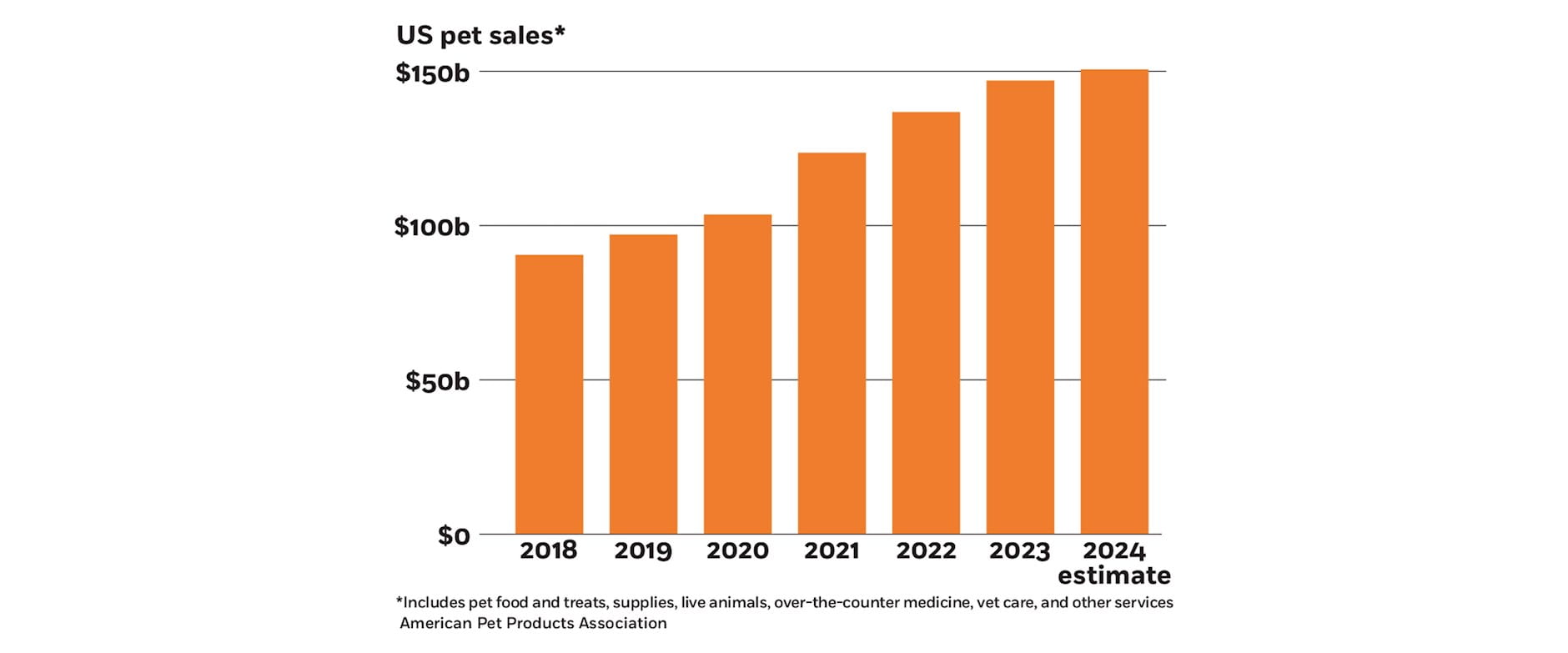
Pets reside in 82 million of the 130 million or so total US households, which means nearly two-thirds of US consumers are pet owners. While that number isn’t dramatically different from 15 years ago, the amount pet owners spend on their fur babies is. According to the National Pet Owner Survey, spending on pets increased an average of 9 percent per year from 2018 to 2024.
In 2019, the US pet-care industry was valued at nearly $100 billion, according to the American Pet Products Association. A headline in The Economist that year read: “Pets have gained the upper paw over their so-called owners,” citing as some of its evidence “the growing market for pet clothing, pet grooming, and pet hotels.” The APPA’s most recent annual report, in 2024, estimated that US spending on pets would reach more than $150 billion.
This upward trend may be in part thanks to the COVID-19 pandemic, which prompted many people to buy more—not just for themselves but also for the furry companions who helped get them through it. When we look at some of the biggest cultural changes to come out of that time—such as working from home, increased adoption of digital tools, and health consciousness—each one has had at least some impact on our attachment to our house pets.
For good reason, disrupters look at the pet-care landscape and like the opportunities they see. Gabriel Huertas del Pino, MBA ’24; Gil Bolotin, MBA ’14, and Yoav Mordowicz, MBA ’13; Brian Green, MBA ’21; and Maya Shaposhnik Cadena, MBA ’23, are some of the Booth alumni who are running companies that offer innovative ways—from dietary to diagnostic—to support pets’ quality of life and keep them healthy, and all have personal animal connections that set their business ideas in motion.

Gabriel Huertas del Pino, MBA ’24
Arch Pet Food, Chicago
While pursuing his MBA, Gabriel Huertas del Pino lived with his buddy Ray Melencio and their black-and-white foster mutt, Milo, in Chicago’s Bucktown neighborhood. Neither del Pino nor Melencio had much experience caring for canines, so other than a steady diet of affection, they fed him mostly the garden-variety kibble found at any grocery store.
Like most ravenous dogs, Milo ate it all—but a key common ingredient in the food was making him sick. Milo began to lose fur and experience rashes and indigestion. Naturally, the roommates took Milo to a veterinarian, where they soon discovered Milo had a poultry allergy, common in dogs.
The vet suggested a variety of meal alternatives for Milo. The roommates were up for anything to make Milo well, but they got a bit ill themselves when they learned a bag of hypoallergenic dog food cost about $150—or they could spend a bit less and start on kibble containing a “novel” protein.
“All the novel proteins are kangaroo, water buffalo, alligator—I was legitimately surprised to hear any of these existed in dog food,” says del Pino. The whole ordeal reminded del Pino of a story about the United Nations’ Sustainable Development Goals that he’d read years earlier while a staff attorney with the American Bar Association. The story identified opportunities to make meaningful reductions to our carbon footprint by integrating crickets into the food supply. “They’re rich in vitamins, higher in protein than beef, and less harmful to the environment than livestock,” del Pino says.
Some quick Googling revealed that crickets, and insects more generally, are considered a delicacy for dogs in Europe—though not in the United States.
At the time, del Pino was an active member of the student investment committee at the Rustandy Center for Social Sector Innovation’s Steven Tarrson Impact Investment Fund and hadn’t given any thought to entrepreneurship as a concentration. But after realizing that there could be a better solution for not just Milo but all dogs, he pivoted halfway through his coursework. Del Pino submitted a business plan to Booth’s Edward L. Kaplan, ’71, New Venture Challenge and, much to his surprise, got accepted.
“I thought, ‘If I don’t get into the NVC this year, I’ll get to it next year,’ because they get like 70 or 80 applicants,” he says. “And then we got it, and I was like, ‘Oh, cool!’”
As he started working on his project, someone in the Booth community suggested he reach out to Sean Madison, MBA ’20, who, at the time, was the director of North American business development at Innovafeed, a France-based biotech company that specializes in breeding black soldier fly larvae for use in animal and plant nutrition. The company was primarily focused on commercializing the protein and oil derived from BSFL as livestock and aquaculture feed ingredients in animal agriculture but was also exploring pet food. (Read more about Innovafeed and “the Booth Bug Boys” in the Fall 2023 issue and online.)
When del Pino attended the 2022 Petfood Forum, an annual global conference and exhibition focused on research and technologies employed in the pet-care industry, he connected with Greg Aldrich, the forum’s emcee. Aldrich was an associate professor at Kansas State University and a consultant for Nulo Pet Food, where he is now COO.
Del Pino told Aldrich about his interest in sustainable proteins. Aldrich confirmed that insects were “an amazing protein that’s highly digestible and easy to work with” and added that while most major pet-food brands were intrigued by the possibilities of integrating insects, the majors “buy innovative companies, but they rarely like to do innovation themselves,” del Pino recounts.
That was all del Pino needed to hear. With help from certified nutritionists recommended by Aldrich, inspiration from Milo, and $125,000 in startup capital—from Rough Draft Ventures ($100,000), a project of investment firm General Catalyst to fund student entrepreneurs; Booth’s New Venture Challenge ($10,000); and the Polsky Launch Accelerator ($15,000)—del Pino quit his day job and dogged forward with Arch Pet Foods.
Since its launch in the first quarter of 2023, Arch—which will soon change its name to Archway—has produced dog treats made primarily from crickets and plants that are designed to improve dogs’ digestive health, skin and coat, and hips and joints, among other preventive measures. The list of ingredients for the treats is intentionally short: crickets, sweet potato, tapioca flour, and a variety of other plants.
Arch is experimenting with invasive carp as a protein source as well—an eco-friendly choice, as invasive carp (originally imported from Asia) are outcompeting native fish in the United States and disrupting the food web. According to del Pino, these carp account for 80 percent of the biomass in parts of the Mississippi River.
The treats are sold in 220 stores nationwide and are projected to be in close to 500 by the end of second quarter 2025. They will also be available through the online pet superstore Chewy—where Sumit Singh, MBA ’14, is CEO—to coincide with Arch’s launch of its full food line, featuring the same meat-free ingredients. Cat food, too, is in the pipeline.
“We’re planning to use Innovafeed’s Hilucia Protein,” a trademarked product derived from black soldier fly larvae, says del Pino of the in-development food lines. BSFL is five times more affordable than crickets, and could reach 15 times more affordable within the next three or four years, he says. It’s also more abundantly available and offers several unique health properties. Recently, Arch co-branded with Innovafeed, where Madison is now the director of global pet food and North American growth.
Del Pino says the tailwind in the pet-care industry is not just about the increased humanization of pets. The care pet owners show their animals is also an extension of the way many treat themselves, he observes.
“Our road map is to make a product that has no animal proteins whatsoever,” says del Pino. “Pet owners are more likely to be vegetarians than the typical consumer, and have long scrutinized the food and treats they serve their pets.
“For now, we’re avoiding any of the mass-production qualms that you might have with beef, chicken, or pork. BSFL is more ethical while offering equal nutritional value. And best yet, by metrics such as water use, land use, and greenhouse gas emissions, it’s more sustainable by hundreds if not thousands of times.”
What else does he have planned for the future? While del Pino is quick to concede he wouldn’t have accepted NVC money if he hadn’t had an exit strategy in mind, he can’t imagine ever wanting to leave pet care altogether.
“It’s so fun,” he says. “Pets are delightful to work with.”

Gil Bolotin, MBA ’14, and Yoav Mordowicz, MBA ’13
Sploot, Denver and Chicago
All their lives, Gil Bolotin and Yoav Mordowicz have had dogs. And all their dogs’ lives, they’ve had issues that required veterinary attention. But as pet owners, Bolotin and Mordowicz (pictured left and right, respectively) saw gaps in veterinary care delivery. They observed outdated systems, rigid hours, and limited availability that left them—and, they felt sure, other pet owners—without the access they needed when they needed it most.
“What frustrated us was a lack of modern, accessible care,” says Mordowicz. “If your pet has a bad rash or ate something questionable, your vet might be closed—it’s the weekend or past 6 p.m. If they’re open, they might be completely booked. The only alternative? The emergency room—where you could wait hours and pay thousands for something that isn’t truly an emergency.”
It was this broken experience in veterinary care that Bolotin and Mordowicz set out to fix. The two met while earning their MBAs at Booth, and both later worked at McKinsey & Company—Bolotin in New York and Mordowicz in Chicago—before transitioning into high-growth startups. Mordowicz became vice president of business at Via, a transportation tech company focused on smart routing for buses, while Bolotin worked as vice president of business development at Anagog, an AI startup developing edge-AI solutions for mobile, where he led North America operations.
“Working at these startups helped us decide that we wanted to build our own company,” says Bolotin. And their shared experiences in operations, strategy, technology, and business growth led them to a simple idea: Veterinary care should be seamless, stress-free, and built around the needs of today’s pet owners.
Before launching Sploot in 2021, Bolotin and Mordowicz conducted hundreds of interviews with pet owners, veterinary professionals, and industry leaders across operations and medical services. Their research uncovered two challenges in the veterinary industry. Pet owners struggled to navigate pet “parenthood” and needed a trusted, accessible veterinary partner who could provide guidance and care for all their pet’s needs—before, during, and after a visit.
At the same time, veterinary professionals faced extreme burnout—not just from long hours and high stress but also from toxic workplace cultures, limited growth opportunities, and a lack of support—making it harder for vets to attract and retain good staff.
This insight led to the creation of Sploot, which Bolotin and Mordowicz say isn’t just a better veterinary clinic but a revolutionary pet-care model. Unlike traditional vet clinics, Sploot clinics offer comprehensive services—primary care, urgent care, advanced dentistry, surgery, and more—under one roof. Technology is at the heart of the experience, with a mobile app that provides AI-powered personalized recommendations, appointment booking, real-time health updates, and direct messaging with vets. Customers also have access to after-hours tele-triage for quick expert guidance and SplootRx, a streamlined online pharmacy with home delivery.
Every Sploot location is certified “fear free” through the Fear Free Veterinary Certification program, which is designed to keep pets calm and comfortable and workplaces safe. Instead of closed-off waiting rooms, Sploot has glass-walled exam rooms that give pet owners full visibility into their pet’s care, reinforcing trust and transparency.
Beyond transforming pet care, Sploot is tackling the challenges veterinary professionals face by providing sustainable schedules; structured mentorship through Sploot CAMP, a series of coaching and mentorship programs that provide foundational skills training; and a supportive culture that prioritizes work–life balance and professional development.
“We knew that to provide the best care for pets, we had to create the best environment for veterinary professionals,” says Mordowicz. “That means building a place where vets and nurses can grow, thrive, and do their best work—without burnout. At Sploot, we’re proving that a culture of respect, development, and sustainability is good for our teams and directly translates to better care and outcomes for pets.”
Sploot has grown rapidly, with 13 locations in Denver and Chicago and expansion underway in Colorado Springs. Its growth is backed by $50 million in funding, including an initial $10 million investment led by Skydeck Capital, a fund run by Michael Polsky, MBA ’87, and $40 million in Series A funding led by private-equity firm L Catterton.
“From the start, we said we were going to have a culture that is focused on respect and a culture that is focused on sustainability of staff and work–life balance,” says Mordowicz. “And it’s proved to be the right approach.”

Brian Green, MBA ’21
Animal Biosciences, Boston
Growing up in Potomac, Maryland, Brian Green wanted to be a veterinarian. Riveted by the exploits of Steve “Crocodile Hunter” Irwin, he’d wander off golf courses to look for snakes and imagine he might find tiny alligators while his father was stuck in a sand trap.
His affinity for nature and wildlife, plus his academic excellence in the sciences, seemed to put him on target to fulfill his dream. Unfortunately, Green says, “I have a huge fear of blood.”
“As an undergrad, I had a slight seizure when I was getting my blood taken, and I was like, ‘I can’t be a zoo surgeon if I’m going to seize up when I’m with a panda,’” he says.
After earning an undergraduate degree from Cornell, he tried his hand at investment banking, but he never surrendered his adoration for animals. Jobs involving analytical work and corporate development at BB&T Capital Markets and Zenetex, respectively, followed, but he decided neither was for him.
“I was miserable,” he says. “If I meet someone who’s in love with investment banking, I stay away from that person. I learned all these Excel, modeling, and analytical skills, but I just wasn’t really fulfilled. I wanted to see how I could apply what I learned to pets and animals.”
That’s when he decided it was time to return to his first love—pet care—and enrolled at Booth to help him make the career switch.
Signing up for courses, he consulted with an advisor who mistook his interest in “pet” care for an interest in “positron emission tomography”—an honest mistake given that pet tech was still a burgeoning enterprise. Once Green assured her his interest had nothing to do with nuclear medicine, she steered him toward relevant courses to help fast-track his pet-care pivot.
Booth also helped set Green up with an internship at FluentPet, a small cognitive-science company best known for its sound buttons that help optimize communications between humans and cats or dogs, a system later featured in the 2024 Netflix documentary Inside the Mind of a Dog. As one of only a few employees, Green helped launch the new enterprise. It was valuable experience, he says, but he didn’t stay long because the company wasn’t yet ready to use someone at his level.
Post-Booth, he landed a role as CEO at Furba Care, a startup about the same size as FluentPet that had developed an at-home diabetic testing kit for dogs. The concept—which allowed pet owners to swab dogs’ mouths to test glucose levels—bordered on brilliant, though the efficacy of it did not.
The most valuable lesson came from James Schrager, clinical professor of entrepreneurship and strategic management. “Ask yourself these three questions,” Schrager told his New Venture Strategy students: “Does it work? Do people care? Can you protect it?”
Regarding Furba, the answer to the first question turned out to be “no.”
"The dog eats some grass, it plays with a plastic chew toy, or it eats some food right before the test—so many things can impact the mouth’s environment,” Green explains. “It was a coin flip whether or not the coloration on the test strip was accurate.”
Green stuck with Furba until the bitter end. While he wishes the science had worked, he has no regrets about accepting the role. “I loved it,” he says. “The people I worked with were fantastic, intelligent people. Even though it failed, I was fulfilling my life’s goal—helping animals.”
Now the senior director of operations at Animal Bioscience, Green is focused on improving the well-being of aging dogs and even combating the effects of aging itself. Green sees Animal Bioscience as an extension of the booming human market for anti-aging products, which was projected to be $50.1 billion in 2024 and is expected to reach $70.3 billion in 2030. In this way, with his third stab at finding a niche in pet care that has not only staying power but growth potential, he may have hit upon a synergy sweet spot.
“Anything you can think of technology-based and health-based that is trending in humans,” says Green, “the trend in animals is either right there with it or a year or two behind.”
Animal Bioscience manufactures Leap Years, a soft-chew supplement that combines NAD (short for nicotinamide adenine dinucleotide, a coenzyme thought useful for a number of body functions) and senolytics clinically proven to support cognitive function, vitality, and healthy aging. Currently, Animal Bioscience products are available exclusively through the company’s website and Amazon, with Chewy expected to join the list within “the next quarter or two.”
What Green likes most about Animal Bioscience is that he feels respected and has a powerful voice in the company’s direction, especially relative to his investment banking days at BB&T, where he felt like “just a cog” in a “bureaucratic company.”
Because the staff is small, Green takes on many responsibilities, including customer support. “It’s always heartbreaking to hear, ‘My dog just passed away.’ Maybe 30 or 40 years ago, when a dog died, you’d just bury it and get another one. Not for pet owners today. It’s like a baby’s died. It’s a member of the family.”
While Green acknowledges that established companies offer more stability and, potentially, better compensation, he’s willing to accept the risks involved in joining another startup for the opportunity to have more influence and a vested interest in the company’s success.
“If, God forbid, Leap Years goes away too,” he says, “then I’m probably reaching an age where I might start considering something a little more corporate, a little more stable. But, hopefully, that doesn’t happen.

Maya Shaposhnik Cadena, MBA ’23
Vetted, Boston, Chicago, Dallas, and New York
Anyone who owns a French bulldog knows they’re as personable as they are pricey. The average breeder charges upwards of $4,250, making Frenchies—along with their English bulldog relatives—the most expensive breed to buy. And that initial hefty outlay doesn’t factor in the likely medical bills a French bulldog owner will rack up. Because many endure a litany of health issues throughout their typically abbreviated lifespans, the dogs are also among the most expensive breeds to insure (second only to Rottweilers).
Unfortunately for Maya Shaposhnik Cadena, her Frenchie, Shor, fell within the breed’s wellness curve. She noticed early on that her dog’s hind legs trembled when he walked, and he seemed to be in pain every step of the way. Instead of addressing the issue, Shaposhnik Cadena says, veterinarians saw her as a bit of an alarmist.
“I felt that vets were rolling their eyes at me as a typical Frenchie parent,” she says. “‘Here she comes again. Obviously her dog has so many issues. It’s a French bulldog. What does she expect?’”
Shaposhnik Cadena was not unfamiliar with complications common to Frenchies. “Everyone told me not to get one because of that,” she admits. “But because of that, I expected vets to be able to equip owners like me. What could we do to prevent the situations common to Frenchies? Are there behavioral things we could do? Are there grooming things we could do? Are there medications we could give?
“‘Give me some kind of guidance,’” she told vets, “‘because at the end of the day, I’m the primary caregiver here.’”
At the heart of her frustration was an important problem underlying veterinary medicine—and human healthcare too, some critics have argued. “It’s built on reactionary care and has been the exact same model for the past 350 years,” Shaposhnik Cadena says. She saw an opportunity—and the key to disruption—in placing a high priority on preventive care.
Before enrolling at Booth, Shaposhnik Cadena had already been a successful entrepreneur in Israel, where she lived as a young adult. In 2010, at age 20, she founded the event-planning company International Events of the Year. At age 25, she sold it as one of the largest international production companies in Israel. She then cofounded Together Consulting, a six-employee startup commissioned to open hotel spas and franchises. After selling that company, she moved to the United States and worked as a professional fundraiser.
During that time, Shaposhnik Cadena experienced her first traumatic experience with a dog close to her heart. Her sister, Natalie, worked in a canine unit in the military, and was permitted to take her dog, Fedor, home with her.
“They had such a beautiful bond,” says Shaposhnik Cadena. “One day she called us to tell us that he had cancer. It had spread everywhere, and he had four months to live. She was hysterical.”
In 2021, studying at Booth and contemplating her third venture, Shaposhnik Cadena began to consider how she could channel the traumatic experiences that she and her sister experienced with their much-loved pets into something positive. Vetted was born. It combines physical clinics with digital technology to provide preventive healthcare for both cats and dogs.
Through an app, pet owners can book appointments as well as access health records and telemedicine services. Each one-on-one appointment with a vet lasts between 30 and 45 minutes.
The twist is that all Vetted locations are but a single room and are situated inside existing pet day-care operations. “We pivoted the model a few times,” admits Shaposhnik Cadena. “In the beginning, we were a digital app with curated preventive-care kits that we’d send to pet parents. We realized that was too sophisticated—every dog needs something different.
“Then we had a subscription where you had a personalized pet-care plan specifically based on your pet’s age, breed, and lifestyle, and you had 24/7 concierge service on the app,” she adds. “We had that model for about a year, and through it, we realized that people trusted us. They started asking, ‘Well, you’re telling me to access all these services—do you have a trusted vet clinic where I could do this?’
“The model we have now is really accessible,” she explains, “and much cheaper than traditional care.”
Just last month, Vetted purchased the assets of an AI pet-tech company. This will allow it to release an enhanced version of its pet-parent app, which will include a loyalty program with rewards, AI-powered tools that can scan and assess health issues remotely, and the ability to track changes in pet health over time.
Shaposhnik Cadena has invested significantly into Vetted and only started taking a salary at the two-year mark. Four years in as CEO, she earns $135,000 annually, compensation she chose because it’s the minimum she could take to stay afloat, with the goal of giving the company all she could.
There’s no putting a price tag on what Vetted has done for her Frenchie, Shor. In fact, at a Vetted appointment in Chicago, Shaposhnik Cadena learned that he was suffering from intervertebral disc disease, which genetic testing revealed he’d inherited from both parents. She was advised to treat it through preventive behavioral messages as well as acupuncture and physical therapy.
“I do so much more preventive care for Shor than I ever would’ve done, but I needed to feel like I wasn’t just a crazy person saying, ‘Something’s going on,’ and no one believed me,” she says. “The genetic test really gave me that peace of mind to say, ‘OK, I get it. I want to get ahead of this.’”
Since its October 2021 launch, Vetted has opened locations in Boston, Chicago, Dallas, and New York. The one-stop-shop primary clinics, located within dog day cares, allowed Vetted to learn about its customer base and what excellent primary and preventive care should look like.
“We gained a better understanding of the dynamic between the vet, technician, pet, pet parent, and day care,” Shaposhnik Cadena says. Now, iterating their model further, Vetted plans to go deeper into that complex relationship, which Shaposhnik Cadena says she hasn’t seen anyone focusing on. “This pivot will allow us to provide pet parents and their pets the highest standard of care, not only in the locations where we are currently operating but globally,” Shaposhnik Cadena says. “Whether that means we’re going to be acquired one day or that we go public, I’m flexible there. My goal is not an exit strategy; it’s an impact strategy. I want to be able to have the most impact on pet parents and their pets.”
It’s a Good Time to Be a Pet
According to the American Pet Products Association, 82 million US households own a pet—and they’re spending more on them.
What Do the Industry Veterans Say?
Chicago Booth Magazine asked pet-care company executives Jay Mazelsky, MBA ’88, and Bryan Wetta, MBA ’09, to offer their perspectives as long-time professionals in the industry. They shared what they’ve seen as the most transformative trends in recent years.
Trend #1: Pets as Family
Jay Mazelsky: There’s a strong and growing human–pet bond, which makes pet owners willing to prioritize care on their pets’ behalf. There’s a sense of pets as members of the household. This is a global trend. Pet owners want the best possible for their dogs and cats. This includes diagnostic workups, therapeutics, and specialty diets. I only expect those desires and needs to grow.
In January, we introduced a cancer-screening test for dogs called IDEXX Cancer Dx. Over the next three years, we plan to have a panel of six tests that can screen for the majority of cancers in dogs. An early-screening panel like this doesn’t exist right now, and I think it could be potentially transformative.
Bryan Wetta: I agree with Jay. People really treat pets as part of the family. In 15 years, we’ve seen them move from the backyard to the parents’ bed. With pets so central to people’s lives now, there’s a growing emphasis on diagnostics and more advanced treatments, which is resulting in longer lives for pets and better overall quality of life for them and their pet parents.
Trend #2: Embracing the Digital World
Mazelsky: Younger generations of pet owners, who in just a short couple of years will become the majority of household-heading pet owners, are digital natives. They’re accustomed to digital engagement in their lives and they want that in their relationship with their veterinarian. And so the ability to interact with the vet digitally through pet-owner applications is a powerful trend.
This will have a significant impact on workflow optimization, pet-owner engagement, and communication, including previsit preparation and socialization and postvisit follow-ups. All those things are changing in the digital world, and much faster than what we’ve seen on the human-healthcare side since the regulatory burdens are less.
Wetta: AI is removing time-consuming friction at every point in the care ecosystem. It’s getting very powerful and is accelerating the insights veterinarians have at their fingertips and expanding the time they have in their workday to focus on taking care of pets and clients.
Mazelsky: Veterinarians are largely generalists, with the specialist community being much smaller compared with doctors in the US, who can specialize in oncology and cardiology, for instance. But if you’re a veterinarian, you do surgeries, dental cleanings, and general checkups while also diagnosing sick animals that may have pancreatitis or Cushing’s disease.
AI has the transformative potential to provide complementary support to somebody who’s a generalist and has this end-to-end type of responsibility.
Jay Mazelsky, MBA ’88, is the president and CEO of IDEXX Laboratories, a global leader in pet healthcare innovation. He’s been with IDEXX since 2012. Bryan Wetta, MBA ’09, is the CFO of Southern Veterinary Partners, which owns and operates more than 400 animal hospitals across the United States. Wetta has been with SVP since 2015.