CBR Briefing #26
- February 27, 2018
- CBR - Marketing
Why ads that stoke consumer cravings can backfire
Reminding people of something they haven’t had in a long time could make them want it more, but only if there aren’t any good substitutes.
Marketers should denigrate the value of alternatives.
- Getting people to long for a product by asking, “When was the last time you had . . . ?” is a popular advertising tactic. But research by Chicago Booth’s Ayelet Fishbach and Chinese University of Hong Kong’s Xianchi Dai finds that the desire for something depends not only on the time elapsed but also on the presence of alternatives.
- In one study, the researchers asked college students for their feelings about foods specific to their hometowns. They found that the craving for favorite foods increased over time—unless good substitutes were present, in which case craving decreased.
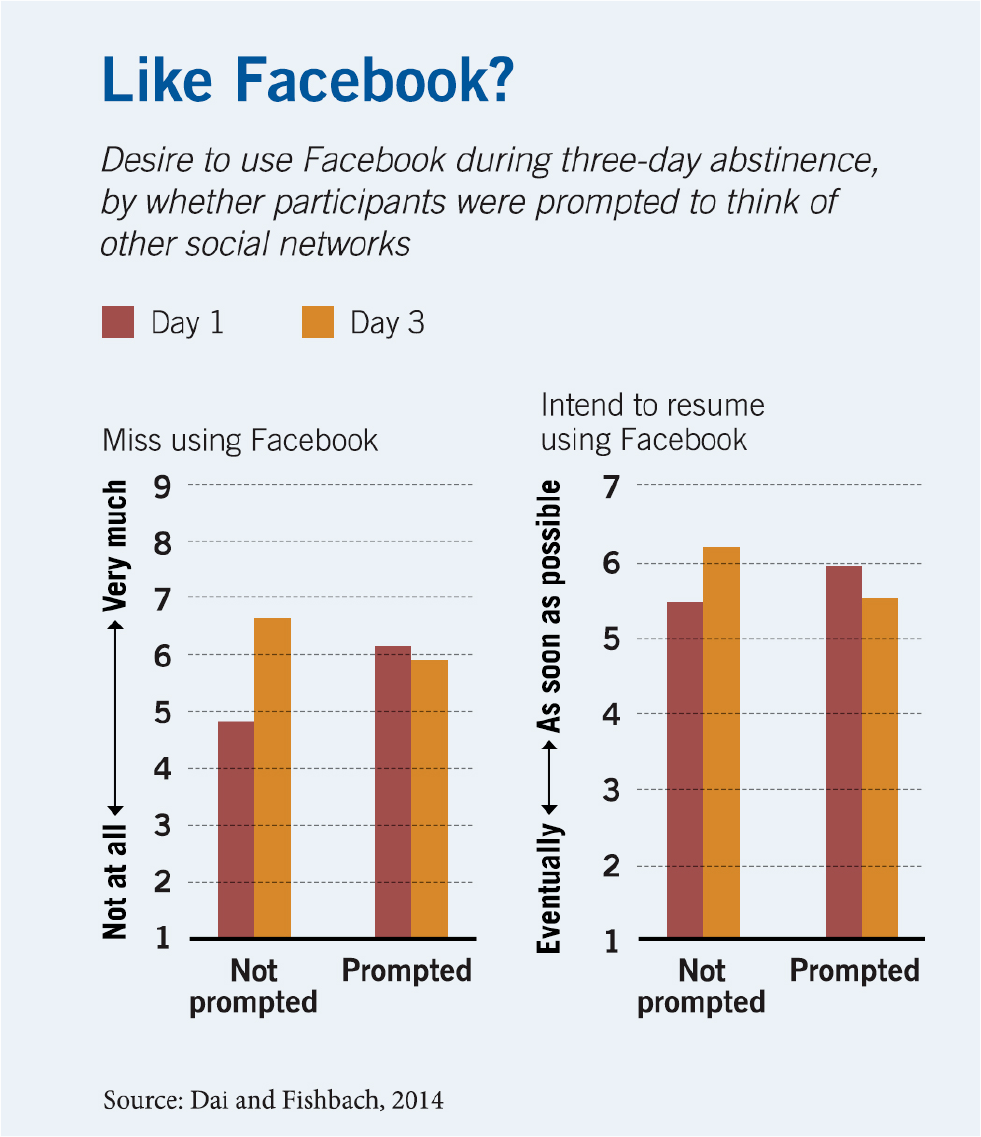
- The results hold true when the object of desire is Facebook. Fishbach and Dai had participants in another study abstain from using Facebook for three days. Some of these participants were asked to list other social-networking sites they had used in the meantime, and how much they enjoyed them. Those who were reminded of substitutes reported missing and craving Facebook less over time (see chart).
- Marketers should denigrate the value of alternatives, Fishbach says, while underscoring that a product is the only one that can satisfy a particular need. Emphasizing the absence of good substitutes may be as important as reminding people what they haven’t enjoyed recently.
Xianchi Dai and Ayelet Fishbach, “How Nonconsumption Shapes Desire,” Journal of Consumer Research, December 2014. Chart reprinted with permission from The University of Chicago Press. Copyright 2014.
More from Chicago Booth Review
More from Chicago Booth
Your Privacy
We want to demonstrate our commitment to your privacy. Please review Chicago Booth's privacy notice, which provides information explaining how and why we collect particular information when you visit our website.