(soft music)
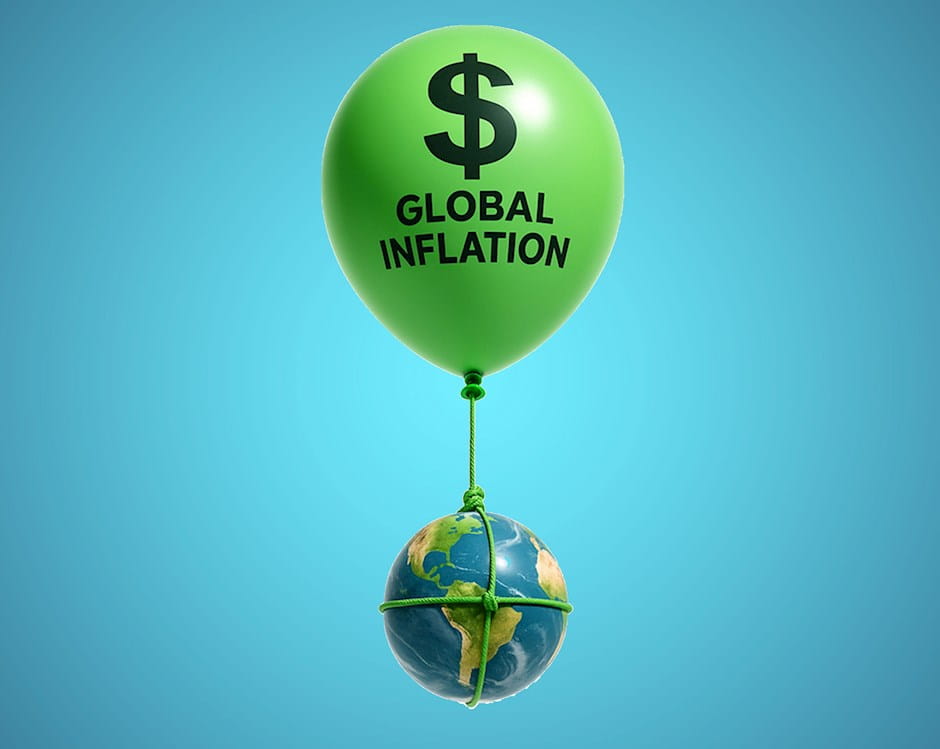
Narrator: When inflation spiked after the pandemic, it wasn’t limited to any one country. The US, Europe, and emerging markets were all affected. Many observers noted that no single country could stop inflation on its own, but Chicago Booth’s Veronica Guerrieri wondered if one country could make a difference if it coordinated with other governments.
Veronica Guerrieri: After the inflationary surge in 2021 and 2022, many economists and economic observers have converged on two main points, one, that this inflationary episode was a global phenomenon, and two, because of that, that single countries could not—neither would monetary nor fiscal policy—do anything to prevent or even fight this inflationary episode. We, in our research, want to question the second part of this common view, meaning that we think that a single country could do something if they act in a coordinated way.
Narrator: Traditionally, central banks respond to inflation by tightening monetary policy: raising interest rates, strengthening their currency, and making imports cheaper. That works for a single country, but not for everyone at once.
Veronica Guerrieri: In reality, it is not possible for all countries at the same time, conducting contractionary monetary policy to appreciate their exchange rate because it’s a zero-sum game: The dollar cannot appreciate against the euro, and at the same time the euro appreciate against the dollar. So if all countries conduct contraction monetary policy at the same time, the result is gonna be just global tightening, an excessive global tightening and an excessive world recession.
Narrator: Guerrieri and her coauthors focused on something else: global prices, especially for goods like oil. Tightening monetary policy in one country can lower global demand and global prices. Since every country benefits from lower global prices, regardless of whether they tightened policy, the motivation to act alone diminishes.
Veronica Guerrieri: The single country may do too little contraction because the benefits of this contraction are gonna, in part, go to the single country, but, in part, go to the world economy through the decrease in the global prices, for example, the price of oil. So if all countries could coordinate, what would happen is that they would decide to have a larger contraction to benefit from the lower price of oil. But if the countries are uncoordinated, the monetary policy is gonna be too loose.
Narrator: This is a classic coordination problem. Each country benefits from tighter global policy, but none wants to bear the cost alone. Economists call this an expansionary bias.
Veronica Guerrieri: Expansionary bias is a technical term to refer to the fact that the central bank can underestimate the effect of a contraction or overestimate the effect of an expansion. So when there is an expansionary bias, the monetary policy is too expansionary relative to the policy that the worldwide authority would decide as optimal.
Narrator: And while this research is theoretical, the implications are real. Guerrieri points to the post-COVID era, where fiscal and monetary expansion didn’t fully account for how domestic stimulus affects global prices.
Veronica Guerrieri: We could interpret our paper like saying that in the post-COVID era, there was too much of an expansion that didn’t take into account the externality through global prices.
Narrator: That global ripple effect matters, especially in a world where not all countries have the same ability to respond. Guerrieri warns that uncoordinated policy can deepen inequality between advanced and developing economies.
Veronica Guerrieri: There are advanced economies that can conduct expansionary monetary and fiscal policies, but there are other countries, developing countries that may be more constrained in conducting expansionary monetary and fiscal policies. In this context, it is even more important to think about coordinations because the costs that monetary policy in advanced economies may create for developing countries through externalities, through global prices, may be higher.
Narrator: In a deeply interconnected world, coordinated policy isn’t just ideal. It’s essential for creating a more stable and equitable global economy.