Why Obama’s Oil Tax Wouldn’t Help Electric Cars

In his fiscal 2017 federal budget requests, US president Barack Obama proposed a $10-per-barrel tax on oil, intended in part to fund "a 21st-century clean transportation system." If the tax were enacted, it might drive investment in green-transportation infrastructure and technology—but it wouldn't threaten gasoline's preeminence. Research by Thomas Covert of Chicago Booth, University of Chicago's Michael Greenstone, and MIT's Christopher R. Knittel suggests that it will take more than that to motivate drivers to abandon gasoline for alternative energy sources.

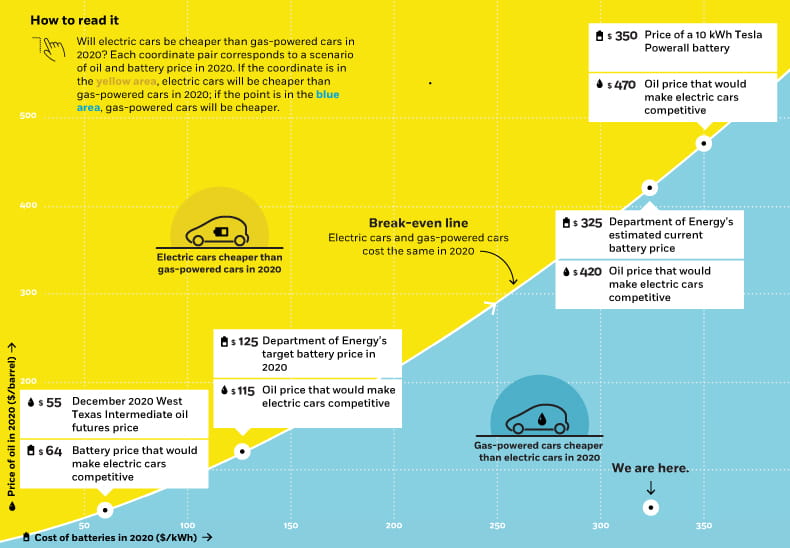
The researchers developed a series of estimates to compare the operating costs of internal-combustion engines to those of electric motors. These calculations suggest that motorists will continue to pay a premium to drive an electric vehicle until battery costs fall and oil prices rise dramatically.

A scatterplot charting the projected affordability of electric cars versus gas-powered cars in 2020, with the price of oil on the y-axis and the cost of batteries on the x-axis. A trend line representing the break-even point at which the two types of cars cost the same starts at the bottom left of the graph and rises to fifty-five dollars a barrel on the y-axis, which was the December 2020 West Texas Intermediate oil futures price, and a battery price of sixty-four dollars per kilowatt hour on the x-axis. Next the line rises to one hundred twenty-five dollars on the x-axis, which was the Department of Energy’s target battery price, and one hundred fifteen dollars on the y-axis. Next the line rises to three hundred twenty-five dollars on the x-axis, which was the Department of Energy’s estimated current battery price in 2016, corresponding with four hundred twenty dollars on the y-axis. Finally, the line rises to three hundred fifty dollars on the x-axis, which was the price of a ten kilowatt hour Tesla Powerall battery, corresponding with four hundred seventy dollars on the y-axis. For reference, a point labeled “We are here” sits at well below the break-even line, indicating that gas powered cars were cheaper, with battery prices at three hundred twenty five dollars and oil at only twenty five dollars.
Credit:
Giorgio Uboldi
More from Chicago Booth Review
More from Chicago Booth

Your Privacy
We want to demonstrate our commitment to your privacy. Please review Chicago Booth's privacy notice, which provides information explaining how and why we collect particular information when you visit our website.