
Reducing Gun Violence Requires Thinking Differently
A behavioral approach to the problem reveals why public policy has been generally ineffective.
- By
- May 27, 2025
- CBR - Public Policy
A behavioral approach to the problem reveals why public policy has been generally ineffective.
In fall 2007, a PhD student in chemistry named Amadou Cisse was shot and killed outside of his apartment, about a block from my office at the University of Chicago Harris School of Public Policy. Cisse, who was from Senegal, had defended his doctoral dissertation just two weeks earlier.
At UChicago, we like to say we’ve won more Nobel Prizes than any other university in the world, but this tragedy threw a spotlight on the lack of impact we were having in our own backyard. And it wasn’t just us: The National Academy of Sciences had just come out with a 500-page Blue Ribbon Commission report summarizing everything that we knew from all of the scientific evidence about how to prevent gun violence in America, and the conclusion was, essentially, that we didn’t really have any idea for solutions.
It was at this time and within this context that several of us at the university decided to establish the University of Chicago Crime Lab. In the nearly two decades since, our research has produced some novel explanations for why gun violence happens and what we can do to prevent it. These findings challenge the dominant ideas that are held by people on both ends of the political spectrum and that are reflected in public policy.
You are very likely aware that the United States is an outlier among developed countries when it comes to gun violence. Its per capita murder rate is off the charts compared with any other country in its socioeconomic category, and the vast majority of those murders are committed using guns. And although a very small portion—0.2 percent—of all crimes in the US are murders, murders account for something like 70 percent of the social harm from crime. (We know this because researchers have asked people what they’d be willing to pay to avert various crimes.) From the perspective of the American public, gun violence is the crime problem.
If you compare the US with the United Kingdom, you might easily come to a quick conclusion about the cause of gun violence: gun laws. The UK has much stricter gun laws and almost no gun murders. The US has much looser gun laws—which have led to something like 400 million guns in a country of 330 million people.
Yes, the data are consistent with gun prevalence being an important factor, but that’s an incomplete and somewhat unhelpful explanation. It’s unhelpful in part because it doesn’t point toward a realistic lever for reducing gun violence: The US doesn’t appear to be moving toward a dramatic reduction in its stock of privately held guns. But also, the evidence suggests there’s something else at work in this puzzle.
To understand what I mean, consider two Chicago neighborhoods, Greater Grand Crossing and, directly to its east, South Shore. These neighborhoods are both on the South Side of Chicago, separated by Dorchester Avenue, and they share a number of characteristics.
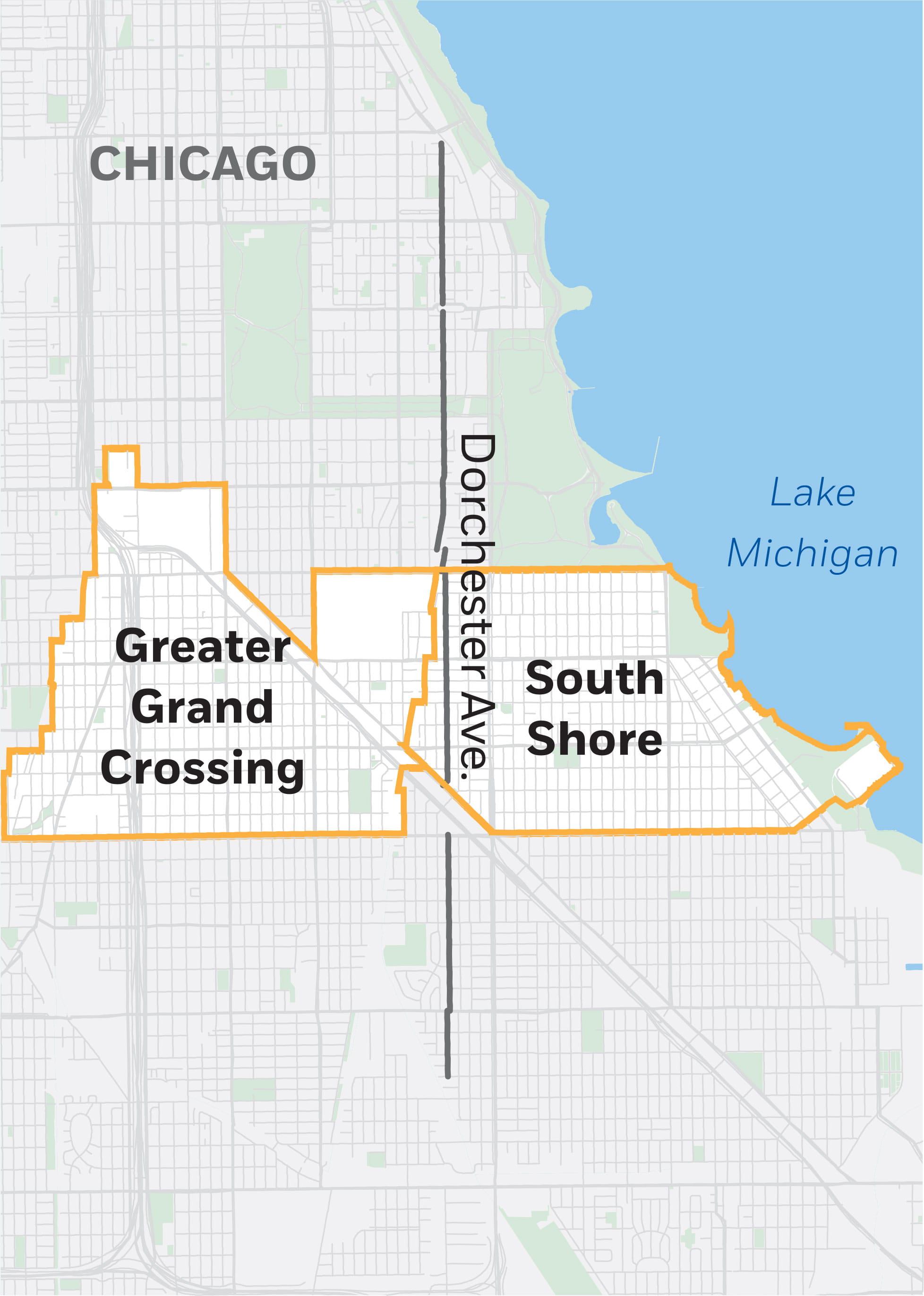
And yet, year over year, on a per capita basis, shootings are about twice as common in Greater Grand Crossing as they are in South Shore. The gun laws, of course, are exactly the same in one neighborhood as in the other, so the answer to what drives gun violence can’t be as simple as that.
Think about gun violence as being guns combined with the willingness of people to use guns to harm other people: guns plus violence. If gun control is the same in Greater Grand Crossing and South Shore, and if gun violence is so dramatically different across these two neighborhoods, it must be the case that violence is also independently turning the dial.
So what is driving violent behavior? When you ask Americans, almost all of their responses fall into one of two camps. A lot of people think the problem is character—bad people who aren’t afraid of the criminal justice system and the penalties that will be imposed on them if they use guns to hurt other people. According to this perspective, the only solution will be bigger sticks: more people in prison, longer prison terms. That conception has dominated our public policy for many years.
Most of the rest of the country thinks that violence is driven by economically desperate people who are doing whatever they need to do to survive: in other words, bad economic conditions instead of bad people.
To evaluate those conventional explanations for violent behavior, let’s return to Greater Grand Crossing and South Shore. Both are in Chicago, which is located in Cook County, which is located in Illinois. They’re served by the same police department, by the same court system, by the same department of corrections. The criminal justice system, to a first approximation, is the same across both neighborhoods.
What about poverty rates? Almost identical as well. So is the level of racial segregation.
In other words, the conventional explanations don’t provide any way to understand why the gun violence rates are so different across these neighborhoods.
Nonetheless, US voters and policymakers have been arguing for one or the other of these ideas for 100 years—and over that time span, we have made little progress on this problem. When you look at the time series of the murder rate in the US, you can see that it’s almost exactly the same today as it was in 1950, when it was almost exactly what it was in 1900.
The US’s homicide rate today is similar to, and even slightly higher than, what it was in the 1950s.
There’s a way out of this problem, however, and it starts with reframing the nature of gun violence. If you think again about the conventional wisdom, you might notice that there’s something the two sides, divided between the political right and the political left, share in their perspectives: They both frame it as an incentive problem, solved by either bigger sticks or bigger carrots.
The assumption in both cases is that people are doing some sort of cost-benefit calculation in their head before they pull a trigger. It’s treating gun violence as intentional, deliberate behavior.
Most gun violence is not so calculated. Take a more-or-less randomly selected example I pulled from the Chicago Tribune from June 2, 2024, in South Shore. It’s 3 p.m. on a Saturday. Two groups of kids are arguing with one another in the middle of a crowded street about whether someone in one of the groups had stolen a used bike from somebody in the other group. A 16-year-old pulls out a Glock semiautomatic handgun from his waistband, aims into the other group, pulls the trigger, and hits a 17-year-old kid in the chest. The victim is raced to the hospital, where he’s pronounced dead.
Economic incentives do a poor job of explaining this event. The value of a used bike on the South Side of Chicago is negligible—if you’re lucky, you might get $50 for it on Facebook. And even with the deficiencies in Chicago’s criminal justice system, shooting someone at 3 p.m. on a crowded street comes with at least a 50/50 chance of getting arrested and convicted. (In fact, the shooter is spending the rest of his natural life downstate with the Illinois Department of Corrections.) So a $50 bike traded off against a 50 percent chance of spending the rest of your life in prison—who in their right mind would rationally be willing to flip that coin?
This is what most gun violence in America actually looks like. It is not premeditated. It is not driven by economic motivations. It is the product of garden-variety arguments that end in tragedy because someone’s got a gun.
The national data back this up: The overwhelming majority of gun violence is driven by altercations. So what is happening? Is there any sort of predictable structure to these confrontations that we can use to figure out how to prevent them?
If you’ve read the late Daniel Kahneman’s 2011 book Thinking Fast and Slow, you will know that your mind actually engages in two types of cognition, or two systems of thought, even though you may be aware of just one.
The type of cognition that we’re all conscious of, which Kahneman calls System 2, is a little voice in our head that’s deliberate and slow and gives us a chance to think rationally. It solves problems. It does cost-benefit calculations. And it’s very, very mentally effortful. It takes so much mental effort that our minds are designed to do as little of it as possible.
What we’re doing most of the time is relying on System 1: a series of automatic responses that we have developed for the routine, low-stakes situations that we see over and over again in our daily lives. That type of thinking is so low effort, and happens so quickly, we’re not even aware we’re doing it.
For example, when you see a newspaper headline, a CNN crawl, or other unfamiliar text, you don’t consciously ask yourself, Should I read that? You just read it. It’s automatic and involuntary. That is System 1 at work.
Here’s another example. Read the following word as quickly as you can:
BLUE
If you’re like most people, you experienced a little mental hiccup because of the mismatch between the appearance of the word and its meaning. This is called the Stroop effect, and it illustrates that the automatic response that normally works so well for you can lead to trouble when it’s overgeneralized. It works well usually, but not always.
So how does that relate to gun violence? One of the things we know about underresourced neighborhoods in cities across the country is that the adults are overwhelmed, leaving kids to learn quickly that they’re basically on their own to navigate daily life. (As it turns out, gun violence is disproportionately committed by and against young people—teens and young adults—late at night and on weekends.)
A young person in one of those neighborhoods might reasonably learn: If I’m walking to school and someone challenges me for my lunch money, handing it over would mark me as an easy victim. Tomorrow someone’s coming for my coat. The day after that, my phone.
So this becomes System 1 thinking for these kids: When I get challenged, I push back—not in proportion to the provocation, necessarily, but in a way that signals to everyone in the neighborhood that they’re not a good target.
This may ordinarily be an effective approach for kids in these neighborhoods. But it can lead to tragedy when someone’s got a gun.
According to this perspective on the gun violence problem, it’s not caused by bad people or economic desperation. It’s normal people making bad decisions under difficult circumstances.
A few years ago, I was visiting the Juvenile Temporary Detention Center on the West Side of Chicago, and a staff leader there put it differently. He said he told 80 percent of the kids incarcerated there, “If I could give you back just 10 minutes of your lives, none of you would be here.”
How do we know if that notion is true? And if it is, what can we do about it? We may have gotten some answers from the first randomized experiment that we did at the Crime Lab. It was a study of a nonprofit in Chicago, Youth Guidance, which runs a group-counseling program called Becoming a Man. Boys in grades 7–12 get out of class once a week to talk and take part in various exercises as part of BAM.
For too long, our policies for preventing gun violence have focused too narrowly on System 2.
One activity they do is the fist exercise. Student A and Student B are paired up, and Student A is given a rubber ball. Student B has 30 seconds to get the ball out of his partner’s hand. The only rule is there are no rules.
As it most often goes, for 30 seconds Student B basically tries everything in his physical power to pry the ball free from Student A. Then the counselor calls time, gives Student B the rubber ball, and Student A does the same thing to him.
The counselor debriefs with them afterward, asking about the strategies they used and inquiring about the method neither tried: asking for the ball. Youth Guidance has done this with something like 10,000 kids all over Chicago. They tell me that no more than a handful of kids asked.
Student B explains to the counselor, “Well, if I would’ve asked, he would’ve thought I was weak.” But when the counselor turns to Student A and asks, “What would you have done if your partner had asked for the ball?” Student A says he’d have been more than happy to hand it over. After all, it’s way better than getting beat up for 30 seconds.
This activity puts kids in a situation where they’re being challenged, elicits their automatic response, and in slowing things down afterward for reflection, shows them that in an out-of-the-ordinary situation, that normal response is maladaptive.
To study the effects of BAM, we worked with the Chicago Public Schools and Youth Guidance to enroll about 2,700 kids on the South and West Sides of Chicago. Most of the kids participated for 12–15 hours. Then we used Chicago Police Department data to look at what happened to them after program participation, and we found that their violent crime arrest rate was 45 percent lower than that of kids who weren’t enrolled in BAM.
To an economist like me, this makes no sense. Becoming a Man is not changing incentives. It is not miraculously erasing poverty or anything like that. Nonetheless, a few years later we redid the study, and this time we found a 50 percent reduction in the arrest rate for violent crimes.
The Crime Lab has also studied many similar programs, all of which look a little bit different and use different curricula but have one shared feature, which is helping people anticipate when their System 1 responses are going to get them in trouble. While the question of what happens at gigantic scale remains an open one, at demonstration scale we consistently see encouraging evidence of big reductions in violence. That’s inconsistent with conventional wisdom and only makes sense if there is something to this behavioral-economics explanation for gun violence.
What are the implications? If the problem underlying gun violence is these 10-minute windows, let’s not keep arguing about whether we should be dangling bigger sticks or bigger carrots in those windows. Let’s focus instead on doing two types of things for which we have really good experimental evidence.
One is changing what kids bring with them into these 10-minute windows through programs such as BAM.
The other thing is changing the situations themselves in a particular way. The late author and activist Jane Jacobs in her 1961 book The Death and Life of Great American Cities, documented the huge variation in safety rates among equally disadvantaged neighborhoods and argued that “eyes on the street” were the key explanation for it.
Eyes on the street can be any sort of prosocial adult who’s willing to step in and defuse a situation. It could be a cop, a community violence intervention outreach worker, or simply a neighborhood adult walking to the corner store—which is why Jacobs argued for mixed-use residential development. A mountain of evidence suggests that the presence of these people is helpful in reducing violent crime.
This perspective on violence prevention helps us understand many of the key patterns with gun violence that conventional wisdom cannot. Why, for example, is gun violence concentrated among young people? That can’t be due to, for example, economic desperation, since the data suggest for most people economic concerns increase (not decrease) with age. But behavioral economics gives us an explanation: For most of us, as we get older, we get wiser. Similarly, why is gun violence disproportionately concentrated at night and on weekends? Because that’s when relatively more young people and relatively fewer prosocial adults are out in public places.
This perspective also helps us understand the mystery of Greater Grand Crossing versus South Shore. What are people bringing into the situation? There’s reason to think people in one neighborhood are leaning more on System 1 than their neighbors across Dorchester Avenue.
In the 2013 book Scarcity: Why Having Too Little Means So Much, MIT’s Sendhil Mullainathan and Princeton’s Eldar Shafir argue that living in situations of high stress depletes people’s mental bandwidth. If System 2 takes more effort, that leads people to rely more on System 1 in navigating daily interactions. When you look at the data, you can see there’s a lot more disorder, premature mortality, and other stressors in Greater Grand Crossing than South Shore.
What do we know about the situations themselves? Partly because South Shore is along Lake Michigan, it has developed many more mixed-use residential and commercial buildings than has Greater Grand Crossing. There are, consequently, more eyes on the street.
For too long, our policies for preventing gun violence have focused too narrowly on System 2. They’re not solving the problem. We need to be much more attentive to the fact that there’s another type of cognition that we engage in, one that is underappreciated in its importance to this issue. If we don’t, we have every reason to expect that America’s exceptionalism in this grim respect will remain unchallenged far into the future.
Jens Ludwig is the Edwin A. and Betty L. Bergman Distinguished Service Professor at the Harris School of Public Policy, the Pritzker Director of the University of Chicago Crime Lab, and author of the book Unforgiving Places: The Unexpected Origins of American Gun Violence, published in April by the University of Chicago Press. This essay is adapted from a talk he gave in February as part of the Think Better series hosted by Chicago Booth’s Roman Family Center for Decision Research.
Your Privacy
We want to demonstrate our commitment to your privacy. Please review Chicago Booth's privacy notice, which provides information explaining how and why we collect particular information when you visit our website.