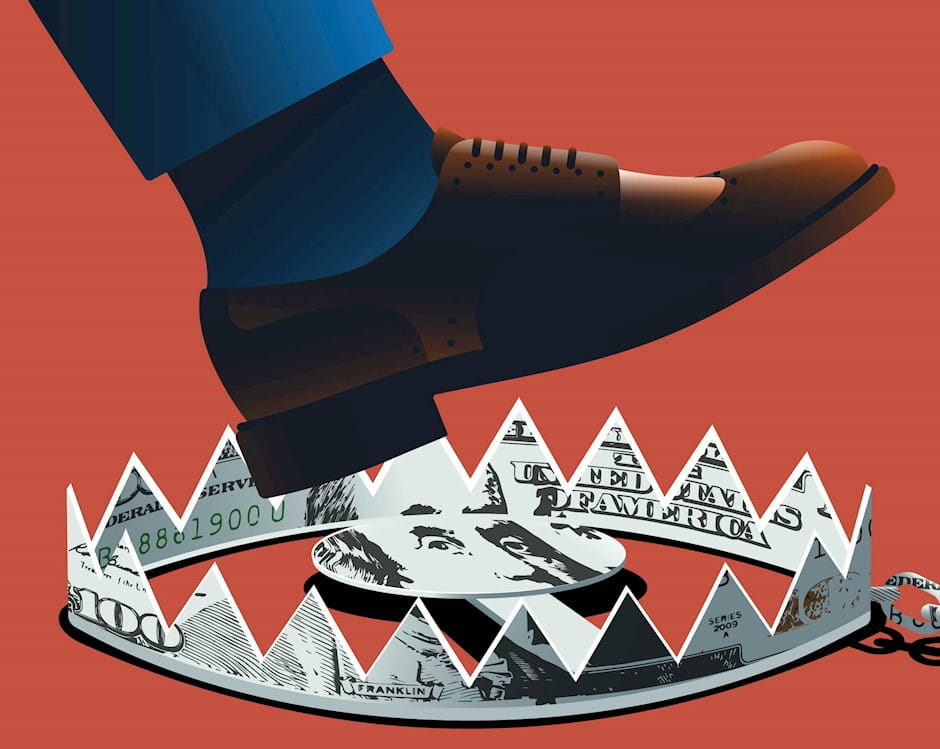
Chicago Booth Review Podcast Will Private Credit Spark a Financial Crisis?
- May 06, 2026
- CBR Podcast
Private credit is in the news, with Wall Street titans including JPMorgan Chase chief Jamie Dimon and Goldman Sachs president John Waldron among those expressing concerns about the sector. How worried should we be? Chicago Booth’s Amir Sufi talks about his views on where private credit is going. Many investors want their money back, and some funds are limiting withdrawals. Are the worries justified or overblown?



Amir Sufi: So interest rates went up in 2022, and I think a lot of people were hoping, "Oh, they'll go back down," but they haven't. And so a lot of these private credit firms have loans outstanding to companies that are coming due in 2026, 2027. And they were done in 2021 when interest rates were lower. So in order to roll over those loans, there's going to have to be a much larger interest rate.
Hal Weitzman: Private credit is in the news with Wall Street titans, including JP Morgan Chief, Jamie Dimon, and Goldman Sachs President John Waldron, among those expressing concerns about the sector. So how worried should we be? Welcome to the Chicago Booth Review Podcast, where we bring you groundbreaking academic research in a clear and straightforward way.
I'm Hal Weitzman. Today, I'm talking with Chicago Booth's Amir Sufi about his views on where private credit is going. Many investors want their money back and some funds are limiting withdrawals. Are their worries justified or overblown? Amir Sufi, welcome back to the Chicago Booth Review Podcast.
Amir Sufi: Thank you. It's a pleasure to be here.
Hal Weitzman: We are delighted to have you. And last time you were on, I think we discussed private credit. We're back, still talking about private credit, because since we recorded that podcast, private credit has really been covered a lot in the news. There's a lot of concern about it, but let's just go back a few steps for those who are joining us and have not been following private credit. What is it and why has it grown so much? Why has it become so important?
Amir Sufi: So traditionally, the institutions that lend to middle market companies between, say, 10 employees and 500 employees were banks and finance companies. Private credit is this super interesting new intermediary that is not a bank. It's not a finance company. It's a separate intermediary that has more of a structure like a private equity fund. So there's a general partner that runs the fund and goes out and looks for borrowers.
And then there's a limited partner, which can be university endowments or pension funds or insurance companies that fund them. So they're a very different type of financial intermediary relative to a bank and a finance company. Even though on the lending side, they're actually lending to very similar borrowers as banks and finance companies.
Hal Weitzman: But this is now a vast sway to the US economy that is not funded by banks that is getting their financing through these other vehicles, right?
Amir Sufi: Yeah, exactly. So they've bypassed the banking sector to get finances, getting funding directly from the limited partners, those endowment funds. And that's why they're called direct lending. It's almost as if the pension funds and insurance companies have a more direct route to lending to the companies through these private credit funds.
Hal Weitzman: So just explain to us, why do the endowments and whoever want to lend in this way?
Amir Sufi: So the history of the market is from about 2013 to about 2023, it did phenomenally well, meaning these private credit funds were able to get returns on their investments and then deliver those returns to the underlying limited partners that were really attractive. There were very low default rates. So it had a good run. I always say give credit where credit's due in the sense that private credit did extremely well for about those 10 years from about 2013 to 2023.
Hal Weitzman: Okay. But they were doing well by lending to these middle markets, small and middle, medium-sized companies that couldn't get loans from the banks?
Amir Sufi: So a key ingredient here is most of those companies are owned by private equity sponsors. I say private equity and private credit go together a little bit like peanut butter and jelly. So you're going to have these companies owned by private equity sponsors. The private equity sponsors have good relationships with these private credit firms. It's not that they couldn't get a bank loan necessarily, but they can get a loan from a private credit fund on better terms with looser covenants and perhaps a closer relationship that leads to better renegotiation in times of default or in times of difficulty.
Hal Weitzman: But how does it work? So if you are a manufacturing firm in the Midwest and you get bought by private equity, do they then do a separate deal to get you funding from some private source?
Amir Sufi: So they actually use the private credit fund to fund the acquisition itself.
Hal Weitzman: I see.
Amir Sufi: So the private equity sponsor has a target company in mind, let's say a family-owned firm, a manufacturing firm somewhere in Illinois, and then they're basically going to decide, "Okay, we want to buy this company, but we want to use some debt to buy it. We don't want to use only our own equity financing." So 20, 30 years ago, they would go to a bank and they would get a loan and they would do it. But they found, especially over the last 10 years, that they liked to go to these private credit funds because they got better terms, they got better negotiations than they would get from banks or finance companies.
Hal Weitzman: So that growth you talked about, that 10 years of fantastic growth in this area is the same period as the growth of private equity. Is that right?
Amir Sufi: Absolutely. In fact, one of our recent research papers makes the argument that the rise in private credit really does reflect the rise in middle market private equity ownership, especially of software companies, of business service companies, of more intangible capital industries. And so I do think that there's been another narrative out there that the rise of private credit is because banks pulled back from lending in the aftermath of the global financial crisis.
Our recent research finds some evidence in favor of that, but the evidence I think is more strongly in favor of just the view that, "Look, private equity grew like crazy over the last 10, 20 years and private credit was funding it. So naturally private credit was growing along with private equity."
Hal Weitzman: That's fascinating because yeah, there has been a narrative that because of the financial crisis, the banks couldn't or wouldn't lend to these companies anymore and they got out of the lending business. You're saying that's not necessarily the complete picture?
Amir Sufi: Yeah. So the paper we're working on right now directly tries to compare those two hypotheses and finds evidence in support of the idea that higher capital regulations on certain banks did help lead to the rise of private credit. But the effect of just the rise in private equity is between two and three times stronger if you think just quantitatively.
So they both have some validity and there's probably interaction between the two, because banks are not going to very easily be able to lend to software companies, to business services companies because they don't have very tangible capital. So there's a bit of an interaction between the two as well.
Hal Weitzman: I see. So they find it hard to value the deals, is that right?
Amir Sufi: Yeah. So that's a very important point that we're making in our most recent research. When a bank does an underwriting on a loan, they're usually looking at the tangible collateral that the company has, the machines, the equipment, the land, the buildings that they could resell in case of a liquidation. Whereas a private credit fund, they're okay with just owning the company as a whole if there's a default. So they take what they call enterprise value bets. And I think that's a big reason why private credit has been able to expand, especially in these intangible capital industries like software.
Hal Weitzman: And things like the brand and the value of the customer relationships and all this stuff.
Amir Sufi: Exactly. Exactly.
Hal Weitzman: That's fascinating. So you talked about 2023 as the end of something. Is that because that's where your data run out or has something changed?
Amir Sufi: No, something definitely changed. There were a couple of factors that have really led to at least some difficulties in the private credit market, one of which is sustained higher interest rates. So interest rates went up in 2022, and I think a lot of people were hoping, "Oh, they'll go back down," but they haven't. And so a lot of these private credit firms, they have loans outstanding to companies that are coming due in 2026, 2027, and they were done in 2021 when interest rates were lower.
So in order to roll over those loans, there's going to have to be a much larger interest rate. And so a lot of people are worried that these borrowers are not going to be able to afford that higher interest rate, and therefore they might just choose to default on the loan instead of trying to roll it over.
And then the second big thing, which is even bigger in the news right now, private credit firms are very exposed to business services and software companies, and there is a huge amount of uncertainty about the effects of artificial intelligence on those businesses, that they might actually hurt those business quite severely. And so that's another reason why people are a little nervous about what's going on in private credit now.
Hal Weitzman: So it's the interest rates on the one hand and it's the AI structural change on the other.
Amir Sufi: Exactly. Exactly. And the combination, the interest rates are especially dangerous because of what we call the maturity wall, meaning a lot of the deals done right after COVID were done with five-year, six-year term loans. So 2021 then goes to 2026, 2027. And so those are really coming due. So the higher interest rates combined with a lot of debt coming due could be a bad sign for private credit.
Hal Weitzman: Okay. And now as you say, the signs are... it hasn't collapsed yet. There's been some movement on things we can talk about, but what there is is a huge amount of concern and chatter about alarm about private credit. Now your co-author and colleague, not at Booth, but Amit Seru, remind me where Amit is.
Amir Sufi: He's at Stanford.
Hal Weitzman: At Stanford, that's right. So he recently had a column in the Financial Times, essentially saying all these concerns about private credit, as we said, which have been voiced by Jamie Dimon and John Waldron, they're all overblown for a couple of reasons. One is there's not much leverage. One is there's no systemic link to the banking system. Are you in agreement with your co-author?
Amir Sufi: So I would say to split it up into two separate questions, there's one question which is, are there more defaults to be expected within the private credit universe? And then the second question is, if there are defaults in the private credit universe, will that somehow cascade into a financial crisis or a massive systematic issue? I think I very much agree with Amit on the second question that the answer is no, that even if there are significant defaults within private credit, it is very unlikely to trigger anything like the financial crisis that we had prior to the Great Recession.
And there's a few reasons for that. One, it's just a much smaller market. It's not nearly as big. They say a $1.7 trillion market is the number that's thrown around, but that's the total amount of capital. Some of that is not drawn. Some of that is what we call dry powder. So it's smaller than that. And the other thing, as Amit mentions, is all of the evidence suggests that the amount of debt that private credit funds take on is an order of magnitude lower than banks or finance companies or most other financial intermediaries.
And then I would say third, and perhaps the most important, the capital that endowment funds, pension funds, insurance companies, for the grand majority, 75 to 80% of what we would call private credit is completely locked up. They cannot pull their money out in any way of traditional private credit funds, GP/LP structures. And so even if you see some defaults rise, there's no way of creating those run-like conditions that we typically see with banks.
Hal Weitzman: So we can't have the classic bank run. Just explain that a little bit for those of us who are not allowed to invest in private capital or don't. Because we've seen headlines where some companies have said, "Right, you can only take out 5% of your assets." How does that work? Just explain that.
Amir Sufi: Yeah. So at a high level, there are two different types of intermediaries that do private credit. The one that's the bigger one, about 75% of the total assets under management is done as what's called a private fund. They are regulated by the SEC, and that is what is a general partner and limited partner structure. So in that, if you're the limited partner, Hal Weitzman is the limited partner, I'm the general partner. I take money from you, you give me money, and it is locked up for sometimes eight to 10 years. And then I do what I call "call on the money when I need it," which is I say, "Hal, you know what? I've got this good investment opportunity. I need 10 million from you now."
Now, no matter what's going on at the fund level by the GP, Hal cannot take out his money just because he's nervous. He can't say, "I want all my money back." That's just the structure of these funds. And that's why they're regulated in such a way that only institutional investors can invest in them. They're not available for retail investors. The other intermediary, which is about 20 to 25% of the private credit fund is what are called business development companies, BDCs. That's what you're reading about in the press.
So BDCs have more liquidity available. They do sometimes have 5% redemptions, meaning they'll pay out 5% per year. But if you actually look at their legal charters, they don't have to do that. They have the ability at any time they want to cut that to 0%. And that's what they've been doing. And it's a very logical thing. It's not surprising at all because if a bunch of people start to try to take out their money, it's just like the traditional bank run.
It's not like they have a bunch of money just sitting around. They'll have to liquidate these illiquid middle market loans. And so they choose not to allow you to redeem. And of course it makes big news, but in some ways it's not good for the investors, but it's probably good for the overall financial system because it prevents that run that would potentially be dangerous and lead to fire sales.
Hal Weitzman: If you're enjoying this podcast, there's another University of Chicago Podcast Network show that you should check out. It's called Capitalisn't. Capitalisn't uses the latest economic thinking to zero in on the ways that capitalism is and more often isn't working today. From the morality of a wealth tax to how to reboot healthcare to who really benefits from ESG, Capitalisn't clearly explains how capitalism could go wrong and what we can do about it.
Listen to Capitalisn't, part of the University of Chicago Podcast Network. Amir Sufi, in the first half, we talked about private credit. You reminded us what it is, why there's concern about it, and we talked about the structure of the industry that really, is it fair to say it's run-proof or it's structurally set up in a way that doesn't allow a panic? Is that fair?
Amir Sufi: Yeah, I think that's accurate.
Hal Weitzman: Okay. So it sounds like what you're saying is we will be reading some more headlines saying private credit is in trouble, but there won't be a systematic or systemic effects as a result of that. Is that right?
Amir Sufi: Yeah, that's my interpretation.
Hal Weitzman: Okay. So if you are listening to this and you are one of the accredited investor, whatever you are involved, you are invested, should you be concerned?
Amir Sufi: Well, I said it before, there's two questions. One is, will there be defaults? And second, will those defaults cause a run and a crisis? So I think the second one, the answer I think is no. Will there be defaults? There is definitely evidence of a rise in difficulties of the borrowers of private credit funds. There's no doubt about that.
The reason it's tricky to quantify how big the problems are is it's not like a traditional lender, creditor-borrower relationship where it's more arm's length and I just wait. And if Hal defaults on his loan, then I have no mercy. I just go take his house from him.
Private credit funds and the private equity firms that own these companies have a much closer relationship. And so it's a little bit hard to know what exactly is going on behind the curtain. Maybe the private equity sponsor really is having difficulty paying the private credit fund, but the private credit fund is more likely to forbear. They're more likely to waive covenant defaults.
Hal Weitzman: Because they're essentially two different accounts in the same organization.
Amir Sufi: Well, they're not literally in the same organization. Most of the time there's actually separate entities. Sometimes the same umbrella company is doing both the private credit and private equity, but it's pretty uncommon. But I do think that there's both a good way of seeing it and a bad way of seeing it. The bad way of saying it is, "Oh, there's a conflict of interest. These guys are being crooked and they're not admitting the companies are in fault."
The good way of thinking about it is, "Well, it's nice to have a creditor that's willing to work with you and try to work through the problem before just foreclosing on the business and liquidating it." And so I think that's where we are right now, which is we can't really tell, "Oh, are these companies in the long run going to be viable and they're just going through some temporary difficulty? Or are these companies just being strung along and actually are really in trouble and everyone's just not admitting they're in as big a trouble as they are?"
Hal Weitzman: Right. Because the systemic effect could be not a financial thing necessarily, but the firms collapse, the companies collapse.
Amir Sufi: Exactly.
Hal Weitzman: And a whole load of people are made unemployed.
Amir Sufi: Yeah, exactly.
Hal Weitzman: Which would be economically disastrous, presumably. I wanted to ask you though, just to come back to press this point a little bit more about bank exposure to this. So there's a report from the US Treasury that put the amount of bank and non-bank exposure... I'm going to ask you what that means, but the exposure from the banking sector to private credit funds is somewhere between 410 and $540 billion, which is not enough to bring down the system.
You mentioned a larger figure, which was the the total universe, but 540 is not nothing, $540 billion. How should we think about that? What would be the effect if they really were something akin to a... even though there can't be a panic mechanically, but what would it look like?
Amir Sufi: Yeah. So it's very important to compare that number to the total value of the underlying assets that that debt is financing. And that value, as I mentioned, most people would estimate between 1.5 and 2 trillion, which means that the actual leverage ratio, if you take, say, that 500 million number, I know that report, it's by the Office of Financial Research at US Treasury, that would put their leverage ratio at something like 25%, which that's again, a debt over assets figure. People say leverage, they mean different things, but that's a remarkably low leverage ratio.
Most of the homeowners listening to your podcast probably have a loan-to-value above 25%. So it's a remarkably low amount of leverage. And why that's so important is that essentially means you need to burn through 75% of the asset value before the credit would be impaired, that there's a huge equity cushion before that debt would be impaired.
And so that's what the arguments have been that leverage levels are very low in this industry. And so even if there are losses, they'll be borne by insurance companies, they'll be borne by pension funds, people might lose their job. So let's be frank about it. It would not be a great thing if there's a lot of defaults, but it's very unlikely to trigger the financial crisis that we had before because the leverage levels are so low.
Hal Weitzman: So if it doesn't trigger a crisis in and of itself, could it be a symptom of a crisis that's happening anyway? We're talking about good old-fashioned Midwest type, what they would call boring businesses, right? The private equity buys and soups up and tries to manage better and do all sorts of financial engineering as well. Could this be the canary in the coal mine? Is this something where if we see a whole load of defaults, it may not in itself cause a crisis, but there might be a crisis looming that this is a sign of?
Amir Sufi: Well, I would think if there is a severe recession, then all companies are going to be in trouble, but I don't think that private credit financed firms are in any way a leading indicator other than perhaps the software point. They are very exposed to software for sure. And I think to the degree that AI really is going to disrupt the software industry, you are probably going to see it in those portfolio companies first.
I don't think you're going to see massive knock-on effects on overall US economy just because software companies are having difficulty. I don't think they're that big of a part of the overall economy. So the other thing we do in our most recent paper is just to try to quantify the fraction of US employees that work at companies that have a private credit loan. And we find that for the whole sample to be about 10%. And then if we condition on middle market firms, it's about 4%. So it's not like 50% of people are working at companies with private credit loans. It's a pretty small fraction of the overall US employment.
Hal Weitzman: Okay. So is there anything you think that would make this a crisis?
Amir Sufi: That's a good question. I think let me give you the one argument that some colleagues both at Booth and other schools are a little worried about. I'm not that worried about this, to be frank, but one argument is that exactly that number that the Treasury is giving, that banks have outstanding lines of credit to these private credit funds and that maybe these private credit funds will draw on those lines of credit really heavily at some point and therefore put the banks in a bit of pressure just because they're having a huge increase in loans.
So it's not exactly a run on the liabilities. It's more by drawing down the line of credit, maybe the banks are going to experience some stress. My counter-argument to that is that, well, look, at the end of the day, if they can block redemptions, why would they draw hugely on their lines of credit? And the banks actually have covenants that protect themselves from those draws.
And in fact, a recent paper by Sergey Chernenko and David Scharfstein has actually looked at the Great Recession where we did still have some BDCs and some private credit instruments. And what happened there was basically, there was some draw down on the lines of credit, but the banks just didn't foreclose on anything. And everything in that particular market ended up being fine. And that was in the GFC, a really, really bad global financial crisis.
Hal Weitzman: Right. Okay. I want to ask you finally about private credit and what happens now. So there isn't going to be a crisis. There's not going to be a panic because they structurally made sure that one couldn't happen, but private equity is not what it was, as you said. What do you think is the future for private credit and private equity?
Amir Sufi: Well, I think that the fundamentals are still quite strong, and this is related to other research I've been working on as well, I do think that private equity is positioned quite well to try to finance the growing part of the US economy, which really is information services and business services. So software companies, consulting companies, accounting, law firms, a lot of private equity firms are trying to invest in those companies and grow those companies. And again, banks really aren't willing to do those loans to those kinds of companies.
And so I think private credit remains quite well-positioned in where the US economy is heading. I think that's really the bullish case behind private equity and private credit. And I do think that banks are going to increasingly be pressured on making loans to businesses because those aren't the kinds of businesses they're going to be financing. And so I do think in the long run, you could see the commercial and industrial lending segments of US banks start to shrink over time because they're really not willing to lend to the most quickly growing parts of the US economy.
Hal Weitzman: Well, Amir, thank you so much for coming back on the Chicago Booth Review Podcast. Always fascinating to chat with you.
Amir Sufi: Yeah, thanks for having me.
Hal Weitzman: That's it for this episode of the Chicago Booth Review Podcast, part of the University of Chicago Podcast Network. For more research, analysis and insights, visit our website, chicagobooth.edu/review. When you're there, sign up for our weekly newsletter so you never miss the latest in business-focused academic research. This episode was produced by Josh Stunkel. If you enjoyed it, please subscribe and please do leave us a five-star review. Until next time, I'm Hal Weitzman. Thanks for listening.
Your Privacy
We want to demonstrate our commitment to your privacy. Please review Chicago Booth's privacy notice, which provides information explaining how and why we collect particular information when you visit our website.