CBR Briefing #13
- February 23, 2018
- CBR - Behavioral Science
How rethinking deadlines could save managers time and money
Managers may be overestimating the time it takes to complete a task—and overpaying contractors in the process.
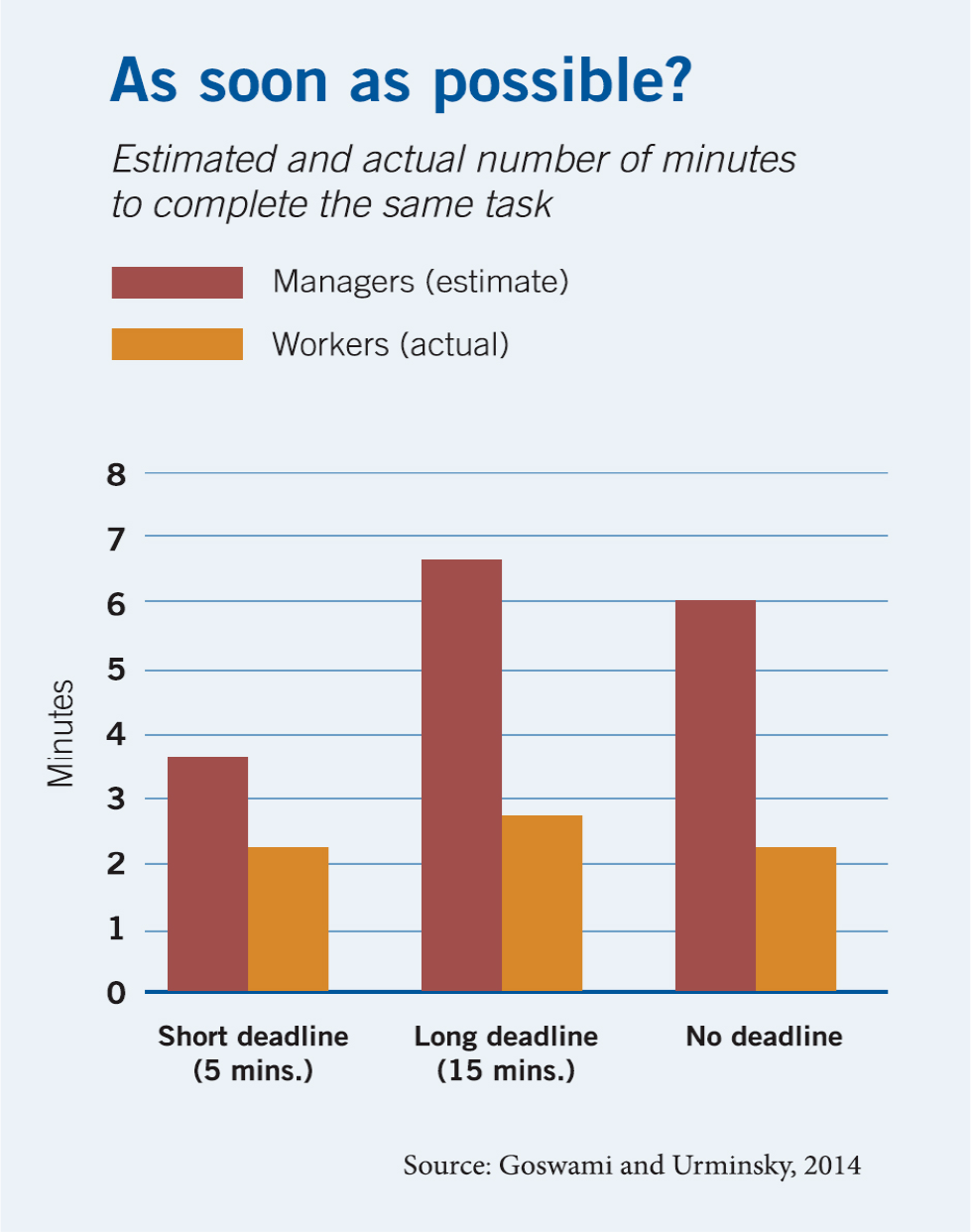
A long deadline makes managers think a task is more involved.
- Managers work under deadlines to complete projects. They plan tasks for employees and budget for the amount of time each one will take. But managers could be suffering from a bias when estimating the time a worker needs to perform a task, according to Chicago Booth’s Oleg Urminsky and PhD student Indranil Goswami.
- Managers are heavily influenced by deadlines, say the researchers. A long deadline makes managers think a task is more involved, so they tend to allow more time than necessary.
- To simulate a corporate environment, the researchers asked some participants in a series of studies to assume the role of workers while others acted as managers.
- In one study, workers given more time to complete a puzzle took only slightly more time to do so than those given less time (see chart). However, a longer deadline made most managers expect that workers would take much longer than they actually needed.
- This bias can lead managers to overpay contractors. In another study, most managers chose a flat-fee contract over a time-based one for tasks with a longer deadline. But managers could have saved money by opting for a time-based contract instead, because a project with a longer time limit may not take as much time as its deadline suggests.
Indranil Goswami and Oleg Urminsky, “More Time, More Work: How Non-diagnostic Time Limits Bias Estimates of Project Duration and Scope,” Working paper, March 2014.
More from Chicago Booth Review
More from Chicago Booth
Your Privacy
We want to demonstrate our commitment to your privacy. Please review Chicago Booth's privacy notice, which provides information explaining how and why we collect particular information when you visit our website.