Capitalisn’t: Are Betting Apps Engineered for Addiction?
- February 09, 2026
- CBR - Capitalisnt
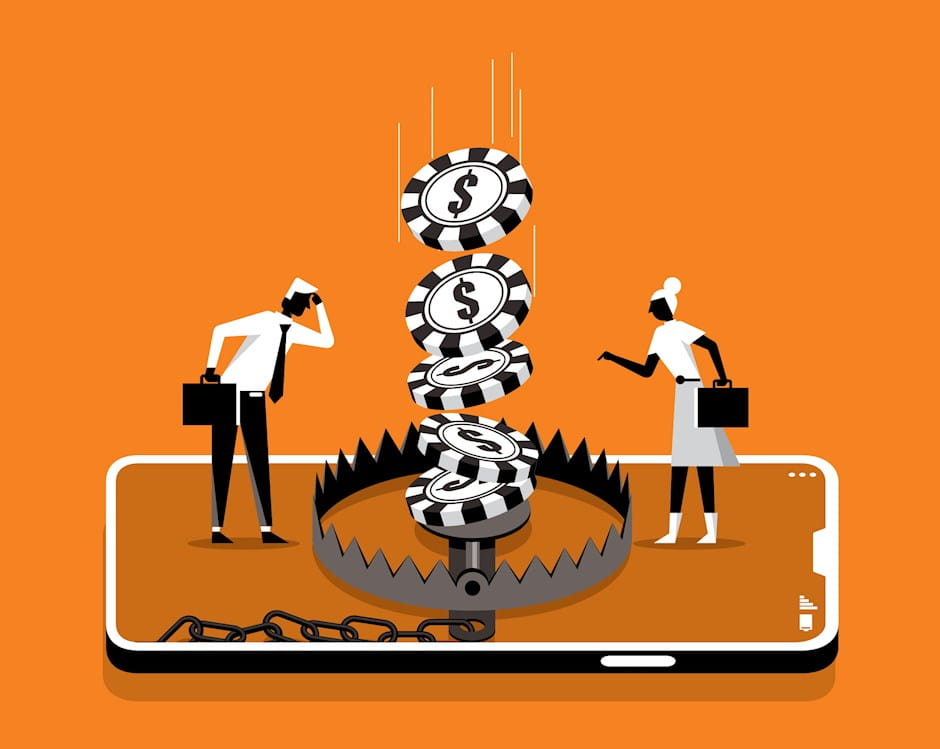
On this episode of Capitalisn’t, we dive into the murky waters of the American sports betting explosion. We are often told that legalization simply moves an existing black market into the light, but guest Jonathan Cohen of the American Institute for Boys and Men argues that the issue isn’t that the United States legalized the industry—it’s that it did it “recklessly.” Is there a way to fix this market so that it is fair for consumers and doesn’t impose a high degree of societal cost?



Jonathan Cohen: I've watched a talk given by a Fanatics executive who says this explicitly at a Sloan conference a few years ago, where she says, "We have all this data. We know if you're depositing more money more quickly than you're used to, if you're placing more bets on a weeknight, if you're getting a bunch of credit card deposits that are declined, we can tell if you are running into trouble, if you are gambling more than you should, if your risk factor is going up," per se. The question is, okay, it's amazing that Fanatics has that data, but who at Fanatics has that data, and what is it being used for?
Bethany McLean: Today's guest is Jonathan Cohen, legal scholar and historian and the author of Losing Big, America’s Reckless Bet on Sports Gambling.
You trace much of what has happened to the fall of something called PASPA in 2018. Why did that happen? Why historically was betting illegal?
Jonathan Cohen: PASPA, the Professional and Amateur Sports Protection Act, came about in the early 1990s at the behest of the sports leagues when states started thinking about legalizing this thing that actually wasn't sports gambling, but it was maybe resembled sports gambling. The sports leagues saw it as the camel's nose under the tent for broader legal sports gambling. They went to Congress and said, "Congress, sports gambling is bad. You cannot allow states to legalize it." Congress indulges them and passes the Professional and Amateur Sports Protection Act, which doesn't make sports gambling illegal, but it stops states from legalizing sports gambling. It's one of those Supreme Court decisions that's normally about one thing, but of course, it's actually about something else. It's normally about sports gambling, but it's actually about states' rights. It's actually about the 10th Amendment and what's called the commandeering statute. The Supreme Court decides states are allowed to decide sports gambling for themselves as of May 14th, 2018, 10:01 AM. Sports gambling is not the law of the land, but states were now free to choose whether or not they were going to offer legal sports gambling and in what form.
Luigi Zingales: Not that I'm a legal scholar, but the Supreme Court decision was the right decision. If I understood correctly, your book, you're not against legalization of betting, but you use the term reckless in the subtitle of your book because you're against a reckless liberalization. Can you explain to us what's the difference between a normal legalization and a reckless legalization?
Jonathan Cohen: You've got right to the heart of it. The word reckless is the key word in the title. Thank you, Bethany, for the introduction. I would not call myself a legal scholar, but I guess I'll take it. My mother-in-law will be very happy to hear that. As far as I can tell, the Murphy decision was correctly decided, so to speak. It's a matter of, okay, if we're going to have legal sports gambling in this country, should we have a process by which we learn from, let's say, other countries like in Europe that have had legal online sports gambling for the past few decades? Should we learn from Nevada, which has had legal, full-throated gambling since 1931, or should within six weeks of the Supreme Court decision, Delaware have legal gambling, and within a year, should Pennsylvania, basically for the first time in this country, allow people to bet frictionlessly on their cell phone on any sports game that they want? That to me is the reckless version. There's all sorts of negative externalities that we can talk about that came from not just the fact that sports gambling arrived. I think the problem actually is not that sports gambling is here. It's the way we rolled it out so quickly and so recklessly. Heedlessly, that allowed for all of these problems, both when it comes to the legal market and when it comes to the illegal market that hasn't gone away as a result.
Bethany McLean: Is there a simple answer to a fairly basic question, which is why have 38 states legalized sports betting at this point in time?
Jonathan Cohen: If you have to ask why a state is legalizing any form of gambling, the answer is always money. Our lawmakers are not so beneficent that they want to allow people to have fun and to gamble. They are beneficent because they want to raise tax-free government revenue from forms of gambling. Whether or not it is actually an effective form of tax revenue, we can talk about, but that is fundamentally, I think, the carrot that is dangled in front of states that gets them to plunge us further and further into the gambling economy.
Luigi Zingales: I have to admit, I'm not a major sport fan. The only sport that occasionally I used to watch was when Italy was in the World Cup, and has not qualified for many years. I don't watch sport, and I hate betting. I'm not really the right candidate for this podcast. However, I found your book very interesting because to me it is a metaphor. Something much bigger that is taking place. I would call the fight of David against Goliath in the sense that at least I used to be raised in a libertarian tradition where personal responsibility, you make your choice, et cetera, et cetera. This is all nice and well, except that now the consumer is facing an army of PhDs in psychology trying to force him or her to do what the company wants and not what you want. Can you explain to us how devious this industry is because it's not the old play that you go to an old bookie and you make a bet? It's something completely different that really takes advantage of every little nuances of weakness you have in life.
Jonathan Cohen: Right. I agree with you just in terms of wanting to be reflexively libertarian when it comes to letting people enjoy their lives and make their own decisions, even bad ones, but then looking at what is happening and what these apps are and how different they are and saying, okay, this is a different category. To start with the UX design of the platforms themselves, casinos are notorious for taking the clocks off the wall, not putting any windows on, pumping oxygen. They can't pump oxygen through your phone. I bet they would if they could. There's other little tricks of the display to keep you engaged and mimic what you call the endless scroll phenomenon of social media, where there's endless number of games to bet on, endless number of micro-events within a game to bet on. It's not just you bet on the Knicks, and then you put your phone down and watch it for three hours. It's you bet on the Knicks, and then you can bet on who's going to score the first bucket of the second quarter and then who's going to hit the next free throw and so on. Continuous engagement, mimicking a slot machine where you just want to keep pulling the lever, keep pulling the lever, keep pulling the lever. Then, okay, two o'clock in the morning comes around, there's no more American sports to bet on, but you can bet on minor league British darts or Dutch table tennis or whatever the case may be, again, for the purposes of continued engagement. Not to mention the fact that you can get an auspiciously timed bonus offer when you haven't logged in in a couple of days or maybe on the day your paycheck arrives. Not to mention that some of these companies, or all these companies really, have VIP hosts, as they're called. Actual people whose job it is to engage and entice large volume bettors and lure them in with things like free iPhones and free tickets to the Super Bowl or whatever to try to keep them playing. This is not your father's sportsbook. This is not Las Vegas anymore. As problematic as Las Vegas was, I think we've entered a new epoch.
Luigi Zingales: What I find interesting is there is a natural resistance to gambling. That's the reason why so many Colorado voters voted against. The fact that there was this immediate push for it by legislators who, as we know, tend to be financed by many gambling casinos, et cetera. Actually, the simple vote to say no is quite telling that this is what was pushed down the throat of a lot of people. Now, what I find funny is one of the few states that does not have online betting is Mississippi, and not out of the benevolence of the legislators, but out of the fact that legislators are captured by the casino industry that does not want competition. The Mississippi people are protected by the competition among the lobbyists. I'm sure that if any of the PhD student is listening here, there is a fantastic study of doing some discontinuity analysis around the border between Mississippi and Louisiana to see to what extent this stuff is hurtful to people. In your book, you mentioned that there are some studies, and I would like to know about that. There are some studies, but they're not precise. Now, with this discontinuity, you can do a very nice study.
Jonathan Cohen: I was going to say, first of all, gambling has always created strange bedfellows. You get Christian pastors alongside casino executives, both lobbying against online casino legalization or online sports betting in this case. That is held true in this case. The studies that you mentioned, which again, maybe are part of the calculus by these states, is why they don't want to enter into online specifically. They're aggregate-level studies, but it's the methodology that you're both probably familiar with, which is when you have something, a product, that is rolled out in many different states over the course of different times, you can track, okay, Indiana legalizes it here, but Montana doesn't, or Montana legalizes it a few months later. Can we compare Indiana and its arrival of online sports betting there, just for example, as compared to a control state, Indiana before, or other states at the same time, and see what the effects are of online sports betting? These are not causative. I think that would be going too far to say that they're causative, but they're very strong correlational studies.
The strong correlational studies that we do have show a 25% to 30% increase in personal bankruptcies, increase in auto loan delinquencies, increase in use of debt consolidation loans in states within a few months following the arrival of online sports betting, as well as reduced savings and investments in low-income households, as well as increased cases of childhood neglect. There's some debate about this, but about cases of domestic violence as well. Again, these are aggregate statistics. These are correlational, but those seem to be at a broad level within a few months of the arrival of online sports betting. Those are the kinds of things we start to see.
Luigi Zingales: There is no study on suicide? I thought that also the increase in suicide is quite significant. No?
Jonathan Cohen: Gambling addiction is the addiction with the highest correlation to suicide. We don't have great data on this yet, but it seems to be inevitable that rates of gambling addiction will increase with the increase in the number of people who are engaging in gambling. I have not yet seen a definitive study that says suicide is going up specifically associated with gambling addiction yet. I'm assuming that study is probably being worked on right now. If not, one of your PhDs can get on it.
Bethany McLean: When the law was changed in Colorado and elsewhere, proponents have always implied that so much gambling happens anyway that making it legal wouldn't so much expand it as it would simply siphon illegal players into a taxed marketplace. That's true of almost anything that is legalized in the sense that it's true of the argument to legalize drugs. It was true of the argument to legalize marijuana. How true is it in the case of sports gambling?
Jonathan Cohen: It's sort of true. It's a little bit true. It's not true to the tune of like Adam Silver wrote in the New York Times op-ed. He borrowed this number from somebody else, but that they've made up this projection of $300 billion being bet illegally in the United States, which would be like some non-insignificant percentage of the country's GDP. I don't think that amount is being gambled illegally. There are, of course, neighborhood bookies. There are offshore casinos, illegal casinos, operations based in Curacao or wherever, where people were gambling and are gambling. To me, what has happened is that the persistence of some of these illegal gambling operations has provided political cover for the industry to get whatever it wants and to say, oh, this is a big fight happening in Illinois right now. Oh, you can't increase our taxes. That's just going to be a gift for the offshore industry. Oh, you can't investigate our practices of limiting big-time winners. That's going to be a gift for the offshore industry. Except anyone who is going to gamble legally is gambling legally. They're not waiting seven years, eight years, and say, oh, you know what? I'm ready to cut ties with my bookie. I'm going to go over to FanDuel now, no. An initial conversion period that happened around 2018, as states arrived in the legal sports gaming market, after 2018, just to take the example of marijuana that you mentioned. Of course, you do get converts from the black market, but you also get a huge increase in users of people who never would have been caught dead using the black market who are now going to access it, not to mention the fact that now you can do it sleekly on your phone with a credit card. Yes, there is a black market for gambling. No, it has not been destroyed, let's say, by legalization in the way the proponents had claimed. No, it never will be. There is some truth to your point in the proceedings of the black market, but not as much as the industry might have you believe.
Luigi Zingales: As we know, addiction is particularly attractive when people don't have a lot of other things in their lives. What is scary to me is that this betting really hit very hard young white males at a time where they're really falling behind. As you say, if you look at the application for college, you look at their career path, et cetera. Males are really on the losing side of the equation. You now introduce a opportunity to basically give them a rush of dopamine when they can't get satisfaction in a lot of other parts of their life. Surprise, surprise.
Jonathan Cohen: Yes, what could go wrong?
Luigi Zingales: Exactly.
Jonathan Cohen: Yes. Just to be clear, studies show that roughly almost half of American men between the ages of 18 through 49 have a sports betting account on their phone. I think there's lots of factors to explain why it's specifically young men who are getting involved in sports gambling. Maybe even running into trouble, ranging from young men slowly developing prefrontal cortices that inhibit their risk decision-making, a risk tolerance, I think, among young people generally, especially young men, and a sense of overconfidence about all sorts of things, maybe even particularly sports. Then not to mention the sense of what Kyla Scanlon calls financial nihilism among young people, and maybe young men specifically, who, as you said, have lower educational attainment, lower success rates at the lower ends of the labor market. Who, if they have $10,000, $20,000, that's not enough anymore to buy a house. There's not enough anymore to pay off a student loan. Maybe it's enough to run it up to $100,000 or $1 million if you can hit a parlay on the Knicks game tomorrow night. I think any of those factors, not to mention all the design features of the apps that are designed to get these young men in, I think all of those probably help explain a lot of why it's young men that are being specifically targeted and specifically harmed.
Bethany McLean: I don't know if there's a quantitative answer to this question, but I'm interested in your take on it. Given that gambling has always been with us, I don't know if it's one of the original sins or if it should be one of the original sins. I don't know my Bible in addition to not knowing my sports or my gaming. Anyway, that aside. Is there an argument that we're different today because of these dynamics you're talking about and that this legalization of gambling in many different forums is meeting a moment in time that makes it particularly dangerous? Or are we always as we were, and this is just taking advantage of human nature as it has always been?
Jonathan Cohen: I'm sympathetic to that a little bit, that humans are hardwired to enjoy gambling. I'm sympathetic to the point that this is just the next natural evolution of gambling in human life. To me, there's some stepping stone. To Luigi's question earlier. Once you put it on a cell phone and once you allow, you can gamble multiple mortgage payments on Malaysian women's doubles badminton or whatever. You couldn't do that in ancient Rome. Yes, there are probably stories from ancient Rome of people gambling all their money and going broke. There have always been people driven to ruin by gambling, but I think there have never been this many people driven to ruin this easily, and never, at least in American history, has the American government done so much to enable them to fall into ruin so easily.
Luigi Zingales: Also, I think that with other forms of addictions, think about alcohol, we have social norms and legal liabilities that try to discourage people from, for example, serving alcohol if you are drunk. Here is the other way around. I'm sorry to say we, in the sense of category of business school professor, led the way into this because, as you probably know, Jonathan, gambling industry used to be run by the mafia, that was very good in enforcement but, thank God, not very good in marketing. It turns out that it was taken over by business school professors who are very good in marketing and who have also the mafia because they actually introduce frequent gambling cards. They introduce all the psychological tricks to make people more addicted. It's like we know who drink a lot, and we send them special drinks and free drinks every time they try to be sober. We target, what is it, the AAA? No, the Anonymous Association? We know if you belong to that. Every time you go to the meetings, we send you a whiskey or your favorite drinks so that you get addicted again. This is unbelievable.
Jonathan Cohen: Yes, just to be clear in terms of the legal infrastructure and the legal standards in the way that they're different. With alcohol, as you mentioned, we have these things called dram shop laws, where if a bar overserves someone and that person goes and runs over someone's mailbox or drives into someone's house with their car, the bar can be held legally liable for purposefully overserving. We don't have any standard in that way for casinos, "purposely overserving" or the equivalent of taking someone's money even when they know that person is over their skis or is addicted or shouldn't be gambling as much as they are. There's no equivalent legal protection. I don't long for the days of the mob, and Luigi, I'd love to see you try to club someone's knees when they can't pay their marker, but I think there's something to be said for de-professionalizing the industry a little bit and making it a little bit-- I understand the nostalgia, the Martin Scorsese appeal of that old days of gambling as a result because of what we have now.
Bethany McLean: Ah, the evil done by MBAs. If you have, and maybe this is an oversimplification, but if we have three players here. People, governments, and companies. Who's winning, who's losing, and how much?
Jonathan Cohen: Yes. I'll just include sports leagues. Let's call it in the companies. They indirectly benefit. Let me be really clear because I don't want to make it sound like everyone who has a FanDuel app on their phone is addicted to gambling. 60% of people who gamble on the NFL account for roughly 1% of sportsbook revenue when it comes to football betting. A large percentage of gamblers, and this is, as you know, true for lots of other industries as well, but a large percentage of the people involved in gambling are effectively meaningless or unimportant when it comes to the companies. It's that 82% of revenue that's coming from just 3% of gamblers. That's where the money's coming from. Some of those people are really, really rich. Some of those people are not rich, and they're like the guys I profile in the book who get over their skis. Those are clear losers. Not the Michael Jordans of the world who can gamble $1 million on Blackjack if they want to, but the guys in the book, like Kyle, who just lost all his money for three years, and that's it. Those are some clear losers.
States are not nearly as big winners as they would have you believe in terms of the fact that sports gambling is a extremely low-margin business, even for the sports gambling companies. Then the states are just taking, in most cases, a relatively small percentage tax on sportsbook profit, in some cases, it's as low as 10%. Sure, it's helping, but pun intended for Colorado, it's like a drop in the bucket for the water revenue. These are companies that just wouldn't exist were it not for sports gambling. I don't want to say that Jason Robins, the CEO of DraftKings, is diving into a bucket full of gold coins at the end of the night. These are stakeholder-accountable companies like everybody else. No, this is a big industry, specific to online sports gambling, that really didn't exist prior to 2018 in any real way and is now propped up by the losses of primarily a small percentage of participants in the product.
Luigi Zingales: Now, what is scary is that these people know exactly who is addicted because they have all the information, and they don't do anything about it, while at the same time, you teach me, they are prohibiting people who are professional bettors from participating to offer. They identify pretty quickly if you are a good bettor, and they exclude you. Not only they don't exclude you if you're about to go bankrupt, they actually seek you out.
Jonathan Cohen: Right. This is what's frustrating to me and embodies the recklessness. This is not me speculating. I've watched a talk given by a Fanatics executive who says this explicitly at a Sloan conference a few years ago, where she says, "We have all this data. We know if you're depositing more money more quickly than you used to, if you're placing more bets on a weeknight, if you're getting a bunch of credit card deposits that are declined, we can tell if you are running into trouble, if you are gambling more than you should, if your risk factor is going up," per se. The question is, okay, it's amazing that Fanatics has that data, but who at Fanatics has that data, and what is it being used for? Is it the so-called responsible gambling team that is charged with sending you an email saying, "Hey, Luigi, you need to chill out, you need to take a break, we're cutting you off from our app for a little while," or is it the VIP team at Fanatics whose job it is to entice big bettors? I don't mean to pick on them. Every company, I think, has the exact same data and will do the exact same thing. I generally don't know. We don't have evidence yet as to how this data is being used, but the data they have would make Las Vegas of the 1950s weep in terms of their ability to target players as a result, and these companies could be forced to leverage it in more positive ways.
Bethany McLean: That's really interesting. We need a deep dive into these companies the way people have done with Facebook or Meta.
Jonathan Cohen: I'm just waiting for someone to leak it. As long as they leak it to me, that's great. They can leak it to you, Bethany, but other than that, yes.
Bethany McLean: For anybody who's listening out there, you can leak it to me, too.
Jonathan Cohen: Right, exactly.
Bethany McLean: Given that states aren't winning the way they perhaps thought they would, I understand the desperation of states struggling with budget issues thinking we'll just go all in on this, but given that they aren't winning the way they thought they would, why is no one willing to do anything about this. Maybe to ask the question a different way, what happens to the people who are trying to do something about it?
Jonathan Cohen: Hopefully, people like me, they don't end up with their kneecaps broken in the desert or something. If something does happen, now you know why. I think states, and so my last book, is on the American state lottery system. My fear actually with all this sports gambling is that it winds up like the lottery in that primarily less educated poor Black and Brown Americans spend around $120 billion on lottery tickets every year, and nobody cares. Nobody talks about it. It's not an active policy conversation. It's just baked into the model. States, you would think, in the same way, especially a progressive state. I'm from Massachusetts originally. Massachusetts has the most profitable lottery in the country, but you would think that a socially justice-oriented progressive state like Massachusetts surely would never profit $1 billion off the backs of poor Black and Brown people in the state, but they do. I think gambling has always been a blind spot for progressives and for social justice-minded people. Sports gambling is still so new, and I think people still are drinking the Kool-Aid of, oh, people are going to do this anyway. We might as well have it licensed. We might as well make some money from it. I don't know if it's hit home yet, these negative consequences.
Ironically, the thing that's going to make it hit home is not going to be, I think, people like me talking on podcasts about aggregate studies of auto loan delinquencies. I think it's going to be things like sports integrity scandals and game-rigging scandals that I think is probably going to capture the national attention. That might be the first domino that ultimately gets lawmakers to wake up. I don't care what it does. As long as it wakes them up, that's fine, but I think it's probably going to be something like that rather than concerns over individual harms.
Bethany McLean: Which leads to the current NBA scandal, and I wanted to ask you.
Jonathan Cohen: Which one?
Bethany McLean: The one that's been rolling out this fall, and I can't believe I know about this, but somehow I happened to see a headline about it. Would it have happened without sports betting?
Jonathan Cohen: That's a great question. Yes and no. For folks who, like Bethany, are only getting cursory headlines. This was back in October, but an active player, an active coach, and a former player were all arrested and charged with various involvement in game-rigging scandals. Two of those scandals, Damon Jones and Chauncey Billups, I think those would have been actually pretty familiar to the Chicago Black Sox of 1919. They were charged with leveraging insider information to rig performances or to tip off gamblers in advance with information that the public did not have as to how their team or how an individual player would perform. Okay, fine. You know what? That could have happened in 1919. That could have happened in 2019. It could have happened before the Supreme Court decision. Okay. There's a couple other cases like this, too, for Terry Rozier, who's a player on the Miami Heat, by the way, making $26 million a year, so we can ask why he did any of this, but I don't know. Who was rigging his own performance in a different way, which is you could bet on whether Terry Rozier is going to get eight rebounds or five assists or whatever over the course of the night. People were gambling lots and lots of money that he would not exceed eight rebounds, five assists, whatever the number was. Then, lo and behold, he'd check into the game, claim his eye hurt, and then he checks out. By coincidence, he doesn't have eight rebounds. He doesn't have five assists. Everyone who bet on his unders wins a lot of money. That's not inevitable. That's specifically new. The only reason you can bet on a player like Terry Rozier to have a certain number of rebounds is because of this technologically supercharged version of sports gambling that we've unleashed specifically since 2018. Are sports gambling integrity scandals inevitable in general? Yes. Is the volume of those scandals and the form of those scandals that we've gotten over the last eight years or so different, and has it heightened because of the version of sports gambling that we have now? I would say also yes.
Luigi Zingales: One of the things I find fascinating of your book is precisely this normalization of gambling. The sport industry was against gambling, so much so that, as you said, in the early '90s, they pushed for a legislation trying to prevent a diffusion. The moment it was legalized, they not only accepted, but they integrated it to their games in an unprecedented way. I read in your book, because I don't watch these games, that they talk about the bets during the game. It's become really a normal part of the game in a way that run the risk of bringing down the entire game with the eventual scandal, because there will be a scandal. We know for sure. It would be devastating and might bring down the game. I know I'm going to have the hate of a lot of people. My only hope is this happens in the NFL so that at least the American football, which is a dangerous sport, will go down the tube, but that's a different story.
Jonathan Cohen: This is to Bethany's question earlier about the winners, and I put the Sports League in vain with the companies. I think in the short term, the driver here is that gambling, and this is true, gambling drives engagement and interest in sports. You're more likely to watch more sports. You're more likely to watch a game whose outcome has been decided when you have money on it, and I can say this is true for myself. It's just more fun to watch a sports game when you've gambled on it than when you haven't. Okay, fine. Over the long term, you open up yourself to these scandals, and you open yourself up to this possibility that these young men don't actually care about sports. They just care about gambling, and they would be gambling on Robinhood if they could. Well, they are gambling on Robinhood, but they would gamble on all sorts of other things that don't involve sports, and they just happen to have chosen basketball or whatever as the vehicle. They don't have the underlying love, let's say, for the product itself. They just want the gambling on top of it. I think in the short term, it's driving the league's revenue upward and interest in their product upward. Over the long term, it feels a bit like a Faustian bargain, that I don't know if they reckon with the cut. They're yet another entity that hasn't reckoned with the consequences of going all in, pun intended, on the gambling economy.
Bethany McLean: What do you think the consequences are if people lose trust in sports and start to think that sports are as rigged as other things in our society? Do you speculate or have thoughts about what the damage might be to our societal fabric?
Jonathan Cohen: Trust is already in such high supply across American life that what could go wrong? This was actually a fear of the sports leagues in the early '90s when they got past what passed was, someone would interpret routine player or referee error. Which is, of course, a basic spot of sports, as Luigi, as an Italian soccer fan, knows this full well. They would interpret that not as a result of something that happens in sports, but as a result of someone being bribed or some great performance being [crosstalk]
Luigi Zingales: By the way, the Italians always interpret it like that because, like, there is a team, Juventus, that is owned by a big industrialist, and they always think that Juventus has bought all the referees.
Jonathan Cohen: That's actually the point. Even before 2018, Americans, being so trusting in our institutions, were already prone to thinking that the NFL was rigged on behalf of the Kansas City Chiefs or whatever. Then now, layer on gambling money, but not just at the highest corporate level, but also at the individual level. Oh, Bethany has $10 on the Eagles, and there's a holding call against them. Oh, that's such BS. Oh, this isn't just something that happens in the football game. This is the league screwing me over because they know that I gambled on it, and they want me to lose. Again, I think not that sports were always such a great vessel for American trust, but if it was let's consider football as indistinguishable from Americana in many ways as being maybe one of the last great elements of the monoculture, and maybe gambling is, to Luigi's point, the one thing that's going to bring it down or that will topple it from its place in American life. You're welcome, Luigi, or congratulations for whenever that happens.
Bethany McLean: Switching gears a little bit to these new, let's see, they're not gambling platforms. They are Kalshi as a prediction market, and I think Polymarket as an information tool. What do you make of these claims--
Jonathan Cohen: Very generous of you to describe them that way, yes.
Bethany McLean: Thank you. What do you make of these claims that this isn't gambling, that this is a prediction market, it is an investment platform, it is an information tool? Would this be possible if it weren't for what has happened with sports gambling? Is there a link between the two?
Jonathan Cohen: Yes. Let me take the last part of your question first because I think it's really important, and it speaks to this recklessness thesis, which is that had we proceeded with more care and more caution, we might have figured out how to draw the line between things like investment and gambling before we stumbled into this conundrum of prediction markets and the total blurring of the line between gambling and investing that we've now allowed to happen over the last few years. This is just yet another manifestation of, oh, if these companies had just been a little bit more careful and a little bit slower, we would have ended up with a better outcome for all involved. Prediction markets, just for folks who don't know, turning to Bethany's point, are legally speaking, not gambling. They are legally speaking investment platforms, and as such, they are regulated not by states but at the federal level by the Commodities Future Trading Commission because technically these platforms, which started out as a forum for election betting, but since last year, have basically become sports betting platforms.
90% to 95% of the betting volume on Kalshi is on sports. Again, it seems quirky and seems weird. Oh, you can gamble on who's going to be a bridesmaid in Taylor Swift's wedding. Oh, you can gamble on the gas prices in Miami tomorrow. In practice, in reality, this is a platform for people who are between the ages of 18 and 20 who are not allowed to legally gamble on sports in most states, and they are a platform for people in California, Texas, Minnesota, South Carolina, and Georgia that don't have legal online sports gambling yet to gamble on sports. These are so obviously gambling. I know it looks different. I know it's technically regulated like an investment contract, whatever. It's so obviously just gambling on sports, and the companies themselves have completely blurred the line in their own advertising. In courts, they'll claim that they're investment platforms. In their advertising, they'll say they're gambling. They're facing all sorts of legal lawsuits as a result. It's just so obviously gambling that let's just-- I just don't like it when the companies claim they're one thing and whatever. Sorry.
Bethany McLean: Looks like a duck. Looks like a duck, quacks like a duck, right?
Jonathan Cohen: You gamble like a duck. Yes, exactly.
Bethany McLean: Okay. Then the second part about would this have happened if it weren't for sports gambling.
Jonathan Cohen: Right. That's where I think where that recklessness comes in. I think where we elevated the cultural place of gambling to such a degree. Luigi used the word neonormalized. We've normalized it to such a degree that no wonder a 19-year-old who's legally not allowed to access it other than in Wyoming, Washington DC, and Kentucky. No wonder that a 19-year-old is going to want to find a way to gamble and that a prediction market has a natural stepping stone into a vacuum to fill in the gambling economy. Yes, maybe. Prediction markets have been around for a long time. My brother lost $2,000 on Hillary Clinton to win the 2016 election on some prediction market, but they weren't nearly this prominent. Sports betting elevated the cultural place of gambling to such a degree that all forms of gambling have benefited, including these prediction markets, which are maybe the Achilles heel for the sports betting industry.
Bethany McLean: I do want to talk about solutions. I am concerned about solutions, but I had one more philosophical question, which is, can you define a difference between gambling and investing? Is there a line? What should the line be?
Jonathan Cohen: Well, I would point that question to our resident business school professors. To me, investing has to be productive in some manner. That is not, I'm investing in the New England Patriots to win the Super Bowl. The New England Patriots are not more likely to win the Super Bowl for me having invested and bought an event contract predicting that they will. If anything, the prediction market platform, for example, is more like, let's say, speculation than it is investing. Maybe even speculation is too generous. Again, because there's no secondary means other than your entertainment. I guess that's where I would draw the line. It is gambling as a form of entertainment. Of course, some people do it professionally, but gambling primarily as a form of entertainment and investing, even speculation, as at least nominally serving some other justifiable purpose. To me, investing in an Eagles parlay just does not pass the sniff test in that regard.
Luigi Zingales: Let's try to move to solutions. We have complained enough. If we want to legalize betting in a non-reckless way, what should we do?
Jonathan Cohen: The byword for any solution, to me, is friction, to the point earlier about the app design and wanting to make it not impossible. The conversation earlier, you're never going to eliminate gambling addiction. There are always going to be some Americans or some people who run into trouble. Estimates are that, basically under any circumstances, roughly 1% of American adults are going to have a gambling addiction of some kind. The question is not to eliminate gambling addiction but to make it almost impossible for someone, for the snowball to start gathering velocity as it rolls down the hill. Putting, basically, as many speed bumps as possible to prevent someone from rolling from that 60% of bettors who provide 1% of revenue into those higher categories. Into that 3% of bettors who provide 82% of the revenue.
Number one would be limiting what's called loss chasing, which is Luigi loses money on Italian football. Oh, he's so mad. Oh, now he's going to go gamble on Czech table tennis. Oh, he's so mad. Now he's going to go gamble on the Singapore Open, and so on. He's increasing his bet amount each time. To me, that's a clear indicator of gambling-related harm and someone rewiring their dopamine pathways on the fly. Things like that would slow it down and slow down the user experience, would be the byword for me. I'm open to basically almost any solution that instills friction into these currently frictionless apps.
Luigi Zingales: Let me try another solution that is not specific to this. I was reading the latest book by Yuval Harari, Nexus. He makes an excellent and exposed obvious point, which is when we give our data to our doctor or our accountant or our lawyer, they have a fiduciary duty of using those data only in our interest. If we had a general rule to say whoever accumulate data from you has a fiduciary duty to exercise in your interest, I actually might be interested in being informed that there is a bet on whether Italy will qualify to the World Cup. There is still a small chance, but I don't want to be bombarded with all the possible manipulation possible in the face of Earth. I think having a bright general rule in which you put fiduciary duty to everybody who collects our data will fix this problem. It will fix a lot of other problems in our economy.
Jonathan Cohen: Yes, I hadn't thought of it that way. I think that that's fair. I think, again, to the point earlier, the companies have so much data on individual gamblers and leverage that in such nefarious ways that I'm not going to say that this is my advisor at TIAA who is telling me how to invest my money, but at the very least, they shouldn't be trying to drive me to financial ruin. The joke, you can shear a sheep many times, but you can only slaughter it once. Right now, the companies are just slaughtering away and just on the assumption that there's always more market share. There's new states. California, Texas are going to come on board eventually. They can just slaughter with impunity. What you're describing, basically, would be a sustainable gambling economy where the companies have a responsibility to shear and not to slaughter.
Bethany McLean: If you had to bet.
Jonathan Cohen: I do. For my job, I do.
Bethany McLean: If you had to bet as to whether there will be A, no solution, no fixes, or B, a solution that's actually a result of the market because the companies have slaughtered instead of sheared, and that either sports leagues start to say having people question the honesty of sports outcomes isn't great for us, or these lawsuits as prediction markets have morphed into sports betting platforms, that there is some kind of pushback. That way, or would you think that states and governments need to take action?
Jonathan Cohen: Well, I don't trust Congress to do anything anymore. States are, as we said, it's not a lot of money, but they are susceptible, especially to lobbying and even to whatever money does come in. I would bet on option B of some scandal breaking through. Again, it might not be a scandal of public health. It might be a scandal of sports integrity, but meaningful self-regulation. What I would call meaningful and what the companies would call meaningful is probably different, but that seems to be the most likely solution, at least in the short term, is that there is some reshuffling of the order and of the priorities by the companies. Maybe that's because of a Supreme Court ruling on prediction markets, for example, which some folks in the industry think is going to have to happen eventually because there's so many different state cases that are going to get aggregated into one, or maybe it's because the companies are trying to get ahead of congressional legislation, which is what the alcohol and tobacco industries used to do a lot. They would self-regulate to prevent congressional action. That seems to be just the most likely scenario, given all the players involved, how much money would be spent on lobbying, and so on. That, to me, is why I don't want to wait for any legislation or any self-regulation, and why I think actually public education is the lowest-hanging fruit in terms of parents not letting their 16-year-olds have DraftKings on their phone, which is what a lot of folks did because they were like, "Oh, this is fun. Let's gamble together. Let's do it on your phone, Johnny." Lo and behold, that's a terrible idea. I think in the way that we now know how to talk to kids about porn, about alcohol, about tobacco, and so on, we're playing catch-up on that side. This is a little bit beyond your question, but I think while we wait for that regulation or whatever it is to come through, I think there's a lot of work for regular people that they can do in the meantime.
Luigi Zingales: That's the wrong answer, Jonathan. You should say that your book is the new Sinclair Jungle. Remember that after Sinclair exposed the meatpacking industry in Chicago, the book was actually read by the then president, Theodore Roosevelt, who actually pushed for legislation to change and create the Food and Drug Administration to discipline the food market as a result.
Bethany McLean: Well, if our president knew how to read, maybe he can read my book too, yes.
Luigi Zingales: Or if his kids were not involved in this business after the wazoo, yes, that would be the change. I think that that's a big problem on that dimension. We are waiting for a whistleblower. The whistleblower of Facebook, for example, was very instrumental. We're waiting for this to come, and hopefully one of the two of you will write a book with the whistleblower. Also, you mentioned that there are some important legal suits that are taking place against this industry, which might reveal a lot of the problem. Tell us more about those.
Jonathan Cohen: There's a couple of different interesting ones. First, I just mentioned briefly, these are state attorneys general that are suing Kalshi primarily, the prediction market, on the basis to our conversation earlier, that these are actually gambling platforms disguised or pretending to be investment platforms. Those are ongoing lawsuits. The furthest one.
Luigi Zingales: Let me guess, all those attorney generals are Democrats.
Jonathan Cohen: Actually, it's coming from a variety of states, but you'd be wise to surmise based on the fact that Donald Trump Jr. is paid as a special advisor to Kalshi and to its chief competitor, Polymarket. As I said, I think, because there are so many different lawsuits in so many different states, those are probably going to end up in the Supreme Court, is the prediction. Then there are these cases on the basis of public health being focused on the sports gambling companies themselves. There's a class action lawsuit, also in Massachusetts, against DraftKings over deceptive advertising. Numerous cases, I think mostly in New Jersey and Pennsylvania, some of which have been settled, some of which are still open, from gamblers themselves, or in one case, it's the wife of someone, a husband who drained their family's life savings and their kid's college fund based on his gambling addiction. Those would be meaningful pushback. Again, you never know if these just get settled out of court just to get hush-hush. Or if this is like the tobacco lawsuits, where they failed for 40 years to hold the companies accountable, and then all of a sudden, in the 1990s, they succeeded in holding the companies accountable. I think in that sense, we're progressing faster than the lawsuits against tobacco, but I don't have a bet yet as to whether they're going to succeed and whether that's going to turn the tide in a meaningful way.
Bethany McLean: If you're enjoying the discussions Luigi and I have on this show, there's another University of Chicago Podcast Network show you should check out. It's called Entitled. International lawyers Claudia Flores and Tom Ginsburg have traveled the world getting into the weeds of global human rights debates. On Entitled, they use their expertise to explore the stories and the thorny questions around why rights matter and what's the matter with rights. Subscribe to Entitled, part of the award-winning University of Chicago Podcast Network.
Before we talked to Jonathan, I actually viewed his book and his suggestions for reform as an attempt to have it both ways, of being fairly moralistic about gambling without being moralistic enough to say it should all go away. After listening to him and talking to him, I actually think he's right. You're not going to put the genie back in the bottle, and nor maybe should you. Just like with social media, there's a way to keep it from going to the lowest common denominator and from being used in the most nefarious way possible. I really wish, actually, I think one thing that states should do or the federal government should do is just force all these companies to open up all of their internal emails, and let's see what they say about where they're making their money and how they're luring people into this. Or maybe they don't. Maybe it's a lot more innocent than we all think.
Luigi Zingales: That's the reason why I thought it was very interesting, the legal case that Northeastern University is helping to bring, because litigation brings a lot of discovery. Once you have discovery, it's very difficult to avoid the facts. This could be not only a way to address this problem, but I see this as simply one example of a general problem we need to address because it is the same. Actually, maybe because I like wine, but actually the wine industry is the least sophisticated in that dimension. Part of it is because it's very fragmented. You don't have a big wine producer. You do have a big beer producer, of course, a liquor producer, but not a wine producer. Two, maybe it's because historically it's less sophisticated. In this case, sophistication is bad because it gives you all the tricks to make more money by working on margins where you don't want to work on. It's not just the betting industry, it's the social media industry, it's the food industry. This is a general problem that, in my view, needs a general solution. That's the reason why I'm not so keen on these bumps on the road. In a sense, if you are trying to quickly legislate something in order to minimize the damage, I think the bumps in the road are probably the right direction to go. If you really want to address the problem, you need some global solution like the one that I was mentioning of making this company fiduciaries.
Bethany McLean: I really like that solution. I was actually thinking back. I was still stuck back on this old libertarian argument about let people do whatever they want, which I guess I must have a core of inner libertarian because that was my first thought on this. I think maybe the better analogy, instead of the wine industry, it's actually speeding laws. I don't know many people out there who say there should be no speed limits and cars should just be able to drive wherever they want to on the road. If you can't get out of the way of an oncoming semi, so what? We all agree that there are certain rules of the road that are in everybody's interest simply because the societal cost is too high otherwise. If Jonathan's statistics are all right, and I'm sure they are, then the societal cost of this is really high. Even for state governments, if you have people being bankrupted, having to go on welfare, or get unemployment because they can no longer hold down a job because they're addicted to gambling, it doesn't take too long before it's not. Before net-net. It's not a revenue generator at all. It's actually a huge cost once you take into account the mental health care costs especially. I think because it is a societal cost, it's not just people themselves who bear the harm from their actions. It's all of us. There is a legitimate case to be made for speed bumps or for a broader solution.
Luigi Zingales: I think that we need to understand that people here are weak. To me, what has changed vis-à-vis John Stuart Mill. When John Stuart Mill was writing this stuff, the techniques to seduce you, if you want, were not that sophisticated, but now they're so good, you must be Jesus to resist their temptations.
Bethany McLean: Yes, I think that actually is really also a fundamental point in his book and a truth of the whole thing, which is that the tools that make us addicted are so much more sophisticated than they used to be. As the world adapts and as corporations become perhaps more evil than they once were, at least some corporations become more evil than they once were, in the sense that the name of the game in too many places does seem to be this race to the bottom. Then you do need a different system of regulation because if companies aren't going to police themselves and the market isn't going to make them police themselves and the temptations are being-- the dial is being turned from one to 11, see my Spinal Tap reference, then something needs to be done.
Luigi Zingales: No, I think it's very scary because in his book, he has this line that made me jump when he says, gaming interests got the rules they wanted not through subterfuge or regulatory capture but because the state's gaming officials, like its lawmakers, had a vision for sport betting fundamentally aligned with the industry. This is a level of capture which is above and beyond. Actually, I was thinking if an economic researcher were to measure, there's not a lot of trace of lobbying here, so the industry is not very influential. No, because it's so hegemonic that it controls the very culture of the state assembly. This is how scary this is.
Bethany McLean: That's so funny. I had highlighted that line too, and it made me think about something I've argued in the past, which is that implicit corruption is almost more dangerous than explicit corruption, meaning that in explicit corruption, you might be able to trace the bag of cash that was handed over to the person in order to do the thing that they weren't otherwise going to do. Implicit corruption, where everybody already thinks the same way because all of their incentives are aligned. That's almost uglier.
Luigi Zingales: It is uglier, there's no question.
Bethany McLean: The one place I wasn't sure I agreed with him on, and I'm not sure I don't, I think I need to listen to it again, but when I asked him to draw the line between what gambling is and what investing is, I'm not really sure because there certainly are some forms of investing. I guess investment banks have always argued, or traders always argue, it's the efficient allocation of capital. Maybe you can argue there's a larger societal utility to that, but there are certain forms of investing, whether it's highly leveraged option strategies or bets today on cryptocurrencies, that do come awfully close to gambling. I'm not sure his definition works as a way of drawing the line between the two.
Luigi Zingales: Actually, I think it does work well in drawing the line, but not every financial investment, so-called financial investment, is not betting.
Bethany McLean: Maybe that's the point.
Luigi Zingales: That's exactly the point. Take, for example, futures on the price of corn. You can think of those as simple bets on something, but in reality, they play a very important function for farmers when they need to plant their seeds. There is a real function. Now, unfortunately, in many markets, the real function becomes small and the financial side much bigger, which has created volatility and all the problems associated, but I think at least in the original incarnation, that was the function and very useful. Now, you are right that investment bankers started to develop more and more complicated tools. Actually, some of them revealed to me that it was an arm war in which you basically created very complicated tools to test how the other investment bank will price them to see how smart they were, or not smart. At some point, it became completely a betting game, but that definition will help us separate the wheat from the chaff.
Bethany McLean: I'm not sure because under your argument that, say, the price of corn futures does provide a valuable service to farmers, then Kalshi and Polymarket could also argue, and you could even see a sports betting company twisting this to make the argument that, say, on Kalshi, if people are betting whether there's going to be a ceasefire in Gaza, that could be incredibly useful information for people who need to figure out world peace. I worry that could open itself to an argument that involves a lot of sophistry where people are playing word games.
Luigi Zingales: Yes, but I'm very much an empirical guy. You can look at what fraction of those bets are for hedging purposes and what fraction are completely uncorrelated. I think that you will see that certainly the bets on the sports are not really helping anybody hedging any particular risk. I would say 99.9% of those bets are just pure bet. I don't know, recently what is in the future market, but hopefully it is a little bit better.
Bethany McLean: Would you set a hard limit then?
Luigi Zingales: Yes, I think that, for example, I would treat them from a tax point of view in a completely different way. If you find enjoyment, I have nothing against finding enjoyment, but if you find enjoyment in something that does not have other big social purposes, I tax you like I tax any other enjoyment. On the other hand, if you are trying to provide a useful purpose, maybe I tax you a little bit less. One other idea I had reading his book is currently you can deduct up to 90% of your losses from your gains in the report and the income taxes. I don't see any reason why you should deduct your losses. In a real investment situation, you are actually promoting investment, and so you want to try to get more of it, but here there is no way you want to promote it. You eat your losses, and you pay full income taxes on your gains.
Bethany McLean: I still think you're ducking my question, Luigi, and maybe I just didn't hear it. My question is, if something has to have a utility for it to be investing and not gambling, if it has to serve a purpose, at what limit would you say? Does it have to be at least 10% useful? Does it have to be 15% useful? Does it have to be 50% useful? Where would you draw the line? Does it have to be 1% useful? If it has any use case at all, then do we make a case that it's investing instead of gambling?
Luigi Zingales: I think it's also a function of the size of the market. In a sense, if you have a gigantic market, but 1% is useful, maybe there is some utility of having the overall market overall. If you have a very small market and only 1% of that is a function, then the social loss of shutting down that market is very small.
Bethany McLean: I'll take that.
Luigi Zingales: Sure.
Your Privacy
We want to demonstrate our commitment to your privacy. Please review Chicago Booth's privacy notice, which provides information explaining how and why we collect particular information when you visit our website.