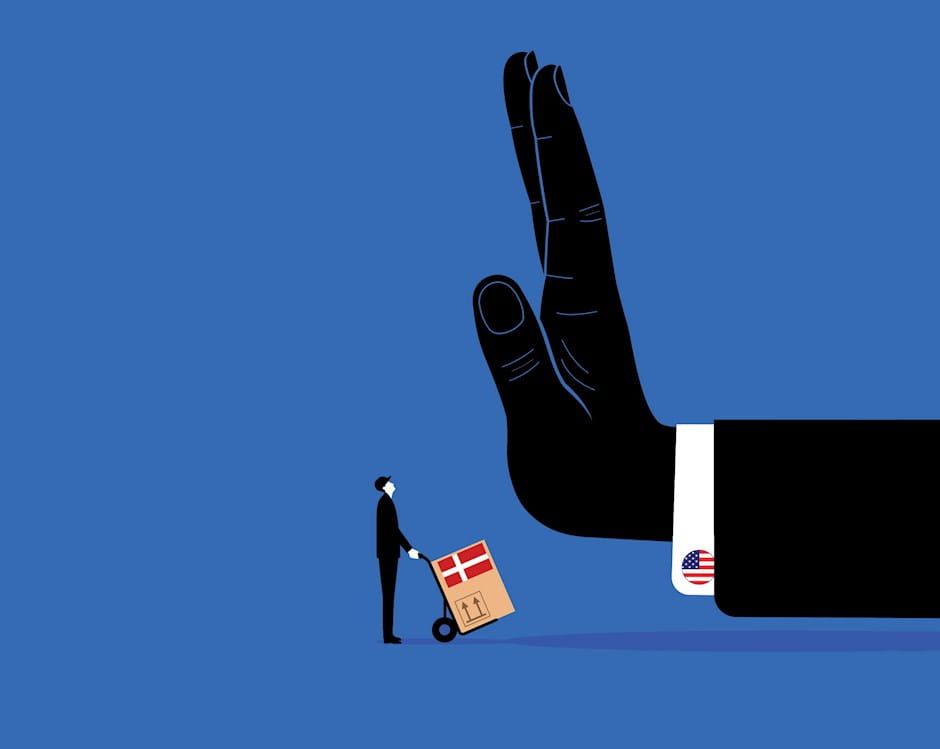
How a Tariff Shock over Greenland Could Play Out
Findings from a simulation could help guide policymakers facing an economic shock.
- By
- March 09, 2026
- CBR - Public Policy
Findings from a simulation could help guide policymakers facing an economic shock.
As US president Donald Trump ramped up his pressure campaign to take over the autonomous Danish island of Greenland in January, he warned that the United States would “tariff Denmark at a very high level” if it opposed his efforts.
The shock from higher tariffs could have uneven effects on the Danish economy, suggests work by a research team that includes Chicago Booth’s Kilian Huber. The study also offers some fiscal-policy guidance, namely that Denmark could get the most “bang for the buck” by directing transfers at specific places and industries—and not necessarily at those most directly affected by the shock.
The findings are applicable far beyond Denmark. They indicate that knowing how areas within an economy are affected by a shock “can help governments identify fiscal policies with high multipliers, thereby improving the cost effectiveness of government interventions,” the researchers write.
Historically, economists have analyzed the effects of sudden external shocks, such as a jump in tariffs, by looking at country-level measures including income, consumption, and output. Standard national accounts include mostly country-level information, as well as some data on transactions among producers.
But economists have had limited insight into how consumption and income flow between specific groups within a country. The researchers set out to better understand these flows, which they note could be important in understanding and mitigating the effects of economic shocks. “The absence of comprehensively disaggregated data limits our understanding of how shocks to individual consumers and producers propagate across the economy and affect aggregate outcomes,” they write.
They developed a system to break down national accounts into two-way financial flows between producers and consumers, as well as flows between those groups, the government, and the rest of the world. This involved grouping people and businesses by industry and geography. For categorizing individuals, they used transaction-level data from the country’s largest bank, as well as government records about purchases including housing, vehicles, and other services. Each group, or “cell,” was small—the typical consumer cell had about 650 adults, and the typical producer cell about 50 businesses.
Through newly developed measures of spending intensity, the researchers were able to make several observations. First, most consumer spending went to domestic producers, particularly in rural regions and among consumers who were older and not college educated. About half of a cell’s consumer spending stayed in its home region, and another 10 percent went to nearby regions.
By constructing a detailed map of millions of economic flows in Denmark, the researchers uncovered a consistent triangular pattern: Rural spending flows to cities, cities spend more abroad, and foreign demand supports exports produced in rural areas.
The researchers also observed a pattern of “triangular flows” across regions: Spending tended to flow from rural regions to large urban ones. Urban areas tended to spend more on foreign imports. Foreign countries, in turn, tended to buy exports from rural regions.
To learn the policy implications, the researchers developed a model and ran simulations. In one, motivated by the political tensions over Greenland, they analyzed a hypothetical recession brought on by a tariff crisis, assuming that the US imposed tariffs on Danish products of 41.4 percent, the same effective rate it charged on Chinese goods as of July 2025.
The estimated effects on the Danish economy were far from uniform. In the model, some regions suffered 8 percent declines in total sales, while others were barely affected. Among the locations that faced the largest effects were export areas including Billund (where toy maker LEGO is located), Kalundborg (home of several Danish drugmakers), and a small manufacturing belt near Copenhagen.
To ward off recession, policymakers might be inclined to support an across-the-board stimulus plan, or one that targets the areas most directly affected by tariffs. But financial transfers to regions feeling the biggest pinch from the tariffs would not necessarily yield the biggest effects on aggregate gross domestic product, according to the study. Rather, the findings suggest that policymakers need to consider the structure of spending flows and seek out those people and businesses most likely to spend in regions and on industries weakened by tariffs.
In fact, some of the regions with the highest multipliers in the simulation did not themselves feel the largest effects of the simulated tariffs but were near places where those duties hurt demand.
For example, while Billund was affected by the simulated tariff shock, adjacent areas were not. Sending fiscal help would buoy consumption in Billund but wouldn’t do much to stoke demand in the nearby areas, the model predicts. Instead, stimulus could be directed to a region seemingly less-hurt by tariffs but where more people around it could use the boost. For example, areas on Denmark’s eastern island, Zealand, are near many other regions that were, in the simulation, weakened by the tariff shock. Focusing transfers there would have high multipliers, the model suggests.
The researchers conclude that cell-by-cell analyses can help shape sound fiscal policy during a recession characterized by varying effects across an economy. Such an analysis can offer insight into which areas face the greatest weakness, providing policymakers with guidance on where to focus their response.
Asger Andersen, Kilian Huber, Niels Johannesen, Ludwig Straub, and Emil Toft Vestergaard, “Disaggregated Economic Accounts,” Working paper, December 2025.
Your Privacy
We want to demonstrate our commitment to your privacy. Please review Chicago Booth's privacy notice, which provides information explaining how and why we collect particular information when you visit our website.