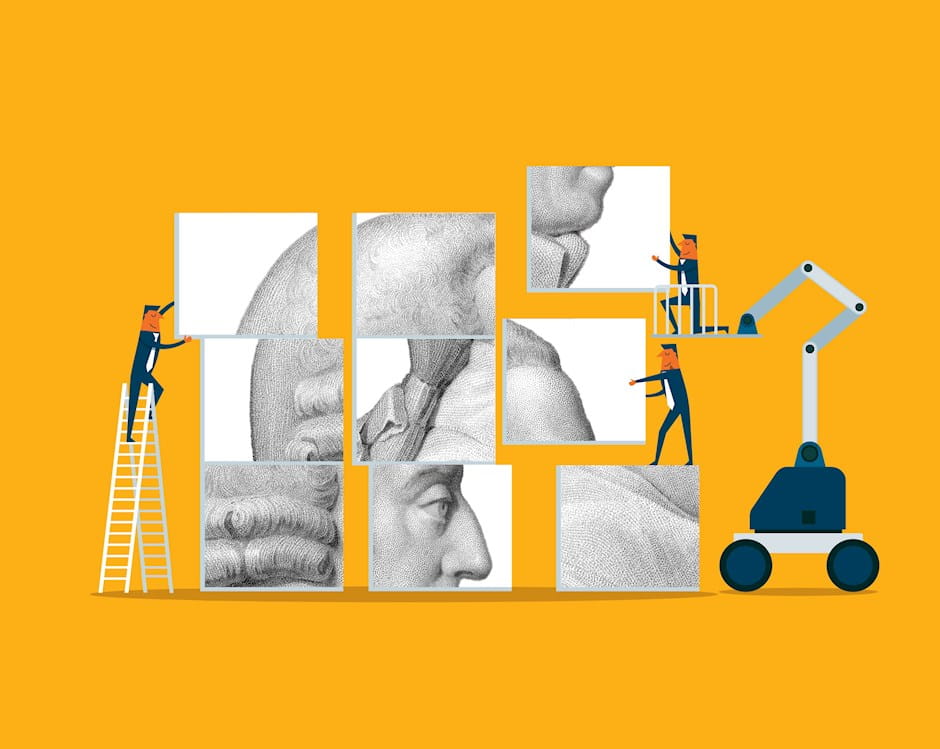
Capitalisn’t: Is Everyone Getting Adam Smith Wrong?
- April 02, 2026
- CBR - Capitalisnt
Most people associate Adam Smith with free markets and “the invisible hand.” But does this conventional narrative purposefully ignore Smith’s deep suspicions about monopolies and power? Georgetown’s Glory Liu argues this narrow interpretation is actually a deliberate historical reconstruction.



Episode Transcript
Glory Liu: Smith sees economic life not as these abstract and impersonal market forces, but really about contests and power and how power and institutions structure who gets what.
Bethany McLean: In 1776, a Scottish philosopher named Adam Smith published a sprawling, and we mean sprawling, book about how nations become wealthy. The appropriately named Wealth of Nations, actually the full name is An Inquiry into the Nature and Causes of the Wealth of Nations, ran more than 1,000 pages and ranged across everything from the origins of money to the economics of apprenticeship to the fall of the Roman Empire.
Luigi Zingales: Today, most people associate Adam Smith with a single phrase: "the invisible hand."
Bethany: The crazy thing is that that phrase, "the invisible hand," appears only a handful of times in his entire body of work. Smith wasn't actually a gung-ho apostle of free trade. Glory Liu, who is an assistant professor at Georgetown, writes in her book, Adam Smith's America, that intellectual historians have long complained that "distorted notions of self-interest, free markets, and the invisible hand have eclipsed Smith's moral philosophy, jurisprudence, and more."
Luigi: Which raises some interesting questions. How did such a complicated thinker become reduced to a slogan or to absolutists? Along the way, there were other aspects of Smith's thinking that got marginalized. He thought deeply about inequality. He worried about chronic capitalists. He actually advocated strong government intervention when necessary. All those things make not only a fascinating figure from the past, but one whose thinking is critically important to where we are today.
Without further ado, Glory Liu, welcome to Capitalisn't. Why everybody ends up using Adam Smith to make his own point? Because they could use David Ricardo, they could use Say, they could use a lot of other people. At least reading your book, it seems that everybody is obsessed with Adam Smith. Why?
Glory: Yes. Well, have you read Ricardo? [laughter] It's impenetrable. People quote Adam Smith because he's such a recognizable authority and because his authority is malleable. His authority is malleable so that you can make Smith stand for not really anything you want, but he's a really, really useful device to articulate a specific view, like what you think the economy should look like.
Bethany: How do you think? Did you feel in the course of your research, did you start to feel close to Smith and perhaps even protective of him? [laughter] How do you think he would have felt about seeing his words twisted in the way that they have? Did you get a sense of that as you researched him?
Glory: Funny. I would say I actually got less attached to Smith when I was doing the research on the reception. I think part of it is because doing reception history requires you to distance yourself from that particular object. I actually found myself having to reattach to Smith and come up with my own version of Smith after writing the book, and I think that's because people were really asking for it. Thanks for asking. I hadn't thought about that.
Luigi: What is your own view of Smith?
Glory: I see Smith as a theorist of power and specifically a theorist of power in the economy. I think Smith really sees economic life as overlapping systems of power. He sees the ways in which organized groups and people with varying levels of power, access to power, can shape, distort, and work to change their economic status. One key example of this is how he talks about the difference in power that he says masters and workmen or employers have.
We have a whole description of how wages are set, but then he says, "Look, the difference in interest between workers and their employers is very stark, right? Workers have an interest in raising their wages, and employers or masters have an interest in pushing down those wages as much as possible." The key difference is that the law is often on the side of the masters, and that they do everything in their power to prevent the combination or prevent unionization of the workers, but they make it possible for employers to combine, right?
Then he concludes this section, this is in Book I of The Wealth of Nations, by saying, this is why any law that's in favor of the workman is often just and equitable, because usually the law is being weaponized by people who have disproportionate power to oppress others. That's one pretty early and very strong example, I think, of how Smith sees economic life, not as these abstract and impersonal market forces, but really about contests and power and how power and institutions structure who gets what.
Bethany: Do you think it's too simplistic to say, then, if at the core of Smith is power, that his view is absolute power corrupts absolutely? I was thinking of this famous line of his that Luigi loves, that people of the same trade seldom meet together, even for merriment and diversion, but the conversation ends in a conspiracy against the public. I'm wondering how, then, this modern framing of him just ignored his deep suspicion of monopolies and consolidated corporate power.
Glory: Smith is so attuned to changing forms of power and new forms of power and new forms of interest group organization, if you will, to use the modern parlance, that were happening in his time that were disrupting older forms of power and institutions that typically governed economic life. In the mid to late 18th century, you have the rise of a whole new class of people, not the nobility of the ancien regime, not the working poor, and not these artisans and light manufacturers, but a whole new class of people whose source of power is wealth, and it's wealth that's coming from things like capital investments and ventures.
They're people whose wealth is generated by a world increasingly connected by commerce. It's these merchants and capitalists, if you will, and people who have access to capital, who are using their wealth as a lever of political power in a new way. The lottery of birth doesn't matter anymore. You could just take over a village, or you could take over and plunder another country, and suddenly you have wealth, and that becomes a source of political authority.
This is outlined in his Lectures on Jurisprudence, which is a set of lectures that he gave in the 1760s. I hope I'm getting that chronology right. It's based on a set of lectures that he gave that has now been a resource for thinking about Smith's views on politics. We have to understand that Smith has this interesting theory of where sources of power come from. When he's looking at the commercial system of Great Britain in his own time, 1776, he's noticing that you have this whole class of people who have disproportionate wealth and a disproportionate ability to organize and articulate their interests to legislators and convince legislators that their private interests as merchants who are organizing is also serving the country's interest.
That's what I find so illuminating about Smith, is that he's able to disclose that dynamic about how certain classes of people are able to use their economic resources to gain political advantage and thereby have this disproportionate effect on the distribution of resources and power in society as a whole.
Luigi: I find your interpretation of Smith as a theorist of power particularly intriguing in light of the embracement of Smith by the Chicago School, because the stuff you describe in the book was not a big surprise to me in the sense that in the middle of the Cold War, economists finally can prove what is known as the First Warfare Theorem, which is the idea that, under a number of assumptions, the competitive equilibrium has some notable property that we call Pareto efficiency, some notable property.
They got enamored with the invisible hand. It's not normal that, because of the recent discovery and because of the Cold War, there is this big push for the invisible hand. It's also understandable because a big part of the United States intellectuals were sympathetic to the Soviet economy and to the Soviet way of allocating resources. I understand all this as a reaction. However, I don't know how familiar you are, but the Chicago School in that particular period in economics does everything possible to eliminate the word "power" from the vocabulary of economists.
Literally, they try to eradicate it because the only notion of power that economists understand is market power, and even that is basically brought to zero by the Chicago School. In general, by that time, they are UCLA, but Alchian and Demsetz are two very famous economists. They have this line about a firm saying that the firm has no power whatsoever except the power of the market, and that being an employee of a firm, it's no different than being a customer of the firm, that you can fire your provider.
They go to an extreme that for a normal human being is ridiculous because no normal human being thinks that firms, especially today's firms-- so how can they possibly embrace myth without some lobotomy or at least lobotomy of Adam Smith's brain in which half of it is taken and half of it is disposed?
Bethany: That is a very gross image, Luigi. Thank you for that.
Glory: This is so fun. The Chicago School is by no means unique in economizing Smith in this way and ignoring power in the way that I was talking about, whether it's about the relationship between masters and workmen or the mercantile system, but you get this slow scraping away of Smith as this multi-dimensional thinker who cared about power and groups and sympathy, the other book, The Theory of Moral Sentiments, about history and about institutions.
That starts much earlier than the Chicago School. You can trace this back to post-1860s political economy and the transformation to economics, really with the Marginal Revolution. What I do think the Chicago School had, again, disproportionate influence in propagating was this idea that Smith, the economist of the invisible hand in the market, is the Smith, right? That is the timeless true Smith that has explanatory power for everything.
I think that that's why the Chicago School Smith is so important to understand and to unpack, right? I like the idea of denaturalizing the Chicago Smith as a version of Smith because it really is based on a selective reading. Now, I will say that having written this book and heard different reactions to it, it's like some people were like, "Oh my gosh, I can't believe how charitable you were to the Chicago School. How did you manage to do this so charitably?" Then other people were like, "You're a crazy lefty activist." Because it felt too critical. To historicize a past reading of Smith was itself an assault on Smith.
Bethany: We've been talking a little bit on Capitalisn't about how maybe one of the things that kept capitalism in check was just this sense of morality that couldn't be legislated, went beyond laws and regulations. It just was a built-in sense of morality in that the more global the world has gotten, the more disconnected people have gotten, and the more it's been possible for an owner of capital not to have to meet a worker in anything in the local community, that morality has disappeared.
I was thinking that Smith, in a way, is emblematic of this because there's this balance between The Theory of Moral Sentiments and then Smith the economist in The Wealth of Nations, even though that's too simplistic. Obviously, there's a lot of nuance in the Wealth of Nations, too. I'm wondering if this stripping by the academic discipline of economics, stripping morality out of Smith's economic framework, mirrors this progression of capitalism in a way.
Glory: That's a really interesting way to put it. I really like that way of putting it, but I think it's also deeper than just stripping out morality from economics. I would put it slightly differently, which is that economics has its own value system. To see economics as somehow value-neutral or value-free is to misunderstand what economics is today and what it has been in the past. I think a lot of that has to do with the rise of the mathematization of economics and the mathematizations and how it makes it value-neutral, and also this idea that values of efficiency are somehow not in the same category of values as, say, interpersonal relations or equity or humanism, democracy.
All these other things, we can put those all as values, and somehow we don't like to see economics as having an overlapping set of values that would put us more in the realm of Smith, thinking about the human lives that make up the thing that we call the economy. Smith doesn't use the term "the economy," he doesn't use the term "capitalism," but it's very clear that the way he describes economic life, it's about people and what they're doing and who they're interacting with and how they're negotiating and how they're creating institutions and how they're trying to solve problems.
That's a very different view of economics and the value of studying economics and the values embedded with economics than what I think most people who study economics say, whether you're taking Econ 101 or whether you're getting a PhD in economics today. I think it's a different set of methodological tools, but I also think a different understanding of human values.
Luigi: I'm sorry that I used the lobotomy analogy, but it was not completely coincidental because The Wealth of Nation is 1,000 pages, so it's a big volume. Glory, I'm pretty sure you know that George Stigler created an abridged version of the Wealth of Nation, where he cut out some part, and he cut out the parts he didn't like. I think there was really kind of a lobotomy done with intention. What I found super interesting is some of the ideas of Stigler on regulatory capture are there, already, in Adam Smith.
Glory: Yes, going back to the overarching theme of Smith as a theorist of power, Smith is such a careful reader of history and a careful analyzer of history that he sees this tendency towards capture over and over and over again, right? Not just in trade policy, but in things like the creation of a tax regime or the creation of certain land regulation laws, and even things like the emergence of independent judiciaries.
He talks about these things in Book V of The Wealth of Nations. Given that there's this tendency towards capture in a modern country whose internal organization and mode of external organization is commerce, how do you create institutions that aren't as susceptible to the rich and powerful just using them for their advantage? He thinks about, "Okay, look, think back into medieval times when we decided that it was maybe a good idea to have an independent judge rather than one guy being in charge of everything, writing the laws, and also executing them and being the judge for things.
"Okay, gave rise to the independent magistrate. This was a good development, but then what happens when the magistrate is also collecting court fees in order to dispense justice? Well, then you get the corruption of justice, because what happens is that even though we had this good development of an independent judiciary, justice is dispensed based on people's ability to pay rather than those who are actually in need of justice," if that's the right phrase to use.
He sees the evolution of these institutions in modern society. He's so attuned to how institutions can be created, and they can be advancements, but you have to be aware of how they can be captured by those who have a vested interest in them or those who have a kind of outsized ability to corrupt them. I think that's another way in which, again, it's not specifically this idea of regulatory capture, the way that Stigler is talking about it, but it is a form of capture and what I call a state capacity deficit that Smith is so attuned to.
Bethany: That begs the obvious question: what do you think he would think if he could see where the US is right now? Would he see modern lobbying and corporate political influence as, "See, I told you so," or do you think he'd think, "Oh, I warned you, but I never thought it could be this bad," or do you think he'd look at some of the systems we've put in place to try to mitigate it, like an independent judiciary, and say, "Hey, you guys are trying"?
Glory: I think it's the second one, right? Like, "I tried to warn you," and I do think that it is about the concentration of wealth in certain sectors of the economy and how certain sectors of the economy can have disproportionate influence on the political system in order to perpetuate these cycles of deep and persistent inequality in ways that renders meaningful political and economic change extremely difficult.
He was well aware of the difficulty of political change, right? He talks about free trade and his system of natural liberty, but he says that "to think that this would happen in my lifetime is a utopia." The fact that we did get an incredible liberalization of international trade policy by the 20th century, Smith probably would've been astounded that that happened during the moment of the post-Bretton Woods institutions and stuff.
I do think that with regards to whatever you want to call it, corporate capture and the vast disparitie, I'm speaking from an American point of view here, the vast disparities in wealth and income inequality, he probably would've had the same reaction.
Luigi: I love your interpretation of Smith as a theorist of power.
Glory: Thank you.
Luigi: Let me try one interpretation, and feel free to say I'm completely wrong. Then, after my interpretation, I have a question for you. The interpretation is, Smith talks about the commercial society as maybe what we would talk now about capitalism. It was the new system. He sees the commercial society as something liberating man, humankind, from a lot of the restrictions and limitations of freedom that a feudal society was bringing about.
Why is because at the end of the day, if you could cultivate your piece of land, you could be an independent producer, et cetera, you had much more freedom than if you had as a serve or as whatever. However, as you correctly pointed out, capitalism has evolved a lot since then. Now we have corporations everywhere. The only corporations that were at the time were the East India Company, and Smith hated them. Now corporations have a lot of power over us, with all due respect for my late colleagues. Is it true that capitalism brings more freedom to individuals, and what will Smith says about that?
Glory: Did you just ask me if capitalism will bring us more freedom? Is that the question?
[laughter]
Luigi: Yes. What does Smith say about that?
Glory: Okay. I'm going to start with "What would Smith say about that?" Again, with the large footnote that Smith doesn't talk about capitalism, he usually talks about commercial societies, but commercial societies are very underspecified, and so he's really interested in the forms of power that come into being within a society primarily organized by commerce. Okay, that's the footnote. What are the possibilities for freedom in these new societies that are primarily commercial?
Smith did see that commerce had this emancipatory potential, right? That when you organize people's needs based on free exchange, like I can go buy my bread from the baker, and the baker is not under these really, really oppressive regulations about the kinds of flour that he has to use and the specific weight and dimensions of the bread, et cetera, et cetera, we are no longer constrained by these really archaic and impersonal and sometimes very personal forms of domination.
Think about the ways in which marriage was regulated. You had to get approval from the lord in order to have your daughter married off to somebody, or sanctuary laws, right? Like, on Wednesdays, you cannot wear pink. This is a version of sanctuary laws. Smith did see this new society in which the arbitrary power of the old aristocracy was slowly being eroded, and that people could meet their needs through free exchange and commerce rather than relationships of dependency.
That is a radical and emancipatory force. To the extent that that has a moral valence to it, it is a form of political and personal freedom that Smith saw as unrivaled in his time, and I think something that is really, really core and important to recognize in his thought. The question of whether capitalism has created more freedom today is really tricky. Here is where I feel like Smith is no longer the most useful thinker for us to answer that question.
We need to think with Marx, too, and we need to think of critics after Marx because, again, I think that the nature of work has changed, the nature of commerce has changed, and the nature of finance has changed. I certainly see myself as freer in the broadest sense of the term than if I were to take myself in my embodied form and put myself in 1776 in Great Britain. I think the quality of my life right now is probably, on almost all metrics, freer and better. It by no means follows that capitalism has created freedom.
Bethany: Do you think that even though people were trying to simplify Adam Smith because they saw that a simplified Adam Smith, a caricature of Adam Smith, could serve their interests more, that actually that was a mistake and that the original, rich and nuanced Adam Smith would actually provide more legitimacy to capitalism now today? In other words, if you could go back, people like Friedman and Stigler, who were trying to legitimize things, did they actually make a mistake? Did they make the wrong turn in that moment?
Luigi: I don't think so at the time. I think it's wrong now. At the time, that was probably the best way to sell capitalism. That's what they use. It's always difficult to do the counterfactual mystery. Especially Milton Friedman, he was a phenomenal debater, and so I think he picked his battle very cleverly, and this is no exception. However, today, I think we are in a different situation, and we do need a more complex Smith. The original Smith is more relevant today than the simplified version of Friedman and Stigler.
Bethany: Is it too late? Do you think we can bring back this more nuanced version of Smith? We've talked on this podcast before, and I thought her way of phrasing it is economics being stripped of everything but the math. In a way, that's not precisely what she said, but we've talked about that, too. Is this a two-way street? Can you go back in the other direction? Once you've taken all of that out of it, is it just down to the bone?
Luigi: I think you can. I think it's uncomfortable in mostly academic environments because they are so used to only use a certain language. However, academics need to justify what they do to the outside world. If they fail to have a bigger moral justification for capitalists, they might end up losing the battle. I think that it is important not just to prove the efficiency of capitalists, but also try to have some moral foundation for it.
Bethany: Yes, I thought that was something really interesting that she said, was that Adam Smith was also possible in his time because there was this lack of disciplinary boundaries. As these disciplinary boundaries have grown up and become really, really, really hard lines, that's what also has led to, in some ways, this simplified version of Smith or stripping some of the moral elements out of him.
I thought we have to really reach for that now and break down those boundaries so that we can have that multidisciplinary, those lack of boundaries. Again, it's as if those boundaries have become too strict and too severe, right? I think that was my favorite thing about the podcast was her calling Smith a theorist of power. I thought that was incredibly illuminating. Did you?
Luigi: Absolutely. It's so novel and unexpected that I think that is a big result of our conversation.
Bethany: Yes.
Luigi: What I got from her is that he understands that now wealth can be very powerful in changing economic policy, and he's thinking about how to organize society in light of that fact, becausee to be fair, up to his time, the political realm was dominated by kings and nobles and people that had more titles and tradition than necessarily money. England at the time is the first commercial society where merchants were very powerful.
Actually, there was the exception since I'm Italian and from that area, Venice was like that, but was, by that time, declining. The Netherlands were a bit like this. Certainly, England is the ultimate commercial power. She sees how these merchants are influential in how things work. He lived at a time where the East India Company was bribing half, if not the entire British parliament to get the way they wanted.
Bethany: I guess I would say it more simply. I would say that the accumulation of capital leads to the accumulation of power. Then that very accumulation of power has an effect on everything, on the institutions that we've set up to safeguard how power works because the power accumulates in such a way that it undermines some of the institutions that we've set up in order to safeguard the disbursement of power. Maybe another version of it, I'd ask her that absolute power corrupts absolutely, but certainly, power corrupts everything it touches. Luigi, you think my answer is too simplistic?
Luigi: No, I think that it might be true later on. Remember, we are before the explosion of the Industrial Revolution. It's not that people have huge buildings, huge machinery, huge firms. This is more a commercial society where, yes, of course, you have some working capital that you need, but mostly are the opportunities that you can achieve that drives your power. It's not the capital accumulation; it's the fact that you know how to get the spices in the right place, go in the right position to import cotton, and so on and so forth. If you want, there is more knowledge than capital accumulation in an American-type society.
Bethany: I don't think so. I don't agree. Well, it could be both, but for sure, part of what he warned about is the accumulation of wealth and the admiration of wealth and how that becomes a corrupting force, both throughout the moral code of man and the way in which institutions work. I think it is directly tied to the accumulation of capital and that the accumulation of wealth becomes power.
Luigi: Yes, I know there is definitely the element of accumulation of wealth, but when you say "capital," what was the capital that they had? They had some wealth that they used to bribe people.
Bethany: Maybe that's where we're getting tied up, is in semantics, because I'm using capital as wealth, the accumulation of money. Maybe that's where we're getting tied up.
Your Privacy
We want to demonstrate our commitment to your privacy. Please review Chicago Booth's privacy notice, which provides information explaining how and why we collect particular information when you visit our website.