CBR Briefing #32
- March 04, 2018
- CBR - Economics
How to grow demand for bike-sharing
Cities could significantly increase ridership without the need to spend more on bikes or docking points.
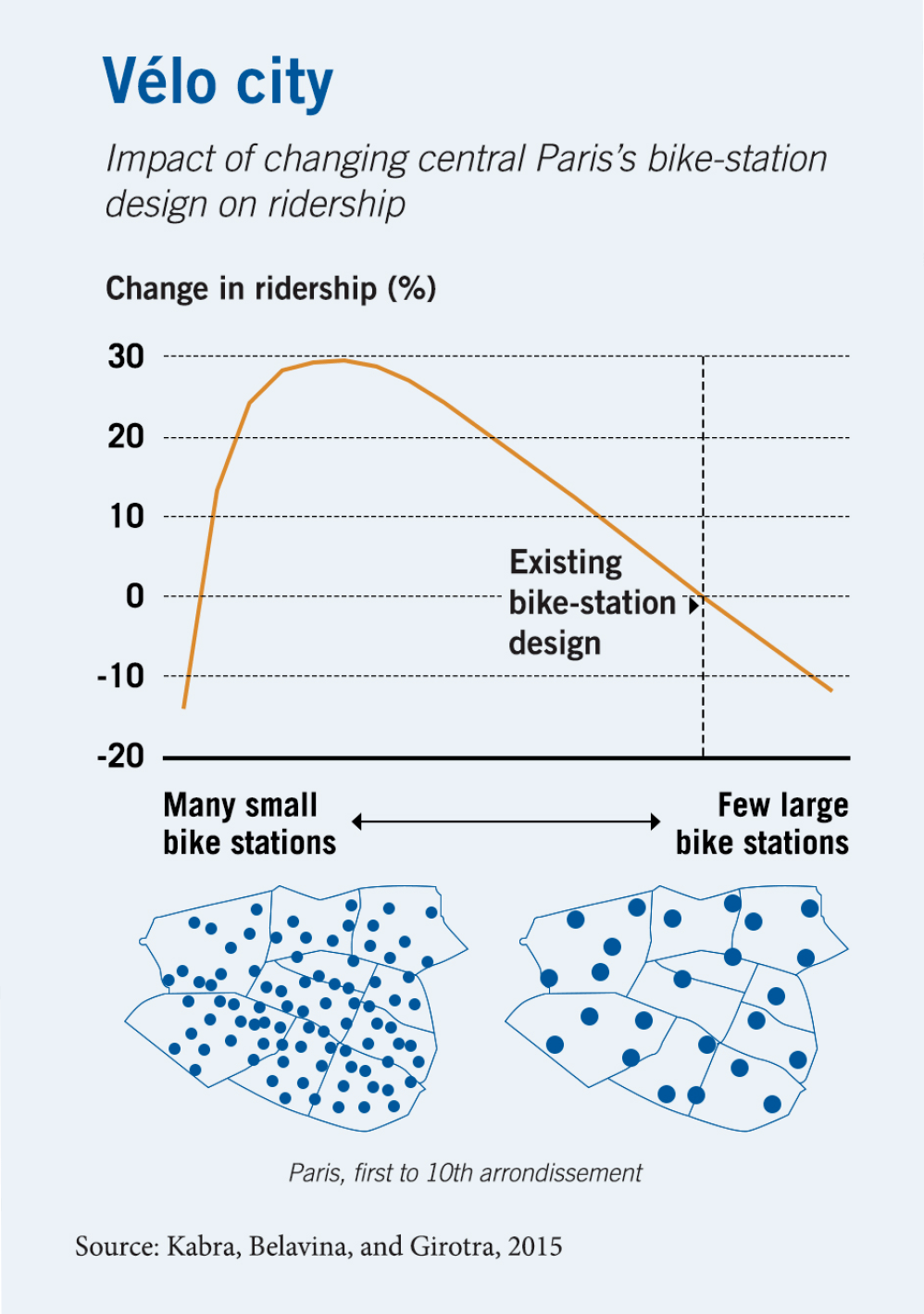
Creating a larger number of smaller docking stations could increase bike-sharing by up to 30 percent.
- Bike-sharing systems have attracted considerable attention, but the number of riders is falling short of projections. Research by INSEAD’s Ashish Kabra and Karan Girotra and Chicago Booth’s Elena Belavina suggests that cities can significantly increase ridership at relatively little cost by redesigning networks.
- The researchers observed commuters at 349 bike-sharing stations in central Paris over four months. They studied the effects of station accessibility—the distance a commuter must walk to reach a station—and bike availability, the likelihood of finding a bike at a station.
- The researchers estimate that a 10 percent reduction in distance traveled to a bike-share station could increase ridership by about 7 percent, and a 10 percent increase in bike availability could increase ridership by about 12 percent. Cities can design better bike-sharing systems by taking these commuter preferences into account.
- As an example, central Paris could increase ridership by up to 30 percent, the researchers argue, by using its existing infrastructure and stock of bikes to create a larger number of smaller docking stations (see chart). This would improve accessibility, but sacrifice some availability by reducing the number of bikes at each station.
Ashish Kabra, Elena Belavina, and Karan Girotra, “Bike-Share Systems: Accessibility and Availability,” Working paper, January 2015.
More from Chicago Booth Review
More from Chicago Booth
Your Privacy
We want to demonstrate our commitment to your privacy. Please review Chicago Booth's privacy notice, which provides information explaining how and why we collect particular information when you visit our website.