CBR Briefing #67
- June 14, 2018
- CBR - Finance
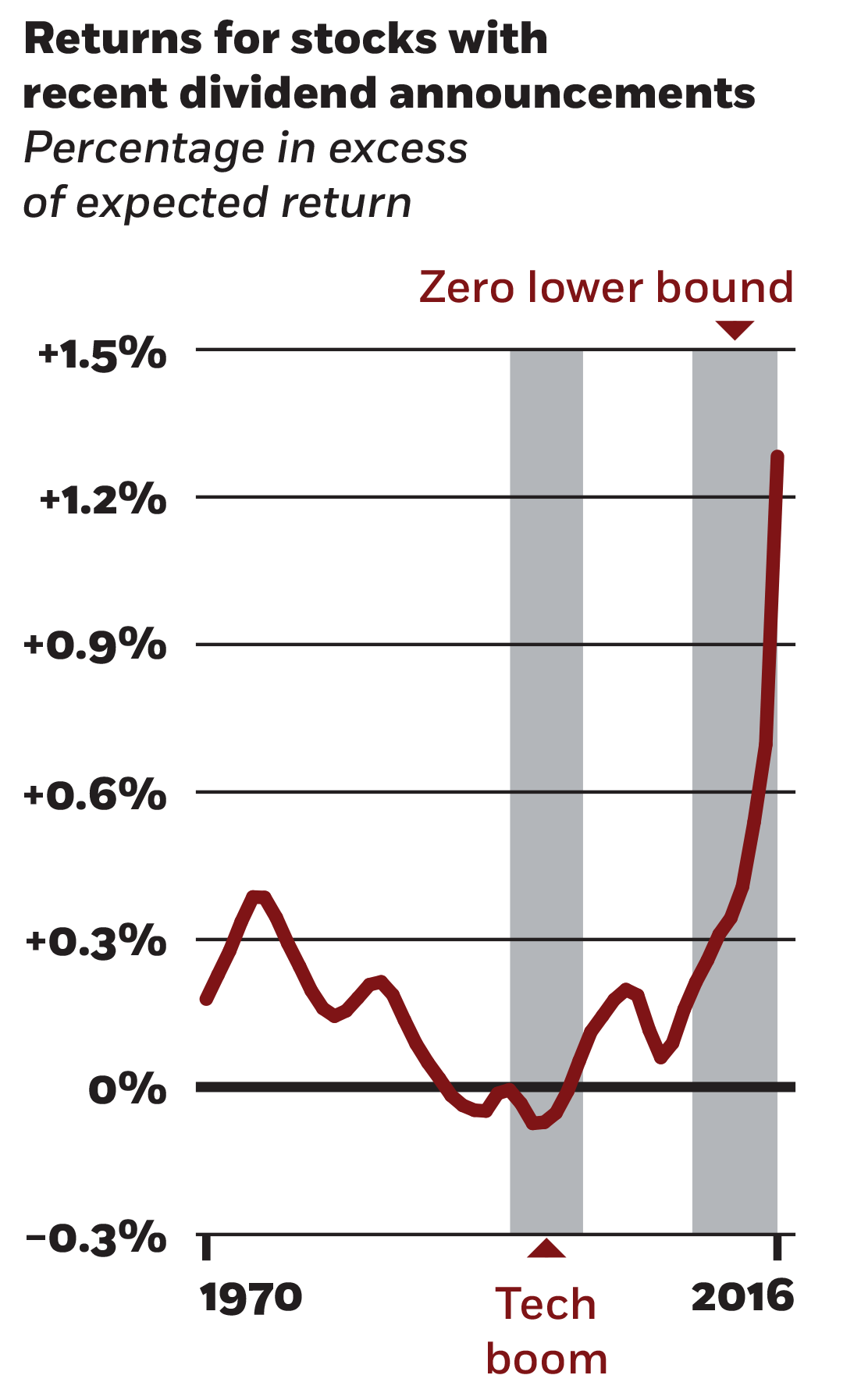
Big and small investors fall for the free-dividends fallacy.
- Investors should be indifferent about a choice between receiving $1 in dividends or selling $1 worth of stock because share prices, on average, drop by the amount of the dividend. However, many investors trade as if they don’t realize this, according to Chicago Booth’s Samuel Hartzmark and Boston College’s David H. Solomon.
- This makes dividends appear as a separate stable source of income similar to a bond coupon, a mistake termed the free dividends fallacy. When bonds are paying low rates or the market is performing poorly, the research finds that demand for dividend payments is quite high.
- The dividend disconnect applies not only to retail investors but also institutions and mutual funds. The researchers find that investors rarely reinvest dividends in the companies that paid them, instead using the payouts to purchase other stocks. This leads to predictably higher market returns on days with high dividend payments, driven by firms that did not pay dividends.
Samuel Hartzmark and David H. Solomon, “The Dividend Disconnect,” Working paper, November 2016.
More from Chicago Booth Review
More from Chicago Booth
Your Privacy
We want to demonstrate our commitment to your privacy. Please review Chicago Booth's privacy notice, which provides information explaining how and why we collect particular information when you visit our website.