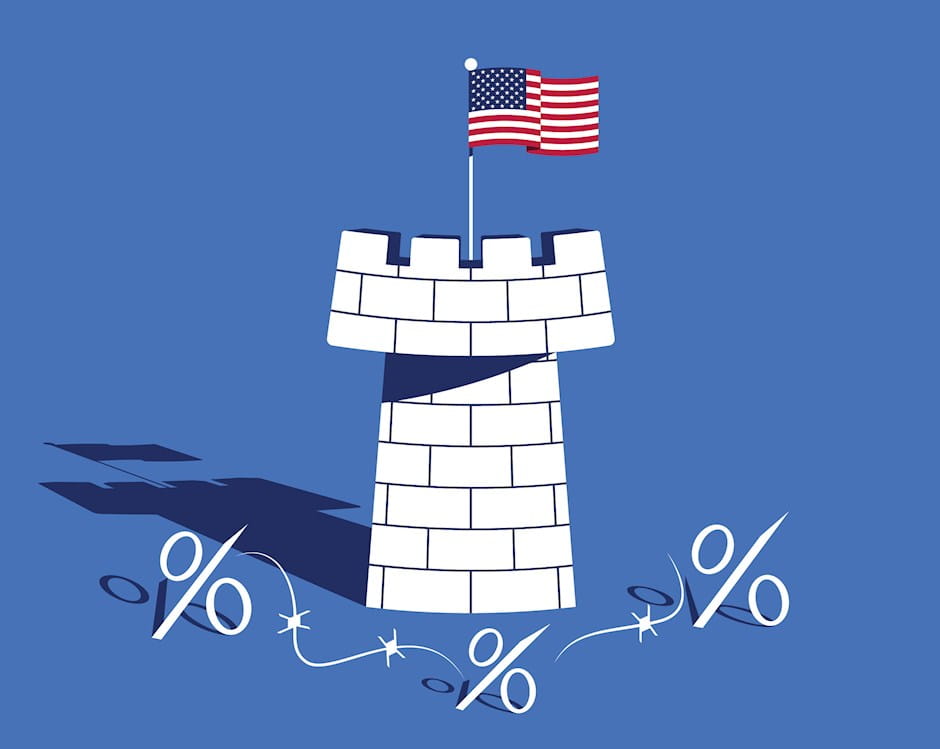
Some Voters Are Willing to Pay for Trade Dominance
The desire for exclusivity helps explain support for tariffs.
- By
- April 13, 2026
- CBR - Economics
The desire for exclusivity helps explain support for tariffs.
Tariffs tend to increase prices for consumers and provoke retaliation from trading partners. Yet such protectionist taxes remain popular enough with some US voters that President Donald Trump was able to win office on a platform that featured tariffs prominently.
The desire for dominance may help explain why, according to Chicago Booth’s Alex Imas, London School of Economics’ Kristóf Madarász, and Booth’s Heather Sarsons. Some Americans support protectionism, despite its costs to them, because they value limiting foreign consumers’ access to US products, they find.
The work builds on past research from Imas and Madarász, who find people derive value from consuming or possessing goods that others want but do not have, a motive they call mimetic dominance-seeking. This behavior, they argue, helps explain numerous market anomalies, from restaurants that intentionally limit their seating capacity to fashion brands that price their sneakers in the thousands.
Imas, Madarász, and Sarsons wondered if the phenomenon might also be influencing international trade. “A lot of nationalistic and protectionist policies have this flavor of making things more exclusive,” says Imas. “Particularly in the case of tariffs, it’s the market that becomes more exclusive.”
The researchers conducted two surveys in the United States to test their predictions. In both, they began by measuring respondents’ “exclusionary preferences” by asking them to bid on an item in scenarios in which either one, two, or three other participants would be barred from purchasing it. Roughly 40 percent of respondents were classified as having exclusionary preferences based on their willingness to pay more as the degree of exclusion increased.
For the first survey, the researchers randomly assigned 1,500 respondents to one of two groups and asked them to rate their support for a tariff policy. One group evaluated a 15 percent tariff that would raise prices at home. The other group considered the same tariff but was also told the policy would boost domestic production and would not harm the targeted foreign country, which could find another trading partner. The researchers randomly used Canada, China, or Mexico as the target country. In addition, they asked all respondents to evaluate a stimulus policy that would result in the same price increase as the tariffs.
In the second survey, the researchers asked roughly 200 respondents to evaluate a broader set of exclusionary nationalist trade policies. For example, respondents shared how much they agreed with the statement: “We should buy from foreign countries only those products that we cannot obtain within our own country.”
In a survey, respondents with exclusionary preferences—deriving satisfaction when others are excluded from goods or opportunities—were more likely to support a 15 percent tariff when they believed it would harm foreign consumers.
Respondents with and without exclusionary preferences were similarly supportive of tariffs that did not harm the targeted trading partner. But those with such preferences were about 12 percentage points more likely to support harmful tariffs than others were.
The same people were more likely than others to support tariffs that harmed trading partners than stimulus policies that caused the same price increases. They were also more likely to endorse policies aimed at preserving a consumption gap between the US and China, even when those policies would raise prices for Americans. And they believed the US should come out on top in trade relations.
These patterns held true across foreign trading partners and when accounting for party affiliation and zero-sum thinking, or the belief that one person’s gain must be another person’s loss. This suggests the differences stem from the desire for dominance, rather than animosity toward specific nations, political leanings, or cognitive biases.
Taken together, the findings offer a new lens for understanding economic nationalism. Multiple forces shape voters’ preferences, but a preference for exclusion is a significant factor that deserves consideration, says Imas. Anyone trying to understand the politics of tariffs “needs to think about more than just the utilitarian pleasure or pain people get—if that was the case, support for tariffs would make absolutely no sense,” he adds. “You have to think about social factors and preferences. It’s not just my utility; it’s also how I perceive my place in society and the world.”
Your Privacy
We want to demonstrate our commitment to your privacy. Please review Chicago Booth's privacy notice, which provides information explaining how and why we collect particular information when you visit our website.