CBR Briefing #12
- February 23, 2018
- CBR - Finance
How short selling affects forecasts of corporate default
When the practice is unrestricted, investors can better predict which companies will be unable to pay their debt-holders.
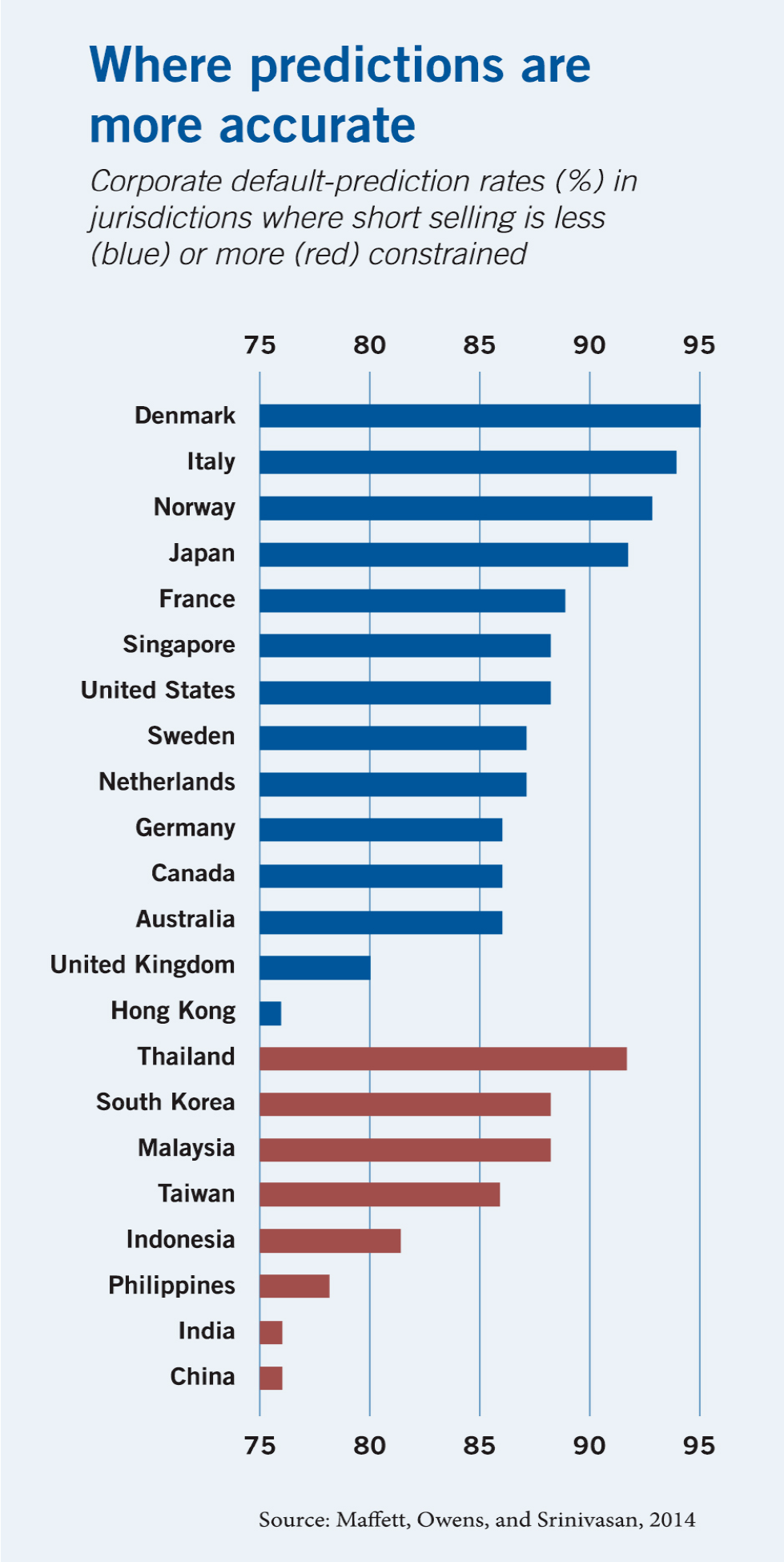
Investors’ predictions of corporate default tend to be more accurate in countries where short selling is practiced.
- Efforts around the world to limit short selling suggest that short sales are thought to destabilize markets. But a research paper by Chicago Booth’s Mark Maffett, with Edward Owens of the University of Rochester and Anand Srinivasan of the National University of Singapore, finds that short selling improves investors’ ability to predict corporate defaults, by increasing the speed and accuracy with which negative information about a company is reflected in its stock price.
- The researchers compared investors’ default predictions in countries that allow short selling and those that don’t. While short sellers operate freely in countries such as the United States, several jurisdictions have cracked down on the practice. In Hong Kong, short selling isn’t outright banned but is limited to a list of approved securities.
- Investors’ models used to predict corporate default tend to be more accurate in countries where short selling is practiced than where it is more constrained, according to the researchers (see chart). But they also find some evidence that during periods of high economic uncertainty, short selling could inaccurately classify some companies as potential defaults.
- In countries with limited short selling, investors may benefit more from relying on financial statements rather than stock prices to assess the likelihood of default, the researchers suggest. They find that in these countries, including accounting information leads to a large improvement in predicting defaults.
Mark Maffett, Edward Owens, and Anand Srinivasan, “The Effect of Short-Sale Constraints on Default Prediction around the World,” Working paper, May 2014.
More from Chicago Booth Review
More from Chicago Booth
Your Privacy
We want to demonstrate our commitment to your privacy. Please review Chicago Booth's privacy notice, which provides information explaining how and why we collect particular information when you visit our website.